
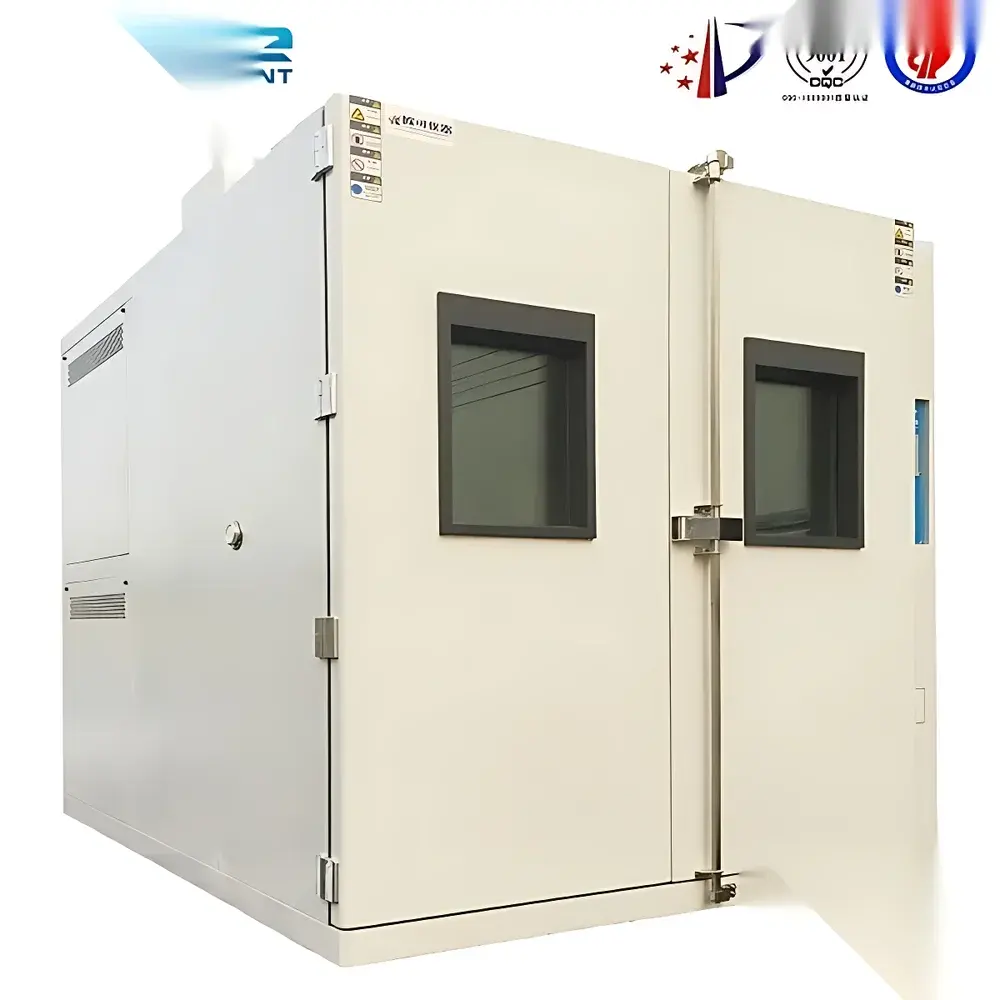
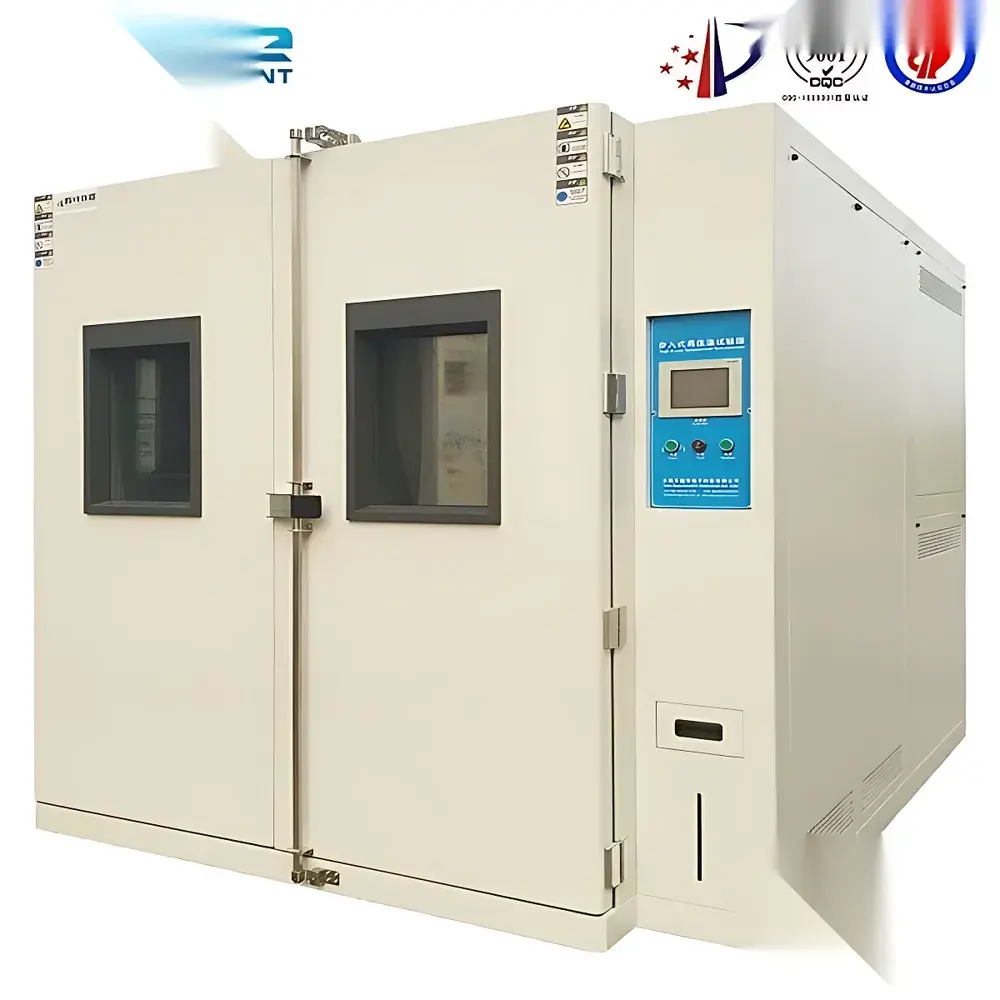
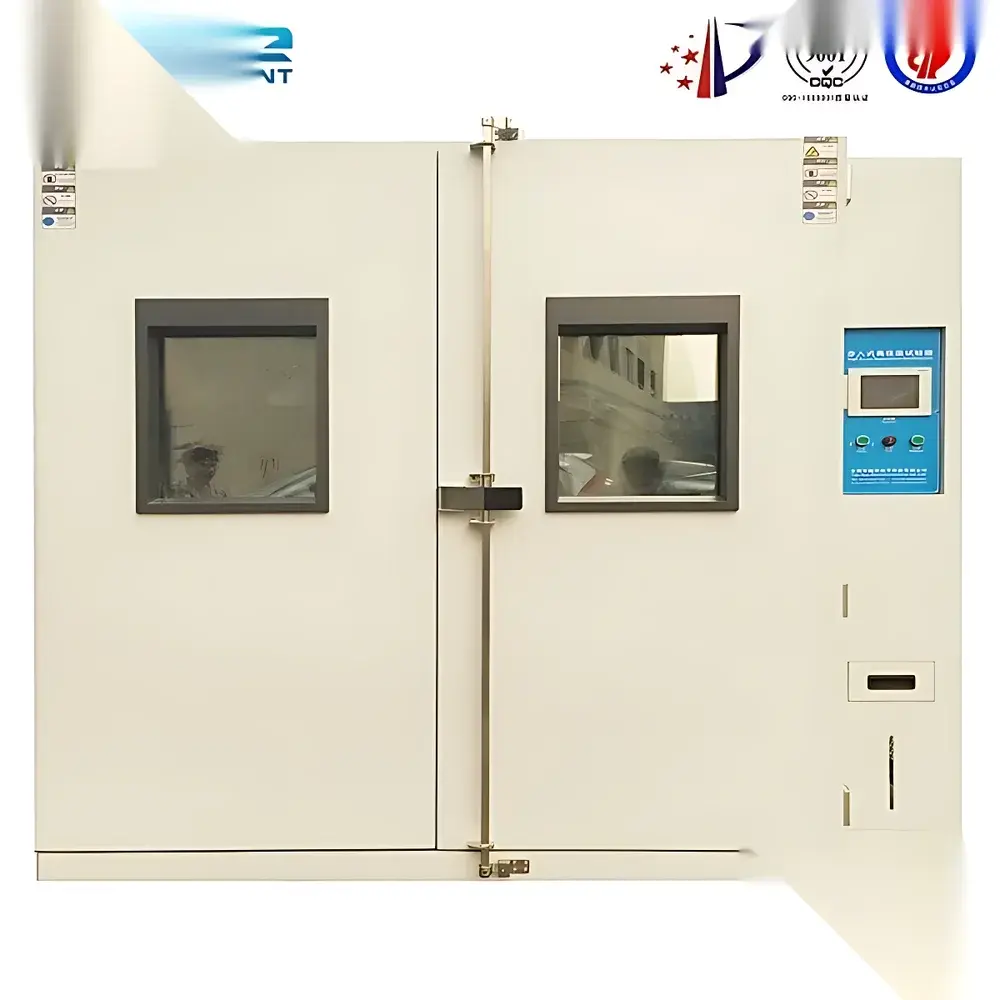
High-Temperature & High-Humidity Environmental Test Chamber – Ming Brand Custom-Built Walk-In Type
| Key Specifications | Internal Chamber Dimensions (W×D×H): 3000 mm × 1000 mm × 2000 mm |
|---|---|
| External Dimensions (W×D×H) | ~3800 mm × 1300 mm × 2450 mm |
| Temperature Range | −40 °C to +130 °C |
| Humidity Range | 20 %RH to 98 %RH |
| Temp. Uniformity | ±2 °C |
| Humidity Uniformity | ±3.0 %RH |
| Temp. Stability | ±0.5 °C |
| Humidity Stability | ±2.5 %RH |
| Heating Method | Nickel-Chromium Alloy Resistive Heaters with PID+SSR Control |
| Humidification | Stainless Steel Steam Generator with Integrated Pure Water System |
| Dehumidification | Surface Cooling via Refrigerated Coil |
| Cooling Method | Water-Cooled Mechanical Refrigeration (R404A/R23/R22) |
| Required Cooling Water | ≤30 °C, 0.1–0.3 MPa, ~12 m³/h |
| Power Supply | 380 V ±10 %, 50/60 Hz, ~30 kVA |
| Air Circulation | Extended-Shaft Centrifugal Blower with External Motor |
| Compliance | Designed for ISO 17025-aligned environmental testing labs |
Overview
The Ming Brand High-Temperature & High-Humidity Environmental Test Chamber is a walk-in type precision climate simulation system engineered for long-duration, high-fidelity reliability testing of industrial components, electronic assemblies, automotive modules, and packaging materials under rigorously controlled thermal and hygrothermal stress conditions. Its operational principle follows the balanced forced-air recirculation method: integrated platinum resistance temperature sensors (PT100) and capacitive humidity transducers continuously monitor chamber conditions; signals undergo analog-to-digital conversion, non-linear compensation, and real-time PID computation to dynamically regulate power output to heating elements, steam humidifiers, and refrigerant flow—achieving stable equilibrium between thermal/hygrometric input and dissipation. This closed-loop architecture ensures reproducible test environments compliant with international standards including IEC 60068-2-1, IEC 60068-2-2, IEC 60068-2-30, and ASTM D4332.
Key Features
- Robust structural design featuring six load-bearing mushroom-foot leveling mounts and heavy-duty swivel casters for safe repositioning and floor-load distribution—critical for facility-integrated installations.
- Stainless steel steam humidification system coupled with an on-board deionized water generator; eliminates mineral buildup and enables continuous operation without manual refilling when connected to municipal supply.
- Water-cooled mechanical refrigeration circuit utilizing R404A/R23/R22 blended refrigerants—fully compliant with Montreal Protocol phase-out schedules and EU F-Gas Regulation (EU) No 517/2014.
- High-efficiency air heat exchanger with optimized fin-tube geometry and low-noise extended-shaft centrifugal blower (externally mounted motor) ensuring uniform airflow distribution and minimal thermal stratification.
- Full-spectrum control cabinet with laser-engraved wire labeling, modular SSR/PID controllers, and redundant safety interlocks—including high-limit temperature cutoffs, high-humidity shutoff, and water-flow monitoring relays.
- Dual observation windows (front: 300 × 450 mm; left side: 500 × 450 mm), constructed from multi-layer laminated safety glass with anti-condensation heating elements to maintain optical clarity during high-RH operation.
Sample Compatibility & Compliance
This chamber accommodates large-format test specimens—including full-size EV battery packs, HVAC duct assemblies, and medical device enclosures—within its 6 m³ net internal volume. The interior workspace (3000 × 1000 × 2000 mm) supports simultaneous multi-point monitoring via third-party data loggers (e.g., Omega OM-DAQPRO or Testo 177-H1). All electrical and mechanical subsystems meet CE marking requirements per EN 61000-6-2 (immunity) and EN 61000-6-4 (emission). The control firmware architecture is compatible with 21 CFR Part 11-compliant audit trail extensions when integrated with validated LIMS or MES platforms. Calibration procedures follow ISO/IEC 17025 guidelines, with traceable NIST-traceable reference probes available upon request.
Software & Data Management
The embedded controller provides local touchscreen HMI with multilingual interface (English, German, Japanese, Chinese), real-time trend graphs, and programmable test profiles (up to 99 segments per cycle). Standard RS485 Modbus RTU and optional Ethernet TCP/IP interfaces enable seamless integration into centralized lab monitoring systems. Data export is supported in CSV and Excel-compatible formats; time-stamped logs include chamber setpoints, actual readings, actuator status (heater %, compressor ON/OFF, humidifier duty cycle), and alarm history. Optional software packages support automated report generation aligned with ISO 9001 internal audit templates and provide electronic signature capability for GLP/GMP validation documentation.
Applications
- Accelerated aging studies of polymer-based seals, gaskets, and conformal coatings under combined thermal cycling and humidity soak.
- Validation of moisture barrier integrity in pharmaceutical blister packaging per USP and ISO 11607-1.
- Functional testing of avionics hardware per DO-160G Section 4 (temperature) and Section 5 (humidity).
- Environmental stress screening (ESS) of printed circuit board assemblies prior to burn-in, in accordance with IPC-9701A.
- Corrosion susceptibility assessment of coated metallic substrates using cyclic corrosion test (CCT) protocols such as GMW 14872 or SAE J2334.
- Thermal management validation of Li-ion battery modules under realistic ambient loading conditions (e.g., 8.5 kW simulated heat load).
FAQ
What cooling water specifications are mandatory for stable operation?
Cooling water must be clean freshwater at ≤30 °C inlet temperature, 0.1–0.3 MPa pressure, and minimum flow rate of 12 m³/h. A dedicated closed-loop chiller or municipal supply with inline filtration and temperature stabilization is recommended.
Can this chamber operate continuously at 98 %RH and +85 °C?
Yes—the stainless steel steam generator, condensate management system, and dew-point-controlled dehumidification circuit are specifically engineered for sustained high-humidity high-temperature operation without internal condensation or sensor drift.
Is remote monitoring and control supported out-of-the-box?
Standard RS485 Modbus RTU enables integration with SCADA or building management systems; optional Ethernet module adds web-based HMI access, SNMP alerts, and TLS-secured API endpoints for cloud synchronization.
How is temperature and humidity uniformity verified during qualification?
Uniformity mapping is performed per ISO 17025 Annex C using nine calibrated PT100/humidity probes placed at defined geometric locations; results are documented in IQ/OQ reports with uncertainty budgets traceable to national metrology institutes.
Does the system include built-in validation support for GxP environments?
While the base unit does not ship with pre-validated firmware, it provides full access to raw sensor outputs, event logs, and calibration parameters—enabling qualified users to execute protocol-driven PQ/UAT per FDA guidance and EU Annex 11 requirements.



