
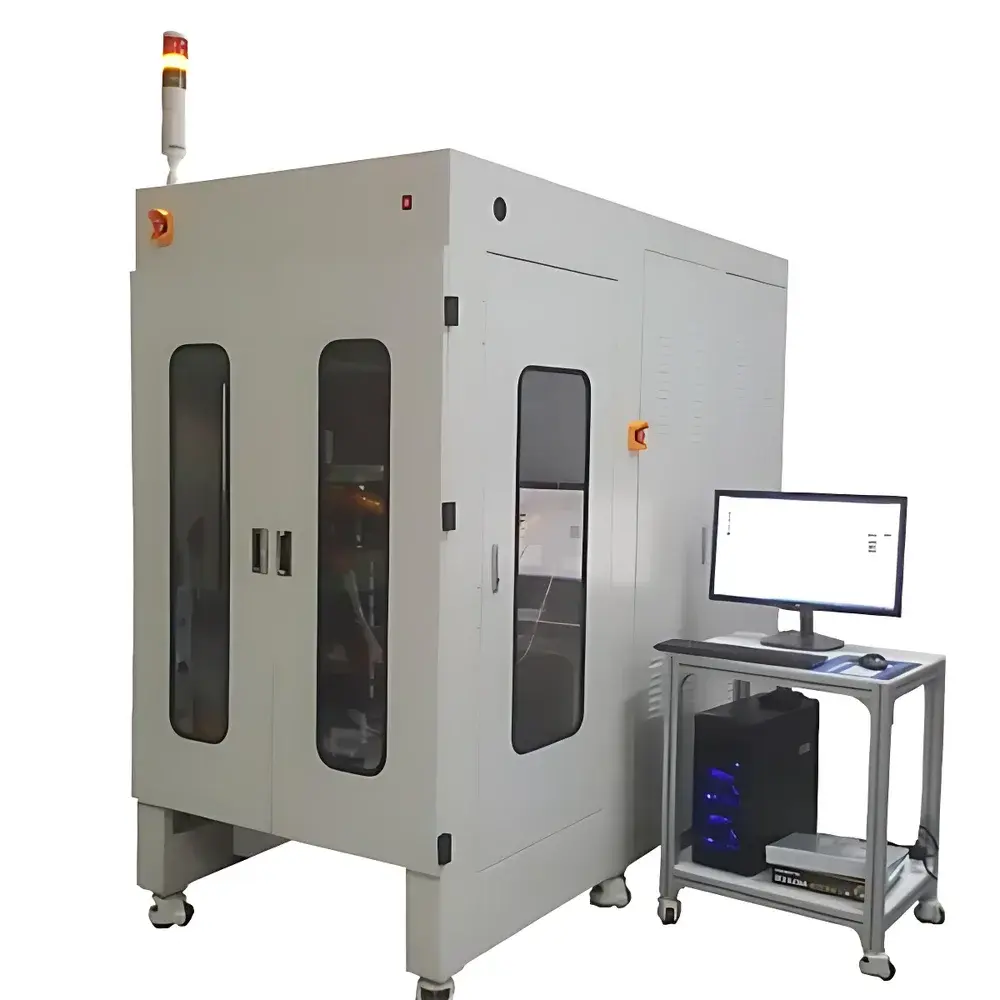
High-Temperature PEM Fuel Cell Stack Test Station AIWEI HT-PEMST
| Brand | AIWEI |
|---|---|
| Origin | Tianjin, China |
| Manufacturer Type | Authorized Distributor |
| Country of Origin | China |
| Model | HT-PEMST |
| Instrument Type | Electrochemical Workstation |
| Channel Count | Single-Channel |
| Current Range | 0–600 A |
| Power Rating | 2.5 kW (Electronic Load Module) |
| Voltage Range | 0–120 V |
| Gas Flow Control | Anode (H₂/N₂, up to 20 SLPM) |
| Temperature Control | Liquid-Cooled Thermal Loop with 30 L Reservoir |
| Backpressure Control | 0–3.5 bar |
| Preheater | SUS Tubing (Anode: 1/4″, Cathode: 3/8″) |
| Humidification | Integrated Condensate Trap with Auto-Drain, Radiant Heating & Cooling Fan |
| Software Platform | LabVIEW-Based Control Suite with Real-Time DAQ, Protocol Automation, Load Profiling, and Optional EIS Module (10 mHz–10 kHz), HFR/IR Drop Analysis, and Cell-Voltage Monitoring (±5 V per cell, selectable channels) |
Overview
The AIWEI HT-PEMST High-Temperature Proton Exchange Membrane Fuel Cell Stack Test Station is an integrated, bench-to-pilot-scale electrochemical testing platform engineered for the rigorous evaluation of HT-PEM fuel cell stacks operating under industrially relevant thermal and gas-dynamic conditions. Unlike conventional low-temperature PEM systems, this workstation supports operation at elevated temperatures (up to 250 °C), enabling accelerated degradation studies, catalyst stability assessment, and membrane durability validation under dehydrated or low-humidity environments. Its architecture follows the core principles of galvanostatic/potentiostatic electrochemical control combined with closed-loop thermal management, precise gas stoichiometry regulation, and dynamic backpressure modulation — all synchronized via a deterministic LabVIEW real-time control engine. Designed for compliance with ASTM D6335, ISO 8528-11, and IEC 62282-2 test protocols, the HT-PEMST serves as a reference-grade system for R&D labs, stack manufacturers, and certification bodies engaged in next-generation PEM development.
Key Features
- Single-channel 600 A/120 V electronic load module rated at 2.5 kW, featuring four-quadrant operation for regenerative braking simulation and dynamic current profiling.
- Modular aluminum-frame floor-standing enclosure (900 × 1600 × 2000 mm) with integrated cable management, ergonomic keyboard/display mount, and dual-input power compatibility (3-phase 220 VAC or 380 VAC, max 50 A).
- Dual independent mass flow controllers (MFCs): anode side (H₂/N₂, 0–20 SLPM) and cathode side (air/N₂, 0–70 SLPM), calibrated to NIST-traceable standards with ±1% FS accuracy.
- Thermal management subsystem comprising a 30 L stainless steel water reservoir, electric heating (0–250 °C), Peltier-assisted cooling, and PID-regulated circulation pump delivering stable ±0.5 °C temperature uniformity across stack manifolds.
- Proportional-integral backpressure regulator with differential pressure sensing (0–3.5 bar range), capable of maintaining setpoints within ±0.02 bar under transient load changes and exhibiting <2 kPa pressure drop at full flow.
- In-line preheaters with SUS 316 tubing (anode: 1/4″ OD; cathode: 3/8″ OD) enabling direct gas stream heating up to 250 °C with ramp rates controllable from 0.1 to 5 °C/min.
- Condensate management system incorporating thermoelectric cooling, infrared radiant heating, and auto-drain solenoid valves to prevent liquid accumulation without manual intervention.
Sample Compatibility & Compliance
The HT-PEMST accommodates planar HT-PEM stacks with active areas ranging from 25 cm² to 400 cm² and up to 100 cells in series. It supports standard bipolar plate configurations (graphite, metal, or composite) and is compatible with phosphoric acid-doped polybenzimidazole (PBI) membranes and Pt-based or Pt-free catalyst layers. All gas handling components meet ISO 8573-1 Class 2 purity requirements. The system’s hardware and software architecture are designed to support GLP-compliant data integrity: audit trails, user access levels, electronic signatures, and raw data immutability align with FDA 21 CFR Part 11 expectations when deployed with optional validation packages. Electrical safety conforms to IEC 61010-1; EMC performance satisfies EN 61326-1.
Software & Data Management
Control and acquisition are executed through a custom LabVIEW Real-Time application running on a dedicated industrial PC. The software provides synchronized sampling at up to 1 kHz across voltage, current, temperature, pressure, flow, and humidity channels. Built-in test sequences include polarization curve sweeps, constant-current holds, cyclic voltammetry, and automated start-up/shutdown protocols. Optional modules enable electrochemical impedance spectroscopy (EIS) with frequency sweeps from 10 mHz to 10 kHz, high-frequency resistance (HFR) tracking synchronized with I–V measurements, and per-cell voltage monitoring (±5 V full scale, 16-bit resolution, up to 64 selectable channels). All datasets are saved in HDF5 format with embedded metadata (timestamp, operator ID, protocol version, calibration IDs) and support post-processing via Python/MATLAB APIs.
Applications
- Accelerated stress testing (AST) of HT-PEM membranes under dry, high-temperature conditions (e.g., open-circuit voltage decay, potentiostatic hold, humidity cycling).
- Dynamic load response characterization including step-load transients, ramped current profiles, and load-following behavior for system integration studies.
- Catalyst layer degradation analysis via periodic EIS and HFR evolution during long-term operation (>500 h).
- Thermal boundary condition mapping using distributed thermocouple inputs and IR camera synchronization (optional).
- Stack-level water management validation via condensate volume tracking, dew point monitoring, and backpressure–humidity correlation studies.
- Protocol development for ISO/IEC standardization efforts related to HT-PEM performance benchmarking and lifetime prediction modeling.
FAQ
What is the maximum stack operating temperature supported by the HT-PEMST?
The thermal loop and inline preheaters are rated for continuous operation up to 250 °C, with temperature stability maintained within ±0.5 °C during steady-state tests.
Can the system perform simultaneous EIS and I–V testing?
Yes — the optional EIS module integrates with the main DAQ and enables concurrent high-frequency resistance (HFR) extraction and multi-sine or single-frequency impedance acquisition during polarization sweeps.
Is per-cell voltage monitoring included as standard equipment?
No — it is an optional add-on module supporting up to 64 individually configurable ±5 V analog inputs with channel multiplexing and isolation.
Does the software support automated compliance reporting for ISO 8528 or ASTM D6335?
The base software exports structured test logs compatible with third-party reporting tools; certified report templates compliant with those standards are available under separate validation service agreements.
What gas purity requirements apply to the MFC inlet streams?
Anode H₂ must meet ISO 8573-1 Class 2 (oil-free, dew point ≤ −40 °C, particle size ≤ 1 µm); cathode air requires filtration to ISO Class 4 for particulates and coalescing for aerosols.




