
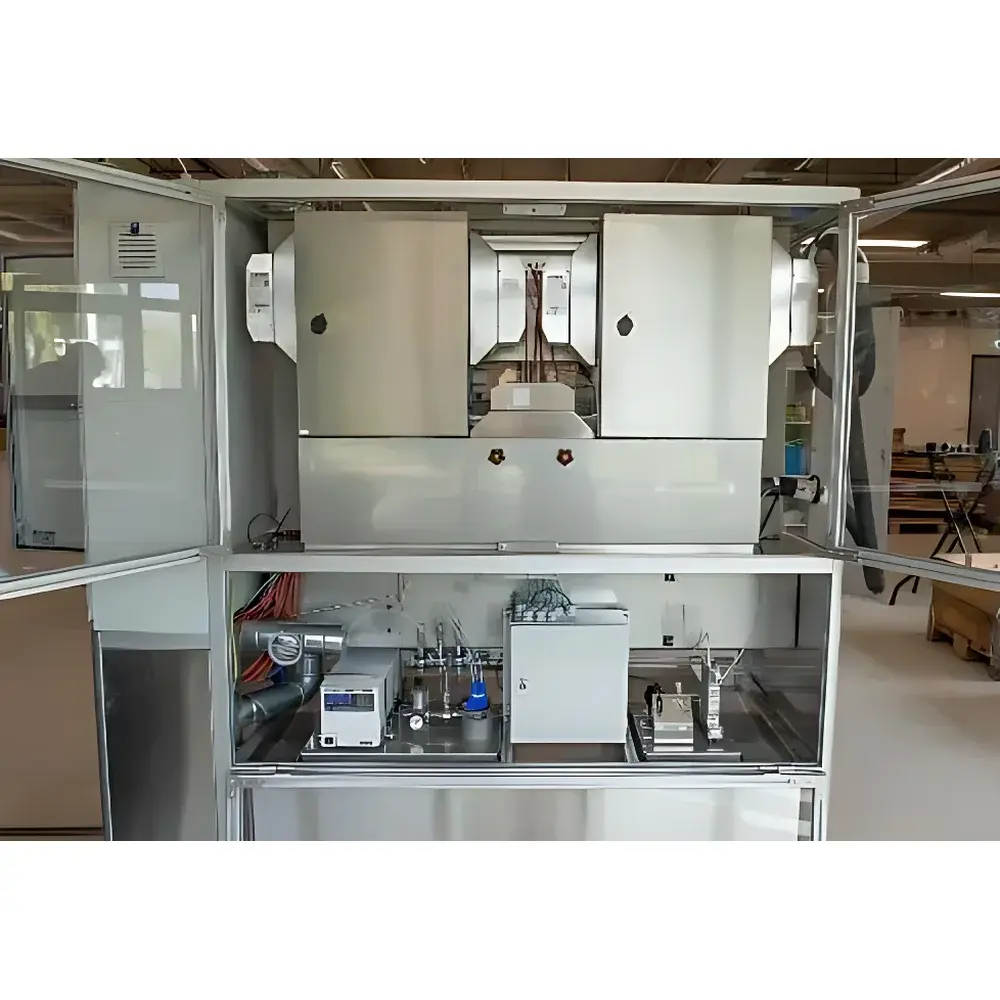
High Throughput DAC CO₂ Adsorption Analyzer by Avantium
| Brand | Avantium |
|---|---|
| Origin | Netherlands |
| Model | High Throughput DAC Systems |
| Instrument Type | Online Analyzer |
| Detection Target | Multi-component Gas Streams |
| Repeatability | ±0.1% |
| Flow Control Technology | Microfluidic Distribution |
| Parallel Channels | 8 |
| Column Operating Temperature (Adsorption) | 10–30 °C (SD ≤0.5 °C across columns) |
| Column Pre-treatment Temperature | Up to 150 °C |
| Isothermal Zone Length | 16 cm per column group |
| Heating Architecture | Dual independent temperature-controlled enclosures (4 columns per enclosure) |
| Sample Volume Range | 0.1–2.0 mL |
| Pressure Operation | Ambient |
Overview
The High Throughput DAC CO₂ Adsorption Analyzer by Avantium is an online, parallel-flow gas adsorption testing platform engineered for accelerated screening and quantitative evaluation of solid sorbent materials under controlled, near-process-relevant conditions. Based on Avantium’s proprietary microfluidic flow distribution technology, the system delivers precise, equalized gas flow across eight independent analytical columns—enabling simultaneous exposure of multiple adsorbent samples to identical gas compositions, temperature profiles, and humidity-controlled environments. Its core measurement principle relies on dynamic breakthrough curve analysis: CO₂-laden humidified feed gas (“Feed B”) is introduced in parallel to pre-conditioned adsorbent beds, while a secondary nitrogen-based stream (“Feed A”) supports pre-treatment or thermal regeneration cycles. Real-time concentration monitoring—typically via integrated non-dispersive infrared (NDIR) or tunable diode laser absorption spectroscopy (TDLAS)—captures time-resolved adsorption kinetics, saturation capacity, selectivity, and cyclic stability. Designed for laboratory-scale process development rather than routine emissions monitoring, this instrument bridges the gap between fundamental material characterization and pilot-scale process validation.
Key Features
- Eight parallel, independently configurable adsorption columns housed in two thermally isolated enclosures (4 columns per zone), each with precise PID-controlled heating and <0.5 °C inter-column temperature uniformity over a 16 cm isothermal zone.
- Microfluidic gas distribution architecture ensures highly reproducible flow splitting (<±0.5% flow deviation across channels) at low volumetric rates (standard range: 10–100 mL/min), critical for small-sample testing (0.1–2.0 mL sorbent volume).
- Dual-feed capability: “Feed A” delivers dry or humidified N₂ for adsorbent pre-conditioning or thermal regeneration; “Feed B” supplies CO₂/N₂ mixtures with precisely controlled relative humidity (RH) generated via saturated/dry gas mixing—enabling systematic study of moisture co-adsorption effects.
- Ambient-pressure operation eliminates high-pressure safety constraints while maintaining compatibility with post-combustion capture simulation conditions (e.g., 10–15% CO₂, 3–5% H₂O, balance N₂).
- Modular hardware design allows configuration adaptation—including column geometry, packing density, and sensor integration—to align with specific material classes (e.g., amine-functionalized MOFs, zeolites, activated carbons) and target applications (e.g., direct air capture, flue gas upgrading).
Sample Compatibility & Compliance
The analyzer accommodates powdered, granular, or monolithic adsorbent forms within standardized stainless-steel or quartz micro-columns. It supports ASTM D7958-22 (Standard Test Method for Determination of CO₂ Adsorption Capacity of Solid Sorbents) and ISO 15714:2021 (Gas Analysis — Determination of CO₂ Adsorption Isotherms on Solid Sorbents) methodologies when paired with certified reference gases and traceable calibration protocols. All temperature controllers and gas mass flow controllers are NIST-traceable. Data acquisition meets GLP/GMP-aligned audit trail requirements, including user authentication, electronic signatures, and immutable event logging—fully compliant with FDA 21 CFR Part 11 when deployed in regulated R&D environments.
Software & Data Management
The system operates via Avantium’s DAC Control Suite—a Windows-based application supporting real-time visualization of breakthrough curves, pressure drop profiles, and temperature gradients across all eight channels. Raw sensor data (analog/digital inputs) is timestamped at 10 Hz and stored in HDF5 format for interoperability with MATLAB, Python (Pandas/H5Py), or LIMS platforms. Batch processing tools enable automated calculation of dynamic capacity, mass transfer zone length, and cycle lifetime metrics. Export options include CSV, PDF reports, and structured JSON for integration into digital twin frameworks or AI-driven adsorbent performance prediction models.
Applications
- Rapid comparative screening of novel CO₂ sorbents under variable humidity, temperature, and CO₂ partial pressure conditions.
- Accelerated optimization of adsorption/regeneration cycling parameters—including purge gas composition, heating ramp rate, and desorption dwell time.
- Validation of structure–performance relationships for metal–organic frameworks (MOFs), porous polymers, and supported amine sorbents.
- Generation of kinetic and equilibrium datasets for process simulation tools (e.g., Aspen Adsorption, gPROMS Adsorption).
- Supporting Technology Readiness Level (TRL) advancement from TRL 3 (analytical and experimental critical function proof) to TRL 5 (component validation in relevant environment).
FAQ
What gas detection method is integrated into the system?
The base configuration uses factory-calibrated NDIR sensors for CO₂; optional TDLAS modules are available for simultaneous CO₂/CO/H₂O quantification with sub-ppm detection limits.
Can the system operate under elevated pressure?
No—it is designed for ambient-pressure operation only. For high-pressure adsorption studies, Avantium offers complementary HP-DAC variants with reinforced column manifolds and pressure-rated microfluidic manifolds.
Is humidity control validated across all eight channels?
Yes. RH uniformity is verified using traceable chilled-mirror hygrometers placed at representative channel outlets, with typical deviation <±1.5% RH across the full operating range (10–90% RH).
How is data integrity ensured during long-duration cycling experiments?
The software implements cyclic redundancy checksums on all acquired data blocks and maintains dual-write buffering to prevent loss during unexpected power interruption.
Does the system support remote monitoring and control?
Yes—via secure HTTPS API endpoints and OPC UA connectivity, enabling integration into centralized lab automation networks and cloud-based experiment orchestration platforms.







