
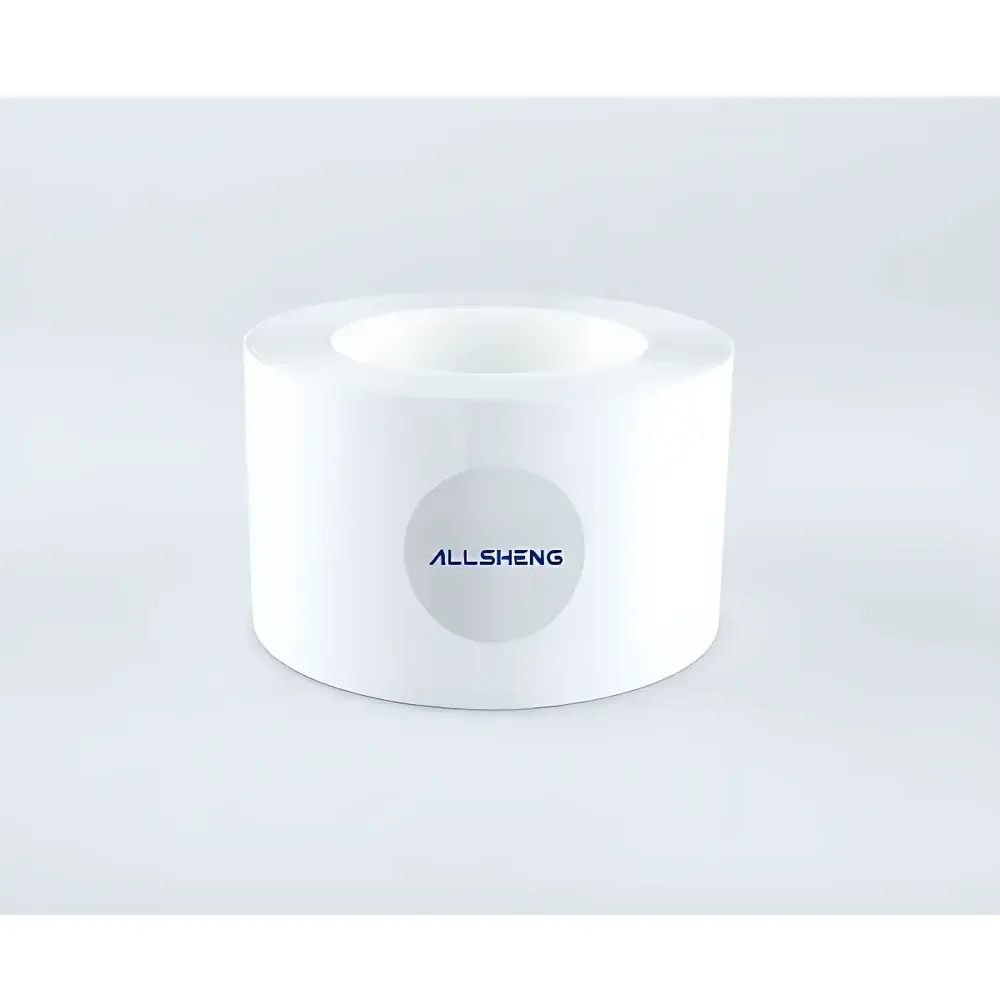
High-Transparency Pressure-Sensitive Sealing Film for PCR Microplates
| Brand | ALLSHENG (Hangzhou Aosheng) |
|---|---|
| Substrate | Fluorinated Release Liner + Transparent PS Adhesive Layer |
| Total Thickness | 95 µm |
| Width | 80 mm |
| Length | 51 m |
| Part Number | AS-F16R |
| Origin | Zhejiang, China |
Overview
The ALLSHENG AS-F16R High-Transparency Pressure-Sensitive Sealing Film is an engineered consumable designed specifically for reliable, contamination-free sealing of 96-well and 384-well PCR microplates. It operates on a mechanical adhesion principle—utilizing a solvent-free, silicone-based pressure-sensitive adhesive system laminated between a fluorinated polyethylene terephthalate (PET) release liner and an optically clear polyester film substrate. This architecture ensures immediate, uniform tack upon light finger or roller pressure without requiring heat activation, UV curing, or chemical priming. Its high optical transmission (>92% at 200–800 nm) supports real-time fluorescence detection in quantitative PCR (qPCR), digital PCR (dPCR), and high-resolution melt analysis (HRM), where signal integrity across the full UV–visible spectrum is critical for accurate Ct value determination and multiplex probe discrimination.
Key Features
- Optimized optical clarity: Minimal autofluorescence and negligible absorbance across 200–800 nm—validated per ASTM E275 for UV–Vis transparency in diagnostic assay workflows.
- Controlled adhesive rheology: Silicone-based PS adhesive exhibits low peel force (0.25–0.35 N/25 mm per ASTM D903) for clean, residue-free removal post-amplification—critical for downstream applications such as Sanger sequencing or mass spectrometry sample recovery.
- Dimensional stability: Polyester base film maintains <±0.15% dimensional change under thermal cycling (−20 °C to 95 °C), preventing delamination or edge lifting during ramped thermocycling protocols.
- Consistent thickness tolerance: 95 ± 3 µm nominal thickness verified by laser micrometry (ISO 4527), ensuring uniform compression seal across heterogeneous plate footprints—including skirted, semi-skirted, and low-profile formats.
- Manufactured under ISO 13485-certified environmental controls: Particle-controlled laminating environment (<100 particles ≥0.5 µm/m³), with lot-specific Certificate of Analysis (CoA) including FTIR identity confirmation and bioburden testing (USP <61>).
Sample Compatibility & Compliance
The AS-F16R film demonstrates compatibility with standard PCR-grade polycarbonate, polypropylene, and cyclic olefin copolymer (COC) microplates from leading vendors (e.g., Thermo Fisher, Eppendorf, Bio-Rad). It resists penetration by common PCR additives including betaine, DMSO (up to 10% v/v), and glycerol (up to 15% v/v), and remains inert toward Taq DNA polymerase, reverse transcriptase, and hot-start antibody formulations. The product conforms to ISO 10993-5 (cytotoxicity), EU Regulation (EC) No 1935/2004 for food contact materials (relevant for diagnostic reagent packaging), and is supplied with full RoHS 2015/863 and REACH SVHC compliance documentation. Each production lot undergoes endotoxin testing (<0.03 EU/mL, LAL assay per USP <85>) and is traceable to raw material batch codes for GLP/GMP audit readiness.
Software & Data Management
As a passive consumable, the AS-F16R film does not interface directly with instrument software. However, its performance characteristics are integrated into ALLSHENG’s QC workflow documentation platform—accessible via secure customer portal—with downloadable CoAs, stability data (shelf life: 24 months at 15–25 °C, 30–60% RH), and application notes aligned with MIQE guidelines. Batch-level metadata—including lamination date, adhesive lot number, and optical transmittance scan reports—is archived for 10 years in accordance with FDA 21 CFR Part 11-compliant electronic record systems.
Applications
- Sealing of qPCR plates for SYBR Green I, hydrolysis probe (TaqMan®), and molecular beacon assays.
- Covering microplates during automated liquid handling to prevent evaporation and cross-contamination in high-throughput screening (HTS) environments.
- Temporary sealing of plates prior to centrifugation (≤3,000 × g) or freeze-thaw cycles (−80 °C storage).
- Use in digital PCR partitioning workflows where optical clarity and surface flatness are prerequisites for droplet imaging fidelity.
- Replacement for aluminum or adhesive-free thermal seals in laboratories requiring non-metallic, non-interfering sealing solutions compatible with magnetic bead-based nucleic acid purification integration.
FAQ
Is the AS-F16R film compatible with real-time PCR instruments equipped with optical calibration modules?
Yes—its spectral transmission profile has been validated against instrument-specific calibration standards (e.g., Bio-Rad CFX Manager, QuantStudio Design & Analysis Software) to ensure no deviation in background correction or reference channel normalization.
Can this film be used for long-term storage of amplified DNA products at −20 °C?
Yes—stability studies confirm no measurable degradation in adhesive integrity or optical properties after 12 months at −20 °C when applied to sealed plates under nitrogen headspace conditions.
Does the silicone adhesive leach into PCR reactions under thermal cycling?
No—extraction testing per ISO 10993-12 confirms undetectable levels (<0.1 ng/well) of extractables following 40-cycle amplification (95 °C/15 s → 60 °C/60 s), verified by LC-MS/MS.
What is the recommended application pressure and dwell time for optimal seal formation?
Apply uniform pressure using a standard laboratory roller (1.5 kg linear load) once across the entire film surface; dwell time is not required—adhesion achieves >95% bond strength within 2 seconds of contact.
Is AS-F16R suitable for use with plates containing volatile organic solvents?
It is not recommended for direct contact with chloroform, acetone, or ethanol concentrations exceeding 70% v/v; compatibility testing with specific solvent mixtures should be conducted prior to implementation.



