
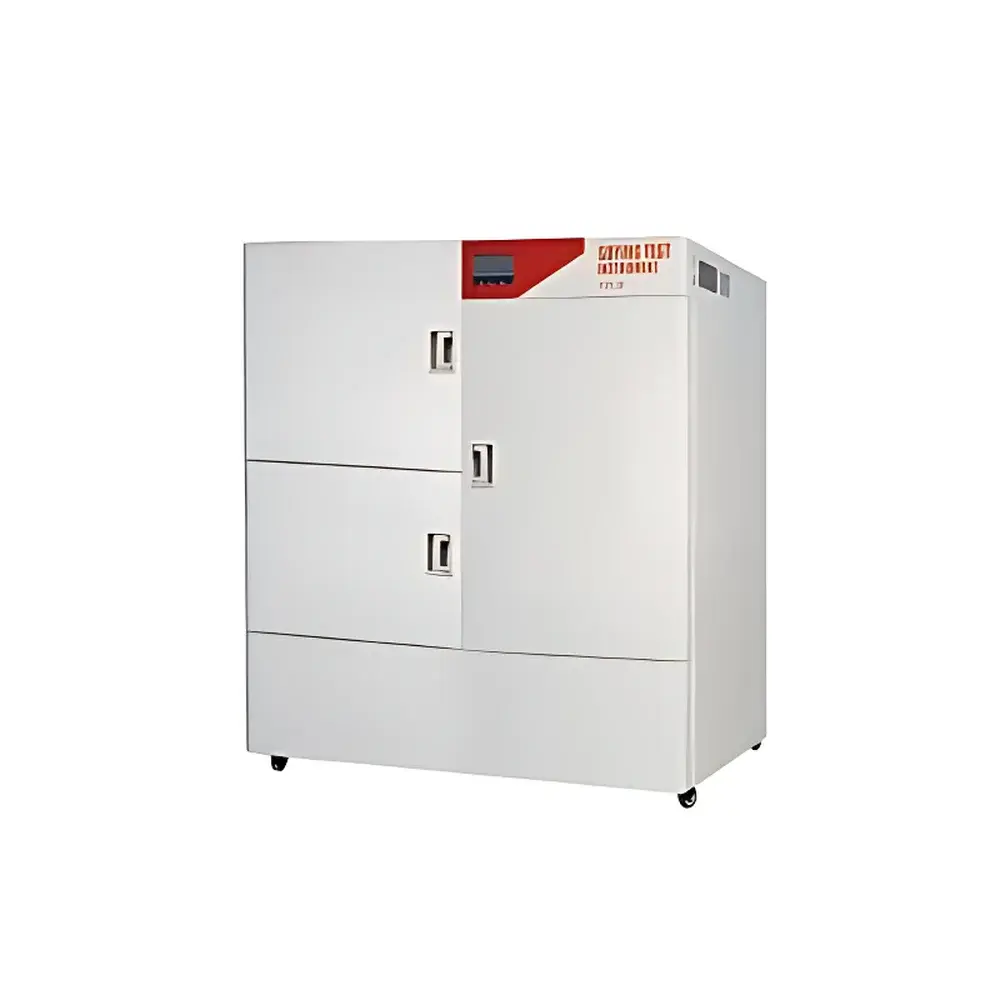
Hinds Instruments YP-TSD-TSDP-TGSD / TGSP Series Tri-Compartment Pharmaceutical Stability Testing Chamber
| Brand | Hinds Instruments |
|---|---|
| Origin | Shanghai, China |
| Model | YP-TSD-TSDP-TGSD / TGSP150 / TGSP250 / TGSP500 / TGSP1000 |
| Temperature Control Range | 10–65°C (±0.5°C fluctuation, ±2.0°C uniformity) |
| Humidity Control Range | 40–95% RH (±3% RH fluctuation, ±5% RH uniformity) |
| Light Chamber Illumination | 0–6000 lux (±500 lux deviation) |
| Chamber Volumes | A/B (100 L each), C (200 L) |
| Internal Dimensions (W×D×H mm) | 500×450×450 (A/B), 500×450×1000 (C) |
| External Dimensions (W×D×H mm) | 1300×900×1800 |
| Power Supply | AC 220 V ±10%, 50 Hz |
| Max. Power Consumption | 4.0 kW |
| Construction | Mirror-finish 304 stainless steel interior, powder-coated steel exterior |
| Refrigeration | Three independent imported hermetic compressors |
| Humidity Sensing | Imported capacitive humidity sensors |
| Controller | Imported programmable temperature/humidity controllers (A/B), dedicated light-temperature controller (C) |
| Data Output | Integrated dot-matrix thermal printer |
| Data Backup | USB flash drive storage |
| Safety Protections | Independent over-temperature cut-off, compressor overheat, fan overheat, high-pressure shutdown, overload protection, water shortage alarm |
Overview
The Hinds Instruments YP-TSD-TSDP-TGSD / TGSP Series Tri-Compartment Pharmaceutical Stability Testing Chamber is an engineered environmental simulation system designed to meet the stringent requirements of ICH Q1–Q5 guidelines and WHO Technical Report Series No. 953 for drug stability evaluation. This three-zone architecture enables simultaneous, independent control of temperature, humidity, and photometric conditions—critical for conducting long-term, accelerated, intermediate, and photostability studies in compliance with regulatory mandates. Chamber A and B function as precision-controlled温湿度 chambers (100 L each), maintaining stable thermal and hygroscopic environments across 10–65°C and 40–95% RH. Chamber C serves as a dedicated photostability chamber (200 L), integrating calibrated illumination up to 6000 lux with spectral output aligned to ICH Q1B Option 1 (cool white fluorescent) and Option 2 (near-UV). The system employs balanced heating/cooling and steam-humidification technology to ensure thermodynamic equilibrium and minimize gradient-induced variability—essential for reproducible shelf-life prediction and degradation pathway analysis.
Key Features
- Tri-compartment modular design: Enables concurrent execution of multiple ICH protocols (e.g., 25°C/60% RH long-term + 40°C/75% RH accelerated + 25°C/4500 lux photostability) without cross-contamination or parameter interference.
- Independent climate control: Each chamber utilizes a dedicated imported hermetic compressor, capacitive humidity sensor, and PID-based controller—ensuring ±0.5°C temperature fluctuation and ±3% RH humidity fluctuation under continuous 24/7 operation.
- GMP-aligned construction: Mirror-polished 304 stainless steel interior (electropolished finish optional), seamless welded corners, and HEPA-filtered air circulation support cleanroom-compatible validation and routine monitoring.
- Dual-layer safety architecture: Primary controller-based protection plus hardware-independent over-temperature cutoff; additional safeguards include compressor high-pressure lockout, fan thermal cutoff, current overload detection, and external water tank level monitoring.
- Regulatory-ready data integrity: Onboard dot-matrix printer provides time-stamped, tamper-evident hardcopy logs; USB-based backup supports secure export of raw sensor data (timestamped at 1-minute intervals) for audit trail reconstruction per FDA 21 CFR Part 11 and EU Annex 11 requirements.
Sample Compatibility & Compliance
The chamber accommodates standard pharmaceutical packaging formats—including blister packs, HDPE bottles, glass vials, and aluminum tubes—across all three compartments. Its internal geometry (500 × 450 × 450 mm for A/B; 500 × 450 × 1000 mm for C) allows placement of up to two adjustable 304 stainless steel shelves per zone, loadable with ≥200 units of 10-mL vials or equivalent surface area exposure. All operational parameters are traceable to national metrology institutes (calibration certificates available upon request). The system conforms to ISO 14644-1 Class 8 (ISO Class 8) air cleanliness when operated with optional HEPA recirculation filters. It supports full 3Q qualification (IQ/OQ/PQ) documentation packages compliant with ASTM E2500-13 and EU GMP Annex 15. Environmental profiles can be preloaded to match ICH Q1A(R2), Q1B, Q5C, and USP specifications.
Software & Data Management
While the base configuration features embedded microcontroller logic with local LCD interface, optional Ethernet-enabled firmware upgrades provide remote monitoring via HTTPS-secured web portal (no proprietary software installation required). Logged parameters include real-time chamber temperature, relative humidity, illuminance (lux), compressor duty cycle, and alarm event timestamps. Data files are stored in CSV format with ISO 8601-compliant timestamps and include digital signatures for integrity verification. Audit trails record user login/logout events, setpoint modifications, and calibration interventions—fully compatible with electronic quality management systems (eQMS) used in GLP/GMP facilities. Optional integration with LIMS via RESTful API enables automated test initiation and result ingestion.
Applications
- ICH Q1A(R2) long-term stability testing at 25°C/60% RH and accelerated testing at 40°C/75% RH over 6-month cycles.
- ICH Q1B photostability assessment using Option 1 (cool white fluorescent) and Option 2 (near-UV) light sources, including forced degradation under controlled irradiance (e.g., 1.2 million lux·hr).
- Intermediate condition studies per Q1A(R2) (e.g., 30°C/65% RH) for tropical climate labeling.
- Excipient compatibility screening under variable hygrothermal stress to identify moisture-mediated degradation pathways.
- Reference standard storage validation under defined climatic conditions per ICH Q5C.
- Process validation support for lyophilization cycle development and container-closure integrity assessment.
FAQ
Does this chamber comply with FDA 21 CFR Part 11 requirements for electronic records?
Yes—the system supports audit-trail-enabled data logging, electronic signature capture (via optional upgrade), and role-based access control. Raw data export preserves metadata integrity for regulatory submission.
Can the light chamber (Chamber C) operate independently while A and B run different temperature/humidity profiles?
Yes—each compartment has fully autonomous control logic, enabling true parallel testing without shared thermal or humidification infrastructure.
What validation documentation is included with shipment?
Standard delivery includes Factory Acceptance Test (FAT) report, calibration certificate for temperature/humidity sensors (NIST-traceable), and electrical safety certification (IEC 61010-1). IQ/OQ/PQ protocols and executed reports are available as optional services.
Is external water supply integration supported for extended unattended operation?
Yes—the external water reservoir permits connection to a continuous deionized water feed line, eliminating manual refilling during multi-week stability runs.
How is temperature uniformity verified across the working volume?
Uniformity mapping is performed per ISO 16770:2021 using nine-point sensor array (3×3 vertical grid at mid-height), with results documented in the OQ report showing ≤±2.0°C deviation across all zones.





