
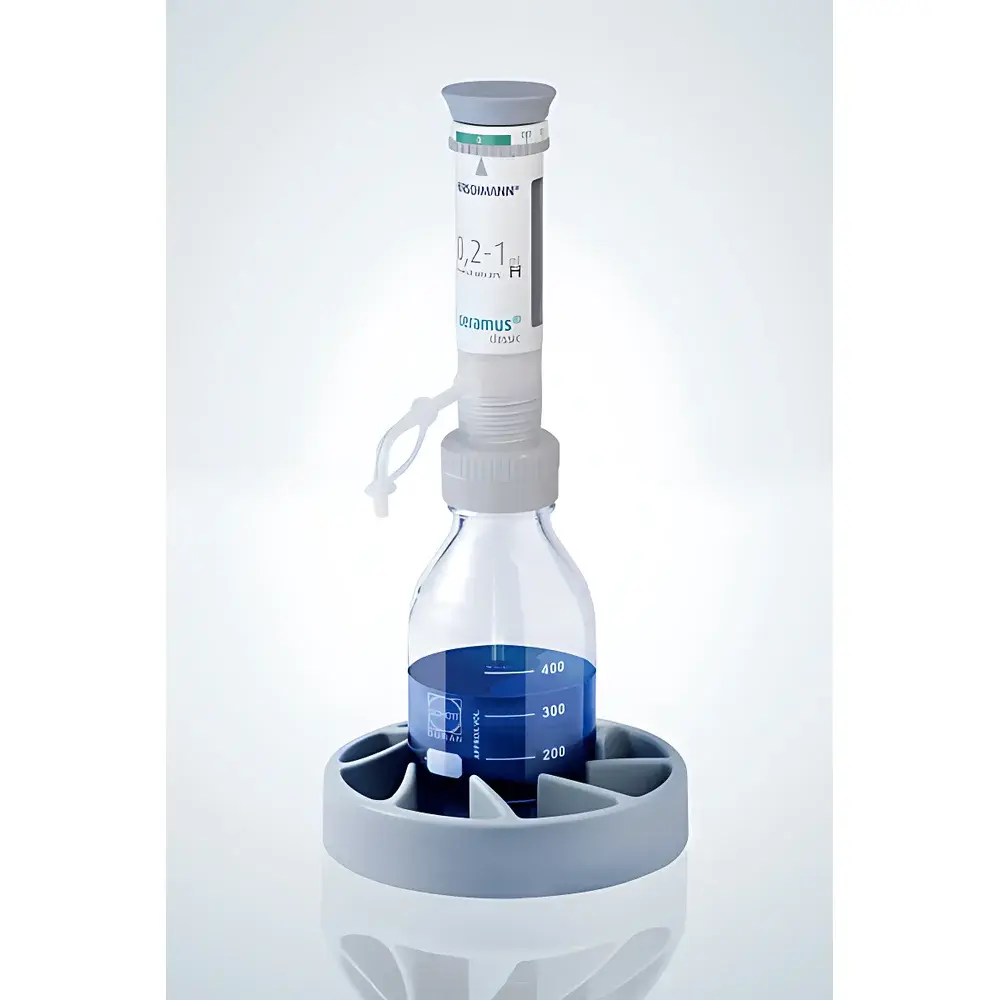
HIRSCHMANN ceramus-classic Bottle Top Dispenser
| Brand | HIRSCHMANN (Germany) |
|---|---|
| Origin | Germany |
| Model | ceramus-classic |
| Type | Manual Bottle Top Dispenser |
| Volume Range | 0.2–60 mL |
| Minimum Increment | 0.05–1 mL (model-dependent) |
| Accuracy | ±0.5% |
| Coefficient of Variation (CV) | ≤0.1–0.2% |
| Material | 99.7% Purity Technical Ceramic Piston |
| Sterilization | Autoclavable at 121 °C |
| Compliance | ISO 8536-3, DIN EN ISO 9001, GLP/GMP-aligned design, ASTM E542-22 applicable for volumetric verification |
Overview
The HIRSCHMANN ceramus-classic Bottle Top Dispenser is a precision-engineered manual liquid handling instrument designed for repeatable, traceable, and contamination-controlled dispensing in regulated laboratory and production environments. Operating on a positive-displacement piston principle, it delivers volumetric accuracy through mechanical displacement rather than air displacement—eliminating variability from temperature, humidity, or liquid viscosity. Its core architecture integrates a monolithic technical ceramic piston (99.7% Al₂O₃ purity), engineered to withstand aggressive organic solvents, strong acids (excluding hydrofluoric acid), and alkaline reagents without degradation, swelling, or dimensional drift. This material choice ensures long-term metrological stability and eliminates the risk of piston leakage—a common failure mode in polymer-based dispensers. The ceramus-classic is not merely a dispensing tool; it functions as a calibrated volumetric transfer device compliant with ISO 8536-3 (infusion equipment — Part 3: Bottles and bottle-top dispensers) and aligned with GLP and GMP documentation requirements, including full traceability via individual serial-numbered calibration certificates.
Key Features
- Ceramic piston technology: 99.7% high-purity alumina ceramic piston provides exceptional chemical resistance, zero solvent absorption, and negligible wear over tens of thousands of cycles—maintaining factory-calibrated accuracy throughout service life.
- Step-range volume selection: Mechanically indexed volume settings (0.2–1.0 mL, 0.4–2.0 mL, 1.0–5.0 mL, 2.0–10.0 mL, 5.0–30.0 mL, 10.0–60.0 mL) eliminate continuous adjustment ambiguity; each range corresponds to a fixed mechanical stop, ensuring reproducible positioning and eliminating user-induced parallax error.
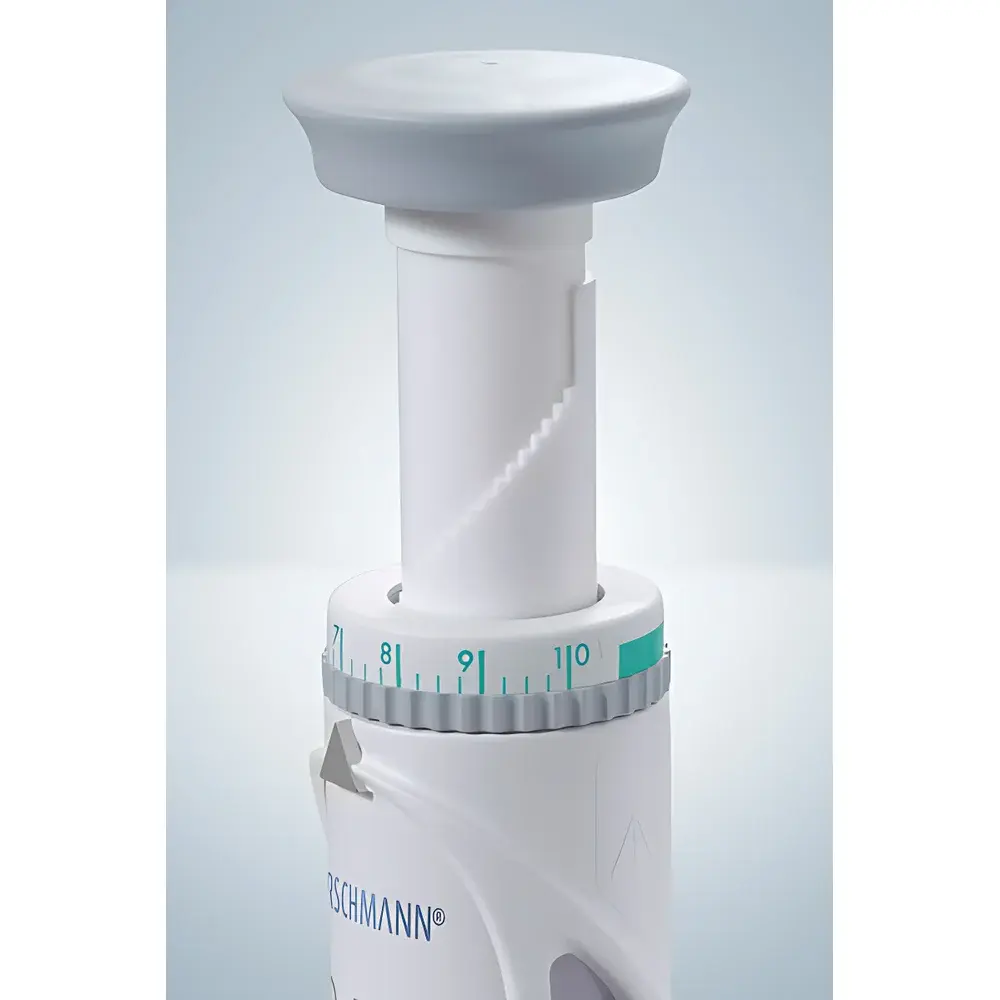
- Dual-scale digital volume ring: Ergonomically positioned for direct line-of-sight reading; calibrated in both metric (mL) and fractional increments (e.g., 0.05 mL), enabling rapid, unambiguous setting without rotation beyond one full turn.
- Integrated safety lock: A rotating safety ring physically immobilizes the piston rod during storage or transport, preventing accidental actuation and preserving set volume integrity between uses.
- Autoclavable construction: Fully compatible with steam sterilization at 121 °C / 1 bar for 20 minutes (DIN EN 285), supporting aseptic workflows in microbiology, cell culture, and pharmaceutical QC labs.
Sample Compatibility & Compliance
The ceramus-classic dispenses liquids across a broad physicochemical spectrum—including low-viscosity aqueous buffers, high-boiling-point solvents (e.g., DMSO, DMF), concentrated acids (HCl, HNO₃, H₂SO₄), and bases (NaOH, KOH)—without material interaction or performance compromise. It is explicitly unsuitable for hydrofluoric acid (HF) due to ceramic etching. Each unit undergoes 100% functional testing and volumetric verification per ISO/IEC 17025-accredited procedures. A unique serial-numbered Certificate of Conformance is supplied, documenting actual measured values against reference standards traceable to PTB (Physikalisch-Technische Bundesanstalt). These reports are structured to integrate directly into DIN EN ISO 9001 quality management systems and support audit readiness for FDA 21 CFR Part 11 (when paired with compliant lab documentation practices) and EU Annex 11.
Software & Data Management
As a manually operated, non-electronic instrument, the ceramus-classic does not incorporate embedded firmware, connectivity, or digital data logging. However, its metrological traceability framework supports robust paper-based or LIMS-integrated data governance: calibration certificates include uncertainty budgets, environmental conditions during testing, and operator signatures. Laboratories implementing electronic records may assign the dispenser a unique asset ID within their QMS and link its certificate to batch records or SOPs. For facilities requiring automated audit trails, the ceramus-classic is routinely deployed alongside balance-based gravimetric verification protocols compliant with USP and ASTM E2877-22.
Applications
- Preparation of standardized reagent aliquots in clinical chemistry and immunodiagnostics labs (CLIA/CAP accredited environments)
- Volumetric transfer of cytotoxic compounds in P2/P3 containment laboratories under BMBL 5th edition guidelines
- Dispensing of calibration standards for ICP-MS, HPLC, and GC analysis where carryover and adsorption must be minimized
- Formulation of excipient solutions in pharmaceutical development, adhering to ICH Q5C stability protocol requirements
- Quality control sampling in fine chemical synthesis, where solvent compatibility and repeatability are critical to batch release
FAQ
Is the ceramus-classic suitable for use with hydrofluoric acid (HF)?
No. HF etches alumina ceramics; use only fluoropolymer-based dispensers (e.g., FEP/PFA-lined) for HF applications.
Does the dispenser require periodic recalibration?
No. Its step-range mechanical design and ceramic piston ensure metrological stability over time; however, users should perform routine performance checks per ISO 8655-5 using gravimetric methods.
Can the entire unit be autoclaved without disassembly?
Yes. All components—including housing, piston, valve assembly, and dispensing tip—are rated for full-cycle autoclaving at 121 °C.
How is traceability documented for regulatory audits?
Each unit ships with a serial-numbered Certificate of Conformance, listing measured accuracy, CV, test conditions, reference standard IDs, and technician signature—fully embeddable in ISO 9001 or GMP quality files.
What is the expected service life under daily laboratory use?
With proper cleaning and avoidance of HF or abrasive particulates, the ceramic piston maintains functional integrity for ≥50,000 dispensing cycles, supported by HIRSCHMANN’s 3-year limited warranty on materials and workmanship.



