
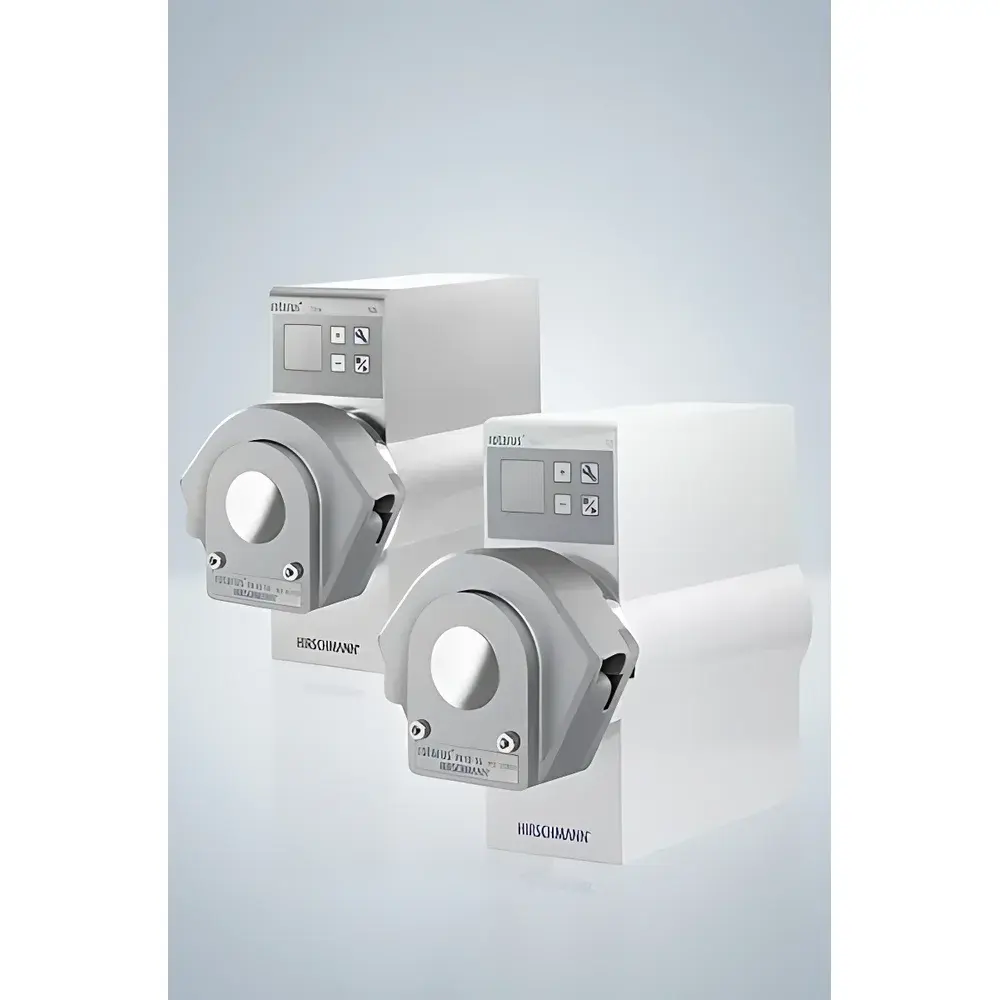
Hirschmann rotarus® volume 50 Peristaltic Pump
| Brand | Hirschmann |
|---|---|
| Origin | Germany |
| Model | rotarus® volume 50 |
| Flow Rate Range | 0.1–10 mL/min |
| Speed Range | 0.2–100 rpm |
| Motor Power | 50 W |
| Protection Rating | IP54 (lab version) / IP65 (stainless steel industrial version) |
| Control Interface | Built-in TFT touchscreen + external TFT controller |
| Connectivity | RS232, USB |
| Power Supply | 24 V DC |
Overview
The Hirschmann rotarus® volume 50 is a precision-engineered peristaltic pump designed for continuous, repeatable, and traceable liquid handling in regulated laboratory and light-industrial environments. Operating on the fundamental principle of peristalsis—where rollers compress flexible tubing to displace fluid without contact between the pump mechanism and the medium—the rotarus® volume 50 ensures complete fluid path isolation, eliminating cross-contamination risk and enabling safe transfer of aggressive, viscous, or shear-sensitive liquids. Its 50 W brushless DC motor delivers stable rotational torque across the full speed range of 0.2–100 rpm, translating into a calibrated volumetric flow range of 0.1–10 mL/min when used with standard silicone or fluoropolymer tubing (e.g., PharMed® BPT or Norprene®). Unlike basic peristaltic pumps, the rotarus® volume 50 integrates closed-loop motion control and real-time tubing health monitoring, making it suitable for applications demanding GLP-compliant documentation, method reproducibility, and long-term unattended operation.
Key Features
- RFID-enabled pump head and tubing identification: Each certified pump head and compatible tubing set carries an embedded RFID tag; the system automatically validates compatibility, recalls optimal compression parameters, and logs usage history.
- Intelligent tubing integrity monitoring: Proprietary pressure-sensing algorithms detect abnormal backpressure signatures associated with tubing occlusion, kinking, or rupture—triggering immediate audible/visual alerts and automatic pump halt.
- Dual-control architecture: Integrated front-panel TFT display (with tactile feedback) and optional external standalone TFT controller support identical programming depth—including ramped acceleration profiles, programmable dispensing cycles (up to 999 repeats), and variable-speed segment scheduling.
- Modular pump head design: Tool-free, one-click pump head mounting accommodates single-channel (1–4 rollers) or multi-channel (up to 8 channels) configurations; all heads conform to DIN 12781 and ISO 8536-4 dimensional standards for universal tubing alignment.
- Robust mechanical construction: Lab-grade white epoxy-coated housing meets IP54 (dust-protected, splash-resistant); stainless steel variant achieves IP65 (dust-tight, low-pressure water jet resistant), supporting deployment in production-line ancillary roles.
- Regulatory-ready firmware: Supports audit-trail generation (user actions, parameter changes, error events), electronic signature-capable method storage (up to 100 protocols), and calibration certificate logging aligned with ISO/IEC 17025 requirements.
Sample Compatibility & Compliance
The rotarus® volume 50 maintains compatibility with a broad spectrum of chemically resistant tubing materials—including silicone (for general aqueous use), Viton® (for organic solvents), and C-Flex® (for high-purity pharmaceutical applications)—all sized per ISO 3669 and DIN 2817 standards. Its non-metallic fluid path eliminates catalytic interference, supporting USP compliant material contact for biopharmaceutical buffer preparation. The device complies with IEC 61000-6-2 (immunity) and IEC 61000-6-4 (emissions), carries CE marking under the EU Machinery Directive 2006/42/EC and Low Voltage Directive 2014/35/EU, and supports validation protocols required under FDA 21 CFR Part 11 for electronic records and signatures when paired with compliant LIMS or SCADA systems.
Software & Data Management
Control and configuration are managed via the native Hirschmann PumpControl™ firmware, accessible through either the built-in 4.3″ resistive TFT interface or the optional external 7″ controller. All parameter sets—including speed ramps, dispense volume per cycle, pause intervals, and total volume limits—are stored as named methods with timestamped revision history. Data export is supported via USB mass-storage mode (CSV log files) or real-time streaming over RS232/USB virtual COM port. Integration with third-party platforms (e.g., LabVIEW, Python pySerial, or Siemens SIMATIC S7 PLCs) is facilitated by documented ASCII command protocol (AT-style syntax), enabling synchronized operation within automated workcells or QC batch processing lines.
Applications
- Continuous buffer delivery in chromatography system priming and column equilibration
- Accurate reagent dosing in automated ELISA and PCR setup workflows
- In-line sampling for online pH/conductivity analyzers in bioreactor monitoring
- Low-shear media transfer in cell culture and fermentation processes
- Calibration standard distribution in metrology labs performing volumetric verification per ISO 8655-4
- Repetitive aliquoting in high-throughput screening where tubing lifetime predictability is critical
FAQ
Does the rotarus® volume 50 support validation documentation for GMP environments?
Yes—it provides configurable audit trails, electronic signature support, and method versioning required for IQ/OQ/PQ execution under Annex 11 and EU GMP guidelines.
Can third-party pump heads be used without compromising accuracy or safety?
While mechanically compatible heads from other manufacturers may mount, only Hirschmann-certified RFID-tagged heads guarantee automatic parameter loading, tubing compression calibration, and full diagnostic functionality.
What is the expected service life of the tubing under continuous operation at 60 rpm?
Typical lifespan ranges from 100–300 hours depending on tubing material, inner diameter, and fluid abrasiveness; the integrated RFID system tracks cumulative rotation count and recommends replacement based on manufacturer-specified duty cycles.
Is remote firmware update capability available?
Firmware updates are performed locally via USB drive using signed .bin files; no cloud connectivity or over-the-air updates are implemented to maintain air-gapped security compliance.
How does the system handle viscosity changes during extended dispensing runs?
The rotarus® volume 50 operates in open-loop speed control mode; for viscosity-dependent flow stability, users must pre-calibrate flow rate vs. rpm using gravimetric measurement per ISO 8536-4 Annex B and apply compensatory speed adjustments in method programming.



