
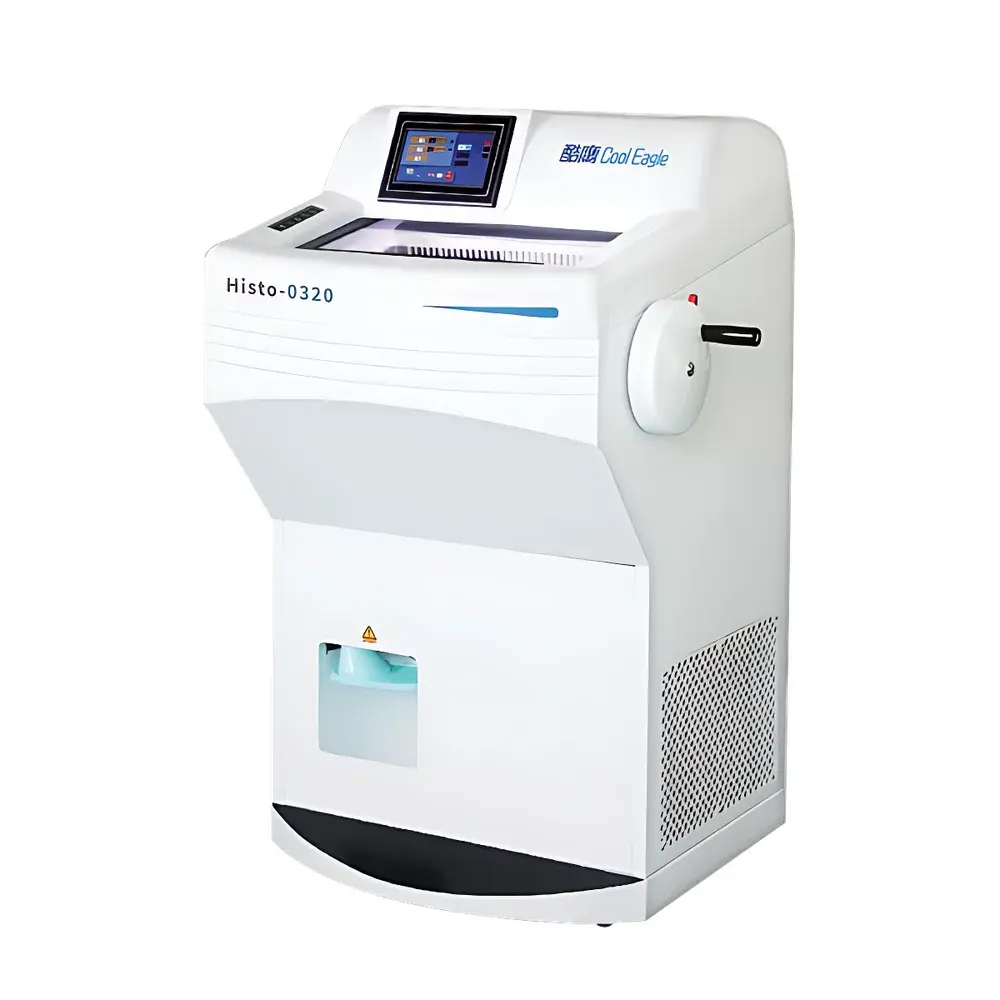
HISTO Cool Eagle Cryostat Microtome Histo-0320
| Brand | HISTO |
|---|---|
| Origin | Zhejiang, China |
| Manufacturer Type | Authorized Distributor |
| Country of Origin | China |
| Model | Histo-0320 |
| Price | USD 21,000 (FOB) |
| Section Thickness Range | 0.5–100 µm (adjustable in increments: 0.5 µm from 0.5–5 µm |
| Trimming Thickness Range | 0–600 µm (increments: 5 µm up to 50 µm |
| Specimen Retraction | 0–60 µm adjustable |
| Maximum Specimen Size | 55 mm × 80 mm |
| Horizontal Specimen Travel | ≥20 mm |
| Vertical Specimen Travel | ≥62 mm |
| Cryochamber Temperature Range | 0°C to –50°C (operational range) |
| refrigerated chamber setpoint range | 0°C to –50°C |
| Cryostage Temperature Range | 0°C to –60°C (with Peltier assist down to –65°C) |
| Sample Head Temperature Range | 0°C to –50°C |
| Number of Cryo-Points on Stage | ≥26 |
| Peltier-Assisted Rapid-Cooling Points | ≥2 |
| Peltier Precooling Time to –65°C | ≤15 min |
| Coarse Feed Speeds | 0.45 mm/s and 0.9 mm/s (motorized, dual-speed) |
| Specimen Head Auto-Positioning | One-touch motorized advance/return |
| Touchscreen Display | Full-color LCD with bilingual UI (English/Chinese) |
| Sleep Mode | Maintains chamber at –5°C to –15°C |
| Five-Zone Independent Refrigeration | Dual Secop compressors cooling cryochamber, cryostage, knife holder, specimen head, and tissue flattener |
| Safety Features | Full-length blade guard with color-coded blade advancement indicator |
| Specimen Holder | 360° X-axis + 12° Y-axis articulating clamp with quick-lock mechanism |
| Tissue Flattener | Actively cooled to –50°C |
| Anti-Fog Viewing Window | Single-layer heated glass |
| Handwheel Lock | 360° infinitely adjustable mechanical lock |
| Overall Dimensions | 680 mm × 720 mm × 1150 mm |
| Minimum Ambient-to-Cryotemperature Delta | >60°C |
Overview
The HISTO Cool Eagle Cryostat Microtome Histo-0320 is an advanced, compressor-driven cryogenic microtome engineered for high-precision frozen sectioning in clinical histopathology, neuroscience research, and preclinical toxicology laboratories. It operates on the principle of cryosectioning—rapidly freezing biological specimens to preserve native morphology and antigenicity, then cutting thin sections under controlled sub-zero thermal conditions. Unlike ambient-temperature microtomes, the Histo-0320 maintains thermally stable environments across five independently regulated zones (cryochamber, cryostage, knife holder, specimen head, and tissue flattener), ensuring minimal ice crystal formation, consistent section integrity, and reproducible ribbon formation—even for delicate, lipid-rich, or high-water-content tissues. Its dual Secop compressor architecture delivers a sustained temperature differential of >60°C relative to ambient, enabling reliable operation in standard laboratory environments without external chillers or liquid nitrogen dependency.
Key Features
- Five-zone independent refrigeration system powered by two internationally certified Secop compressors—ensuring precise, decoupled thermal control of cryochamber (–50°C), cryostage (–60°C), knife holder, specimen head, and tissue flattener (–50°C).
- Peltier-assisted rapid-cooling capability: two dedicated semiconductor points achieve –65°C on the cryostage within ≤15 minutes, accelerating tissue hardening for urgent intraoperative consultations.
- Motorized specimen head with one-touch auto-positioning: eliminates manual alignment, reduces operator fatigue, and improves workflow consistency during high-volume sectioning.
- Full-range section thickness control from 0.5 µm to 100 µm, with variable increment logic aligned with histological best practices—0.5 µm steps for ultra-thin immunohistochemistry sections, 1–5 µm for routine diagnostics, and coarse trimming up to 600 µm.
- Frost-free cryostage with ≥26 cryo-points and dual Peltier-assisted cooling zones ensures uniform thermal distribution and minimizes condensation-related artifacts.
- Heated anti-fog viewing window (single-layer tempered glass) maintains optical clarity throughout extended sessions without manual wiping or airflow interference.
- Integrated UV sterilization cycle (254 nm) automatically decontaminates the specimen chamber between runs, supporting GLP-compliant lab hygiene protocols.
- 360° X-axis and 12° Y-axis articulating specimen clamp enables rapid, ergonomic orientation of irregular or fragile samples—including brain blocks, tumor biopsies, and embryonic tissues.
- Color-coded, full-length blade guard with integrated advancement indicator enhances user safety and provides visual feedback during knife positioning and replacement.
Sample Compatibility & Compliance
The Histo-0320 accommodates specimens up to 55 mm × 80 mm, compatible with standard OCT-embedded tissue cassettes, metal embedding molds, and custom aluminum chucks. Its actively cooled tissue flattener (–50°C) significantly reduces compression artifacts in soft or necrotic samples, while the motorized retraction (0–60 µm) supports serial sectioning with minimal drift. The system complies with IEC 61010-1:2010 for laboratory equipment safety and meets electromagnetic compatibility (EMC) requirements per EN 61326-1. Though not FDA-cleared as a medical device, its design aligns with CAP and CLIA preanalytical standards for frozen section preparation. All temperature sensors include self-diagnostic functionality and are traceable to NIST-certified references. Data logging (via optional USB export) supports audit readiness for ISO 15189 and CAP-accredited pathology labs.
Software & Data Management
The embedded firmware features a full-color 7-inch capacitive touchscreen with bilingual English/Chinese interface and intuitive icon-based navigation. All critical parameters—including chamber/stage temperatures, section thickness, trimming mode, coarse feed speed, and UV cycle status—are logged with timestamps and stored locally (≥10,000 entries). Export is supported via USB 2.0 to CSV for integration into LIMS or QA documentation systems. The sleep mode preserves energy and stabilizes thermal baselines during idle periods; automatic wake-up restores full operational temperature in ≤15 minutes. Firmware updates are performed offline via encrypted USB drive, ensuring data integrity and compliance with internal IT security policies. No cloud connectivity or remote access is implemented—maintaining full data sovereignty per HIPAA and GDPR requirements.
Applications
- Intraoperative frozen section diagnosis in surgical pathology, including margin assessment for breast, prostate, and neuro-oncology specimens.
- Neuroanatomical mapping requiring serial 10–20 µm sections of unfixed, flash-frozen rodent or primate brain tissue.
- Lipid-rich tissue analysis (e.g., adipose, liver, myocardium) where conventional paraffin processing induces extraction artifacts.
- Immunofluorescence and multiplexed spatial proteomics workflows demanding antigen preservation and minimal autofluorescence.
- Toxicologic pathology studies involving rapid screening of acute organ damage in preclinical models.
- Plant tissue cryosectioning for starch granule localization and vascular bundle morphology.
FAQ
What is the minimum achievable section thickness, and what applications require it?
The Histo-0320 achieves 0.5 µm sections—optimal for electron microscopy sample screening, ultrastructural immunolabeling, and high-resolution fluorescence colocalization studies.
Does the system support regulatory-compliant audit trails?
Yes: all temperature setpoints, section parameters, UV sterilization cycles, and sensor self-tests are timestamped and exportable to CSV for QA review and CAP/ISO 15189 audits.
How does the five-zone refrigeration improve section quality compared to single-compressor systems?
Independent thermal control prevents cross-zone thermal lag—e.g., knife holder remains at optimal cutting temperature even during rapid specimen loading or stage repositioning—reducing chatter, compression, and knife marks.
Is the Peltier-assisted cooling required for routine use, or only for urgent cases?
Peltier assist is optional but recommended for specimens requiring rapid hardening (e.g., fatty livers, unbuffered brain tissue); standard compressor cooling suffices for most diagnostic workflows.
Can the instrument be integrated into an existing LIMS environment?
Direct API integration is not supported; however, exported CSV logs can be parsed and ingested into LIMS via standard import modules or middleware scripts.



