
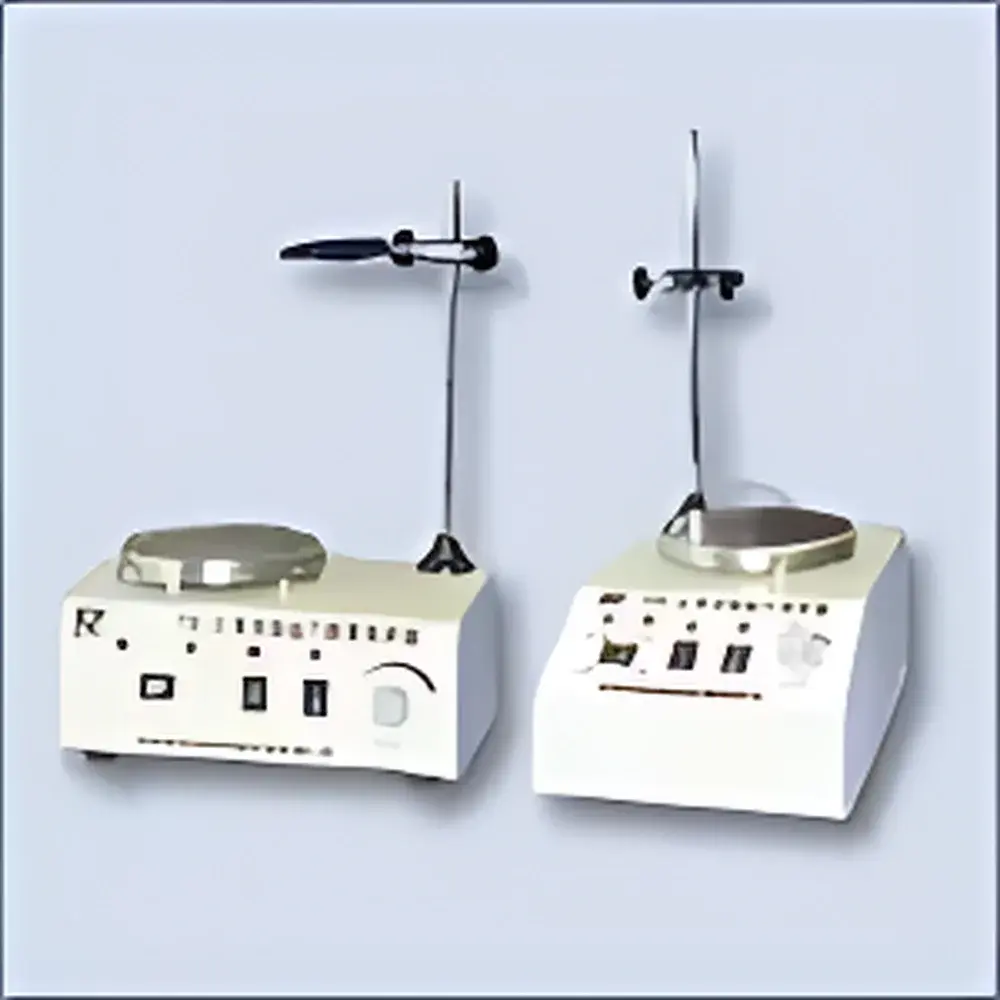
HJ-1 Standard Magnetic Stirrer
| Origin | Jiangsu, China |
|---|---|
| Manufacturer Type | Distributor |
| Country of Origin | China |
| Model | HJ-1 |
| Maximum Stirring Capacity | 1000 mL |
| Speed Range | 0–2400 rpm |
| Price | USD 48 (FOB) |
Overview
The HJ-1 Standard Magnetic Stirrer is a compact, reliable benchtop instrument engineered for consistent, contactless mixing of low-to-medium viscosity liquid samples in research, quality control, and teaching laboratories. It operates on the principle of magnetic coupling: a rotating permanent magnet or electromagnetic drive beneath the non-magnetic work surface induces synchronous rotation of a PTFE- or glass-coated magnetic stir bar immersed in the sample vessel. This design eliminates mechanical shafts and seals, ensuring leak-free operation, minimal contamination risk, and ease of cleaning—critical attributes for GLP-compliant workflows and multi-user environments. Unlike overhead stirrers or mechanical agitators, the HJ-1 delivers uniform shear distribution across small to intermediate volumes without introducing vibration or requiring clamping fixtures. Its robust aluminum alloy housing and thermally stable ceramic-glass top plate support continuous duty cycles under standard ambient conditions.
Key Features
- Brushless DC motor with closed-loop speed control ensures stable rotational output across the full 0–2400 rpm range, minimizing drift during extended operation
- Non-heating configuration eliminates thermal interference—ideal for temperature-sensitive reactions, enzymatic assays, or pre-incubation steps prior to thermal processing
- Compact footprint (160 × 140 × 90 mm) optimizes space in crowded fume hoods or laminar flow cabinets
- Three-position rotary speed dial with tactile feedback enables precise manual adjustment without digital interface dependency
- Ceramic-glass work surface resists chemical corrosion from common solvents (e.g., ethanol, acetone, dilute acids/bases) and withstands brief exposure to ≤150 °C incidental heat
- UL/CE-compliant power supply with overcurrent protection and thermal cutoff safeguards against motor stall or prolonged overload
Sample Compatibility & Compliance
The HJ-1 accommodates standard laboratory glassware including beakers (50–1000 mL), Erlenmeyer flasks, and cylindrical reaction vessels. Optimal performance is achieved with stir bars sized 20–40 mm in length and 5–8 mm in diameter; bar geometry (ellipse, cross, octagonal) may be selected based on fluid viscosity and vortexing requirements. The unit complies with IEC 61010-1:2010 for electrical safety in laboratory equipment and meets RoHS Directive 2011/65/EU for hazardous substance restrictions. While not certified for use in classified hazardous locations (e.g., ATEX Zone 1), it is routinely deployed in ISO/IEC 17025-accredited testing labs for sample homogenization prior to pH measurement, titration, or spectroscopic analysis. No FDA 21 CFR Part 11 functionality is provided, as the device lacks data logging or user-accessible software controls.
Software & Data Management
The HJ-1 is a standalone analog instrument with no embedded firmware, connectivity ports (USB/Bluetooth/Ethernet), or digital display. Speed setting is purely manual via calibrated potentiometer; no audit trail, parameter recall, or remote monitoring capability is included. This architecture aligns with cost-sensitive educational and routine QC applications where operational simplicity, long-term reliability, and minimal maintenance outweigh advanced automation needs. For laboratories requiring traceable speed documentation, external tachometers (e.g., handheld optical or contact-type RPM meters) may be used during method validation per ASTM D1298 or ISO 3104 protocols. Calibration verification is performed annually using NIST-traceable rotational standards.
Applications
- Homogenization of buffer solutions, culture media, and reagent dilutions in molecular biology and microbiology labs
- Preparation of calibration standards for ICP-OES, UV-Vis, and ion chromatography systems
- Accelerated dissolution testing of pharmaceutical excipients under USP guidelines (when paired with temperature-controlled water baths)
- Mixing of aqueous polymer solutions and colloidal suspensions in materials science research
- Supporting environmental testing workflows—including BOD5 incubation and heavy metal extraction per EPA Method 3015A
- Student laboratory instruction in general chemistry, analytical chemistry, and chemical engineering curricula
FAQ
What is the maximum recommended viscosity for effective stirring with the HJ-1?
For consistent vortex formation and homogeneous mixing, the HJ-1 is optimized for Newtonian fluids up to ~1500 mPa·s (e.g., 40% glycerol/water at 25 °C). Higher viscosities require larger-diameter stir bars or alternative agitation methods.
Can the HJ-1 be used inside a CO₂ incubator or cold room?
Yes—provided ambient operating temperature remains between 5 °C and 40 °C and relative humidity does not exceed 80% RH non-condensing. Avoid condensation on the control panel or motor housing.
Is the ceramic-glass top plate resistant to hydrofluoric acid (HF)?
No. HF etches silica-based ceramics and glass. Use only HF-resistant alternatives (e.g., PTFE-coated hotplates) when handling HF-containing solutions.
Does the HJ-1 include a stir bar?
No. Stir bars are supplied separately to allow selection based on application-specific requirements (coating material, size, magnetic strength).
What maintenance is required for long-term reliability?
Wipe the work surface with isopropanol after each use; inspect the motor ventilation slots quarterly for dust accumulation; avoid placing the unit near strong electromagnetic fields (>10 mT) that may interfere with stir bar synchronization.
Related Products



