
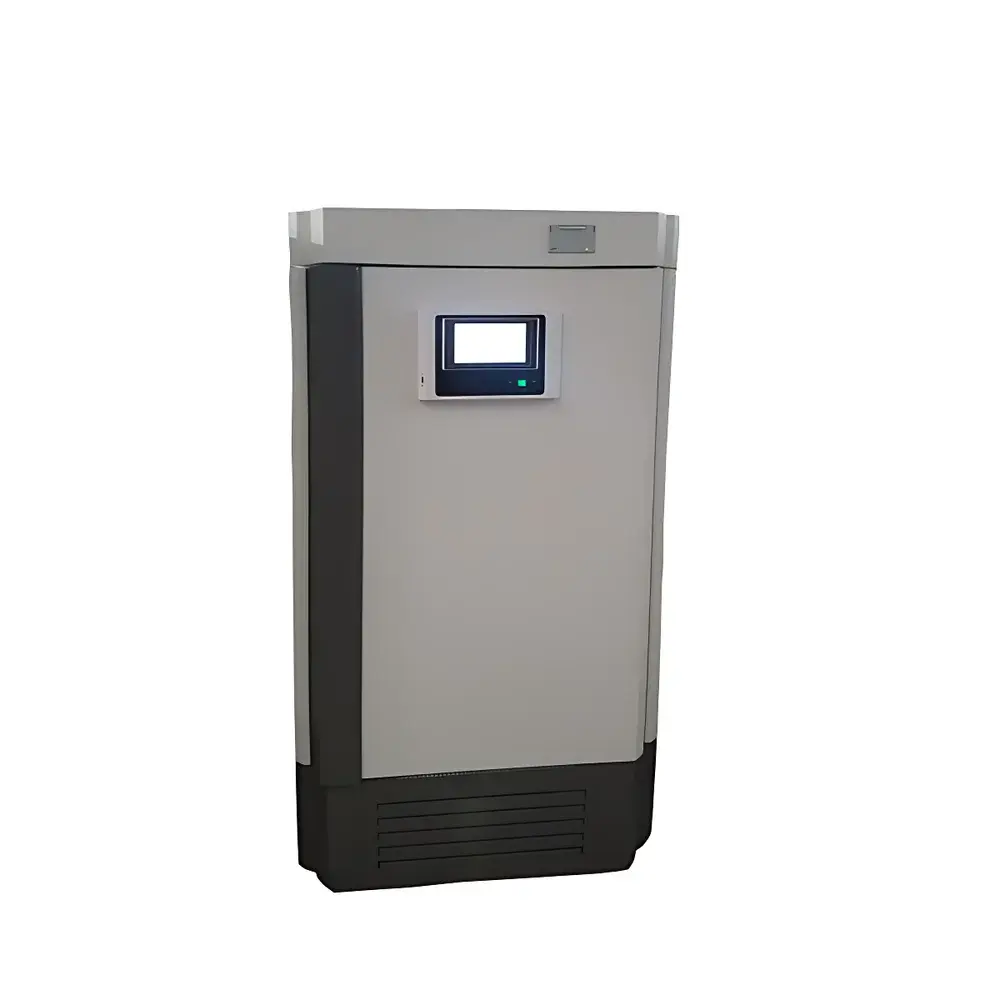
HJ GZP-150ZD Plant Growth Chamber
| Brand | HJ (Hujing Purification) |
|---|---|
| Origin | Shanghai, China |
| Manufacturer Type | Direct Manufacturer |
| Model | GZP-150ZD |
| Temperature Range | 0–50 °C (0–50 °C in dark mode |
| Temperature Uniformity | ±1 °C at 37 °C |
| Temperature Fluctuation | ±0.5 °C |
| Temperature Resolution | 0.1 °C |
| Illuminance Range | 0–12,000 lx (LED source) |
| Internal Volume | 150 L |
| Inner Dimensions (D×W×H) | 400×500×750 mm |
| Outer Dimensions (D×W×H) | 640×640×1360 mm |
| Shelf Capacity | 2 shelves (4 adjustable positions), 15 kg per shelf |
| Heating Power | 0.6 kW |
| Refrigerant | R134a |
| Control System | PID-based microprocessor controller with LCD display, touch-key input (optional touchscreen), programmable cycles, power failure memory, temperature offset correction, and menu lock |
| Safety Features | Compressor overheat protection, independent overtemperature alarm, sensor fault detection, magnetic door seal, double-door structure with tempered glass |
| Insulation | Flame-retardant rigid polyurethane foam + thermal barrier board |
| Construction | Interior – mirror-finish stainless steel (SUS304) |
| Air Circulation | Forced convection via low-noise centrifugal fan |
| Defrost Mode | Automatic cycle defrost |
| Humidity Control | Not equipped |
| Power Supply | 220 V, 50 Hz |
Overview
The HJ GZP-150ZD Plant Growth Chamber is a precision-engineered environmental control system designed for reproducible, long-term cultivation of photobiological specimens under tightly regulated temperature and light conditions. It operates on the principle of active thermal management—combining Peltier-free refrigeration (via a hermetically sealed R134a compressor) with resistive heating and forced-air convection—to maintain stable setpoints across its full operational range of 0–50 °C. Unlike generic incubators, this chamber integrates high-efficiency, spectrally balanced LED arrays capable of delivering uniform irradiance up to 12,000 lx across both vertical illumination planes, enabling simulation of diurnal photoperiods essential for plant morphogenesis, algal growth kinetics, insect developmental staging, and phototrophic microbial assays. Its dual-door architecture—with an outer insulated panel and inner tempered glass viewport—minimizes thermal leakage while preserving optical access, and the mirror-polished stainless-steel interior ensures contamination resistance and ease of decontamination—critical for GLP-compliant botanical or entomological research workflows.
Key Features
- Microprocessor-based PID temperature control with 0.1 °C resolution and real-time deviation compensation, ensuring ±0.5 °C stability and ±1 °C uniformity at reference point (37 °C)
- Dual-sided, dimmable LED lighting system with adjustable intensity (0–12,000 lx), spectral output optimized for photosynthetically active radiation (PAR) without UV emission or thermal load
- Forced-air circulation via low-turbulence centrifugal fan, engineered to eliminate hot/cold spots and support homogeneous gas exchange within the 150 L working volume
- Double-door design: outer insulated door with flame-retardant polyurethane core; inner door with full-height tempered glass and magnetic EPDM gasket for >95% sealing efficiency
- Robust mechanical architecture—mirror-finish SUS304 stainless steel interior, cold-rolled steel exterior with epoxy-polyester hybrid coating, and reinforced shelf supports rated for 15 kg per level
- Comprehensive safety suite: independent overtemperature cutoff (hardware-latched), compressor thermal overload protection, sensor fault diagnostics, and automatic power-resume with program memory after outage
Sample Compatibility & Compliance
The GZP-150ZD accommodates diverse biological samples requiring photoperiodic regulation—including Arabidopsis thaliana seedlings, rice callus cultures, Drosophila melanogaster vials, fungal agar plates, and small-mammal behavioral observation enclosures (up to juvenile rodent scale). Its absence of integrated humidity control aligns with ISO 21748:2017 guidance for non-hygrometric environmental chambers used in standardized plant phenotyping protocols. The chamber meets IEC 61000-6-3 (EMC emissions) and IEC 61000-6-2 (immunity) requirements, and its electrical insulation complies with IEC 61010-1 for laboratory equipment. While not certified to UL/CSA standards out-of-box, it is routinely validated by end users against internal SOPs referencing ASTM E1847 (Standard Practice for Environmental Chambers Used in Biological Testing) and OECD 208 (Terrestrial Plant Test).
Software & Data Management
The embedded controller supports up to 30 programmable segments per cycle, including ramp-soak profiles, timed illumination onset/offset, and multi-stage temperature transitions—exportable via USB to CSV for traceability. Though no proprietary PC software is bundled, the device logs timestamped temperature and light status data internally (10,000-point capacity) with audit-trail capability compliant with FDA 21 CFR Part 11 when paired with validated third-party LIMS integration. Optional RS485 Modbus RTU interface enables remote monitoring and synchronization with building management systems (BMS) or centralized lab infrastructure. All parameter adjustments—including calibration offsets, menu lock activation, and password-protected configuration changes—are logged with user ID and timestamp.
Applications
- Controlled-environment plant phenotyping: germination rate analysis, photomorphogenic response quantification (e.g., hypocotyl elongation under blue/red ratios), and stress acclimation studies (cold/drought/light intensity gradients)
- Entomological development assays: synchronized pupation timing in Diptera, circadian rhythm entrainment in Tribolium castaneum, and oviposition behavior under variable photoperiods
- Phototrophic microbiology: growth kinetics of Synechocystis sp. PCC 6803 under defined light fluence rates, chlorophyll fluorescence baseline establishment, and antibiotic susceptibility testing under illumination
- Tissue culture support: maintenance of light-sensitive explants (e.g., orchid protocorms), pre-acclimatization of in vitro-grown seedlings, and secondary metabolite induction in medicinal plant cell suspensions
- Educational use: undergraduate botany labs requiring reproducible growth chambers for comparative physiology experiments aligned with AP Biology or IB Environmental Systems curricula
FAQ
Does the GZP-150ZD include humidity control?
No. This model is configured exclusively for temperature and light regulation. Humidity modulation requires external humidification/dehumidification modules or alternative chamber variants.
Can the LED light spectrum be customized?
The standard configuration delivers broad-spectrum white light optimized for PAR. Custom narrow-band (e.g., 450 nm/660 nm) LED arrays are available as factory-installed options upon request.
Is validation documentation provided?
Factory-assembled IQ/OQ documentation templates (per ISO/IEC 17025 Annex A.3) are supplied. Full PQ execution requires user-defined acceptance criteria and in-house sensor calibration.
What is the maximum ambient temperature for stable operation?
Rated performance assumes ambient conditions ≤25 °C and relative humidity <80% RH. At 30 °C ambient, cooling capacity decreases by ~18%; derating curves are available in the technical appendix.
Are replacement shelves and LED modules field-serviceable?
Yes. All structural components—including shelves, LED driver assemblies, and PT100 sensors—are modular and replaceable using standard M4 tooling without disassembling the chamber envelope.




