
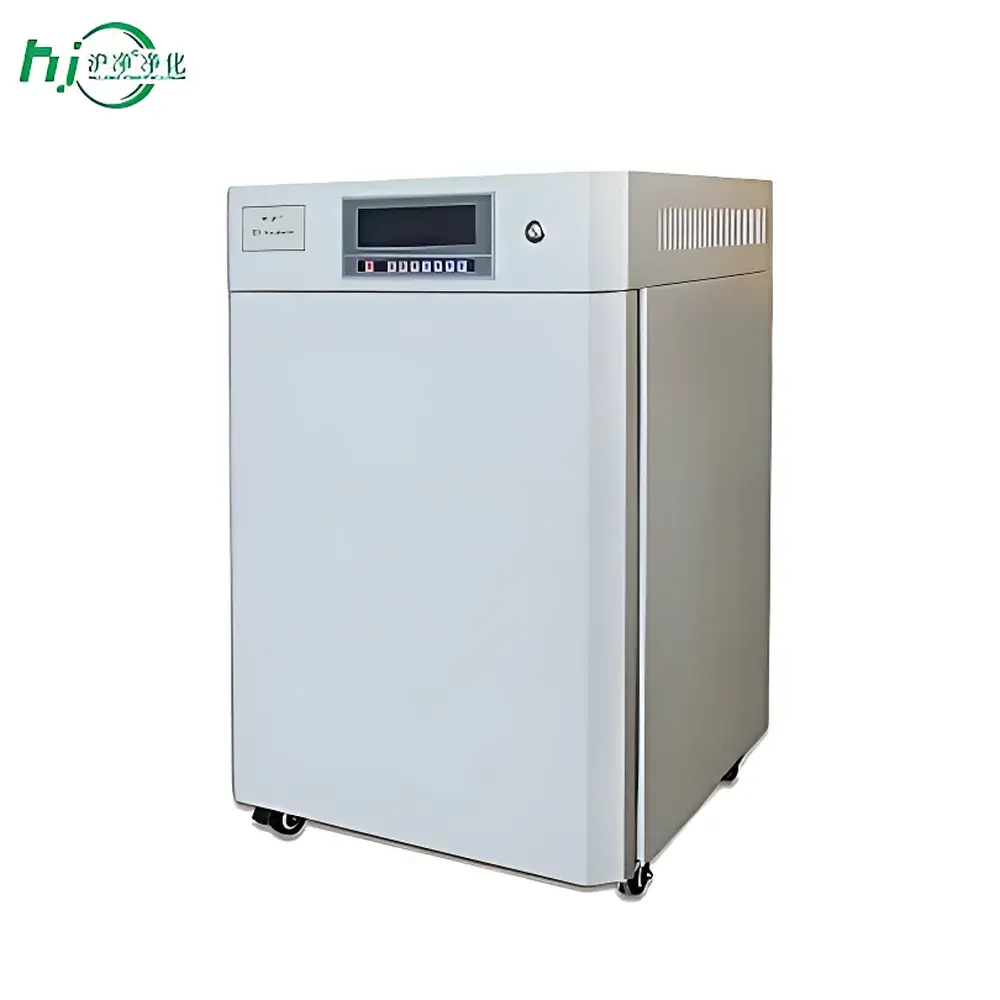
HJ HH.CP Series Carbon Dioxide Incubator
| Brand | HJ (Hujing Purification) |
|---|---|
| Origin | Shanghai, China |
| Manufacturer Type | Direct Manufacturer |
| Model | HH.CP Series |
| Temperature Control Range | RT+5°C to 50°C |
| Temperature Uniformity | ±0.2°C |
| Temperature Resolution | 0.1°C |
| CO₂ Control Range | 0–20% |
| CO₂ Sensing Technology | Imported Infrared (IR) Sensor |
| CO₂ Control Method | Gas Mixing (Proportional Blending) |
| Humidification Method | Natural Evaporation |
| Heating System | Air-Jacketed or Water-Jacketed Options |
| UV Sterilization | Integrated Rear-Mounted UV Lamp |
| Door Heating | Yes, for Anti-Condensation |
| Recovery Time (CO₂) | <5 min to 5% setpoint after 30-sec door opening |
| Recovery Time (Temp) | <10 min to 37°C after 30-sec door opening |
| Chamber Volume | 80 L or 160 L |
| Interior Dimensions (W×D×H) | 400×400×500 mm or 500×500×650 mm |
| Exterior Dimensions (W×D×H) | 530×505×785 mm to 650×640×950 mm |
| Shelf Capacity | 2 or 3 Adjustable Stainless Steel Shelves |
| Interior Material | Electropolished Stainless Steel (304), Rounded Corners |
| Interface | Menu-Driven LCD Display, Multi-Parameter On-Screen View |
| Connectivity (Optional) | RS485 or USB Port for Data Logging |
| Compliance Support | Designed for GLP-compliant cell culture workflows |
Overview
The HJ HH.CP Series Carbon Dioxide Incubator is an engineered platform for reliable, contamination-controlled mammalian cell culture under physiologically relevant conditions. It maintains precise regulation of three critical environmental parameters—temperature, CO₂ concentration, and relative humidity—using a combination of air-jacketed or water-jacketed thermal architecture, dual-mode gas blending, and passive humidification. The system employs an imported non-dispersive infrared (NDIR) CO₂ sensor, which delivers stable, temperature- and humidity-independent measurement across the full 0–20% range—essential for applications requiring frequent access or multi-user operation. Its electropolished stainless-steel chamber features seamless, quarter-radius corner transitions and removable shelves, minimizing microbial retention points and supporting routine cleaning validation per ISO 14644-1 Class 5 cleanroom maintenance protocols.
Key Features
- Intelligent microprocessor controller with backlit LCD interface displaying real-time temperature, CO₂ level, humidity status, and system alarms on a single screen
- Dual heating configurations: air-jacketed (HH.CP-T/HH.CP-TW) for rapid thermal recovery; water-jacketed (HH.CP-01/HH.CP-01W) for enhanced stability during extended incubation cycles
- Integrated UV germicidal lamp mounted on rear chamber wall—programmable cycle timing supports periodic decontamination of circulating air and evaporative water reservoir vapor phase
- Electrically heated inner glass door prevents condensation formation, eliminating moisture-mediated microbial ingress pathways at the chamber interface
- Optimized CO₂ recovery kinetics: achieves ≤5% setpoint deviation within 5 minutes post 30-second door opening, validated under ASTM E1310-22 simulated access conditions
- Stainless steel interior (AISI 304), corrosion-resistant hardware, and tool-free shelf mounting system compliant with ISO 15223-1 labeling standards
Sample Compatibility & Compliance
The HH.CP Series accommodates standard T-flasks (up to T225), multi-well plates (6–96-well), Petri dishes, roller bottles, and custom bioreactor inserts up to 160 L chamber volume. Its design aligns with foundational requirements for Good Laboratory Practice (GLP) and preclinical cell culture workflows, including traceable temperature/CO₂ logging (when equipped with optional RS485/USB module), alarm event timestamping, and configurable high-limit thermal cutoff (optional independent over-temperature protection). While not certified to IEC 61010-1 as a standalone medical device, its construction meets mechanical safety thresholds applicable to Class II laboratory equipment operating in ISO 14644-1 classified environments.
Software & Data Management
The incubator supports external data capture via industry-standard serial communication protocols. When configured with the optional RS485 or USB interface, it outputs time-stamped parameter streams (temperature, CO₂, door-open events) compatible with LabVIEW, MATLAB, or custom SCADA architectures. Logged data retains audit trail integrity—including operator ID (if integrated with networked authentication), parameter change history, and alarm acknowledgment timestamps—supporting 21 CFR Part 11 readiness when deployed with validated third-party software platforms. Firmware updates are performed locally via USB drive without network dependency, preserving air-gapped operational security.
Applications
This incubator serves primary and secondary cell culture applications including stem cell expansion, hybridoma maintenance, transfection assays, organoid development, and co-culture modeling where physiological CO₂ tension (typically 5%) and pH buffering (via NaHCO₃-based media) are mandatory. Its rapid recovery profile makes it suitable for shared core facilities with high user turnover. The water-jacketed variants provide long-term thermal inertia ideal for overnight or weekend unattended runs, while air-jacketed models support dynamic protocol switching in high-throughput screening labs. UV sterilization capability enables quarterly chamber bio-decontamination without chemical agents—reducing downtime versus formaldehyde fumigation methods.
FAQ
What CO₂ sensing technology does the HH.CP Series use, and why is it preferred over thermal conductivity sensors?
It uses an imported NDIR infrared sensor, which provides linear, drift-resistant output unaffected by ambient humidity or temperature fluctuations—critical for maintaining consistent bicarbonate buffer equilibrium in culture media.
Can the incubator maintain humidity without active humidification systems?
Yes—via natural evaporation from a dedicated stainless steel water pan; RH typically stabilizes between 90–95% at 37°C, meeting USP guidance for non-invasive humidification in closed-loop cell culture.
Is the UV sterilization cycle programmable or manual?
UV activation is manually initiated via front-panel command; duration is fixed at 30 minutes per cycle, with interlock preventing simultaneous UV operation and door opening.
Does the system support remote monitoring or integration into building management systems (BMS)?
Native BMS integration is not supported; however, analog voltage outputs (0–5 V DC) for temperature and CO₂ can be added via OEM customization for facility-level alarm relay linkage.
Are calibration certificates available for the CO₂ sensor and temperature probes?
Factory calibration reports are provided with each unit; NIST-traceable field recalibration services are available through authorized HJ service partners upon request.




