
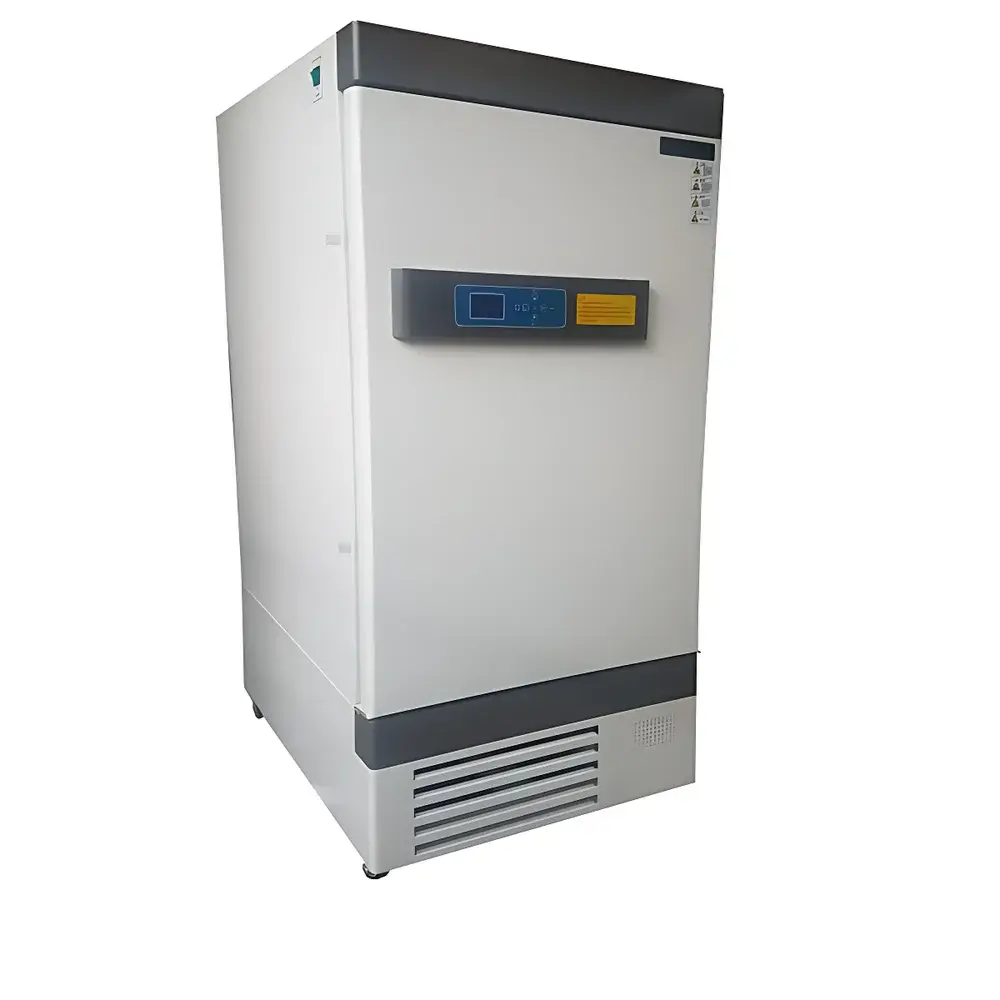
HJ HSP-100ZD Fully Automated Temperature and Humidity Controlled Environmental Chamber
| Brand | HJ |
|---|---|
| Origin | Shanghai, China |
| Manufacturer Type | Direct Manufacturer |
| Product Category | Domestic |
| Model | HSP-100ZD |
| Instrument Type | Upright |
| Temperature Range | 0–50 °C |
| Temperature Resolution | 0.1 °C |
| Temperature Uniformity | ±1 °C (at 37 °C) |
| Temperature Fluctuation | ±0.5 °C |
| Humidity Range | 50–95 %RH (operational only at 10–30 °C |
| Humidity Fluctuation | ±5 %RH |
| Internal Volume | 100 L |
| Interior Dimensions (D×W×H) | 350×450×650 mm |
| Heating Power | 0.5 kW |
| Refrigerant | R134a |
| Control Method | PID-based dual-mode (heating/cooling balance) |
| Display | LCD |
| Input Power | 220 V, 50 Hz |
| Safety Features | Over-temperature alarm, compressor overheat protection, controller fault detection, magnetic door seal, automatic defrost |
Overview
The HJ HSP-100ZD is a fully automated upright environmental chamber engineered for precise, long-term maintenance of temperature and relative humidity conditions in life science and pharmaceutical applications. It operates on a forced-air convection principle with independent heating and refrigeration circuits—balanced via PID control—to achieve stable thermal-hygrometric environments essential for microbial culture, cell line propagation, seed germination, insect rearing, and small-animal holding protocols. The chamber’s working range spans 0–50 °C with humidity control from 50–95 %RH (within the 10–30 °C operational envelope), making it suitable for ISO 14644-compliant cleanroom-adjacent labs and GLP-regulated stability studies where reproducible ambient simulation is critical.
Key Features
- Stainless steel interior chamber (mirror-finished 304 grade) ensures corrosion resistance, ease of decontamination, and compliance with USP cleaning validation requirements.
- Dual-door design: outer door with magnetic EPDM gasket and inner full-view tempered glass door minimizes thermal leakage and enables non-intrusive observation without disturbing internal conditions.
- Hermetically sealed R134a refrigeration system paired with stainless steel tubular heaters delivers rapid thermal response and low-noise operation—optimized for continuous 24/7 duty cycles.
- Intelligent PID controller with LCD interface supports programmable ramp-soak profiles, time-based scheduling, power-loss recovery, and parameter locking to prevent unauthorized modification.
- Comprehensive safety architecture includes over-temperature cutoff, compressor thermal overload protection, controller self-diagnostic alerts, and audible/visual alarm outputs compatible with building management systems (BMS).
- Insulation composed of flame-retardant polyurethane foam (≥50 mm thickness) combined with aluminum-clad barrier layers achieves ≤0.8 W/m²·K thermal transmittance, reducing energy consumption and ambient heat load.
Sample Compatibility & Compliance
The HSP-100ZD accommodates standard laboratory vessels—including Petri dishes, multi-well plates, flasks, and animal caging—on two adjustable stainless steel shelves (15 kg load capacity each). Its 100 L internal volume and optimized airflow pattern ensure uniform distribution per ASTM E2875-22 (Standard Guide for Performance Verification of Environmental Chambers). The unit meets IEC 61000-6-3 (EMC emissions) and IEC 61000-6-2 (immunity) standards. While not certified to UL 61010-1 or EN 61010-1 out-of-box, its electrical design adheres to core safety principles required for Class II laboratory equipment under FDA 21 CFR Part 11–aligned environments when integrated with validated SOPs.
Software & Data Management
Equipped with embedded data logging (internal memory retains ≥30 days of 1-minute interval records), the HSP-100ZD supports optional RS485/Modbus RTU communication for integration into centralized monitoring platforms (e.g., DeltaV, LabVantage, or custom SCADA). Optional USB export enables CSV-formatted temperature/humidity traceability compliant with ALCOA+ data integrity principles. Audit trail functionality—including user ID, timestamp, parameter change history, and alarm event logs—is available via firmware upgrade, satisfying basic GMP Annex 11 and WHO TRS 961 documentation expectations for environmental monitoring systems.
Applications
- Microbiological incubation per CLSI M22-A3 guidelines for aerobic/anaerobic pathogen growth.
- Pharmaceutical stability testing (ICH Q1A–Q1E) under intermediate storage conditions (e.g., 30 °C/65 %RH).
- Tissue engineering scaffold conditioning prior to mechanical testing.
- Seed viability assessment under controlled hygrothermal stress (ISTA Protocol 5.4).
- Entomological research requiring diurnal humidity cycling (programmable via timer function).
- Pre-conditioning of polymer-based medical devices prior to tensile or permeability assays (ISO 10993-12).
FAQ
What is the minimum ambient temperature required for reliable operation at 10 °C setpoint?
The unit requires ambient conditions below 26 °C when operating at setpoints ≤10 °C to maintain condensation-free cooling performance and avoid compressor overload.
Can the chamber be validated for IQ/OQ/PQ protocols?
Yes—its documented temperature/humidity uniformity (±1 °C / ±5 %RH), repeatability, and sensor traceability (PT100 class B) support third-party qualification using standard thermocouple mapping and hygrometer probe arrays.
Is remote monitoring supported natively?
Native Ethernet or Wi-Fi is not included; however, RS485 Modbus integration enables connection to industrial gateways for cloud-based dashboards or local networked supervision.
Does the unit comply with energy efficiency regulations such as EU ErP Directive?
While not CE-marked for ErP compliance, its R134a refrigerant, high-efficiency compressor, and optimized insulation align with Tier 2 energy performance benchmarks for Class 3 environmental chambers per EN 13791.
How often does the auto-defrost cycle activate?
Defrost occurs automatically based on evaporator coil temperature and runtime—typically every 6–12 hours during continuous low-temperature operation—and pauses all active control loops until completion.



