
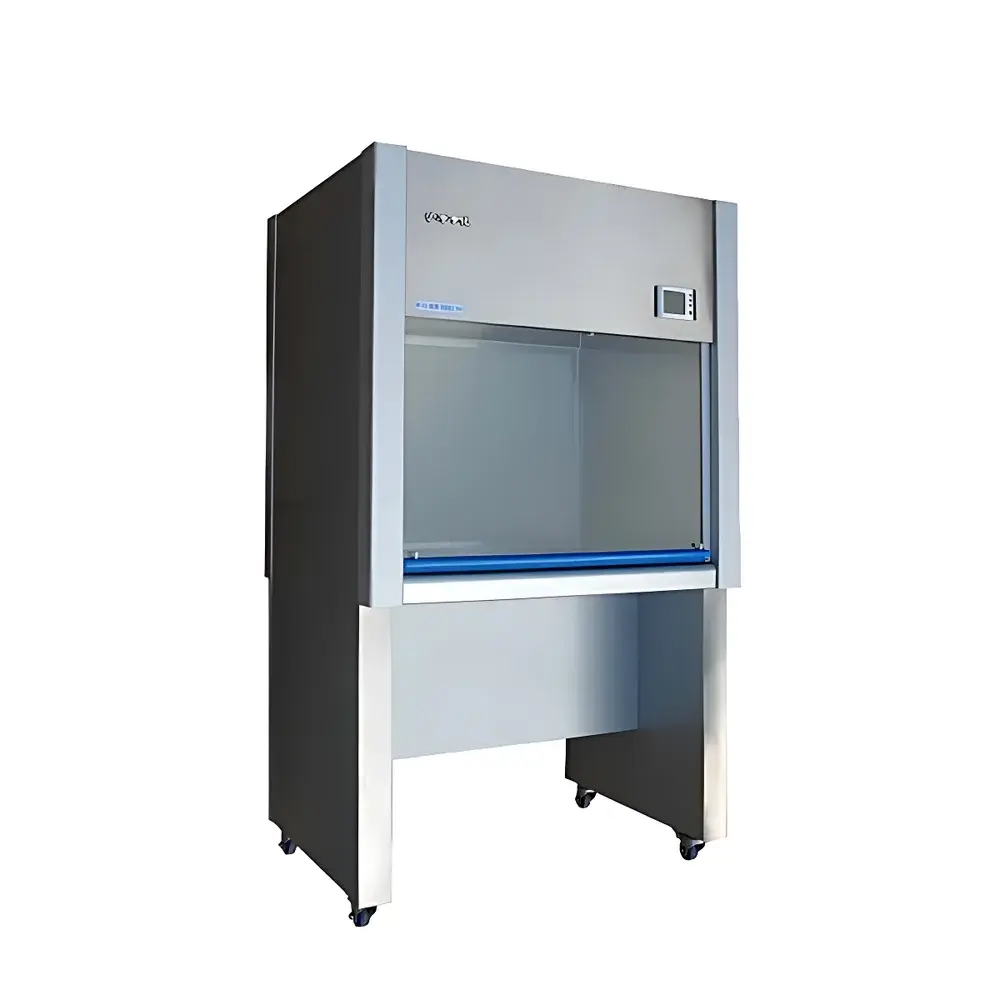
HJ SW-CJ-1B Horizontal Laminar Flow Clean Bench
| Brand | HJ |
|---|---|
| Origin | Shanghai, China |
| Manufacturer Type | Direct Manufacturer |
| Product Category | Domestic |
| Model | SW-CJ-1B |
| Instrument Type | Horizontal Laminar Flow Clean Bench |
| Cleanliness Class | ISO Class 5 (100 @ ≥0.5 µm, Fed. Std. 209E) |
| Noise Level | ≤62 dB(A) |
| User Capacity | Single Operator, Single-Face Configuration |
| Airflow Pattern | Horizontal Laminar Flow |
| Average Air Velocity | 0.25–0.45 m/s (Dual-Speed Control) |
| Microbial Count | ≤0.5 CFU/plate·hour (Φ90 mm Petri dish) |
| Vibration Peak-to-Peak | ≤10 µm (X/Y/Z axes) |
| Illuminance | ≥300 lx |
| Power Supply | AC 220 V, 50 Hz |
| Rated Power | 400 W |
| Net Weight | 100 kg |
| Work Area Dimensions (W×D×H) | 870 × 540 × 515 mm |
| Overall Dimensions (W×D×H) | 1030 × 715 × 1600 mm |
| HEPA Filter Specification | 865 × 600 × 38 mm (Aluminum-framed, Unibody, Zero-Separator Design), Qty: 1 |
| Fluorescent Lamp | 20 W × 1 |
| UV Lamp | 20 W × 1 |
Overview
The HJ SW-CJ-1B Horizontal Laminar Flow Clean Bench is an ISO Class 5-certified (Fed. Std. 209E Class 100) personnel-protective and product-protective workstation engineered for low-risk, non-hazardous microbiological and aseptic procedures. It operates on the principle of horizontal laminar airflow: air is drawn through a prefilter, conditioned by a variable-speed centrifugal fan, and then passed through a single high-efficiency particulate air (HEPA) filter (≥99.99% @ 0.3 µm). The filtered air exits uniformly across the work surface in a unidirectional, parallel stream—minimizing turbulence and cross-contamination. Unlike vertical flow cabinets, the horizontal configuration directs airflow away from the operator’s face, eliminating UV exposure risk during operation and enabling safer handling of non-toxic, non-volatile samples. Designed for consistent performance under ambient laboratory conditions, it complies with core cleanroom engineering principles defined in ISO 14644-1 and supports GLP-aligned documentation practices when integrated into validated workflows.
Key Features
- Horizontal laminar airflow architecture with adjustable dual-speed fan control (0.25–0.45 m/s), managed via intuitive LCD interface for real-time velocity optimization.
- Ultra-slim aluminum-frame, zero-separator HEPA filter (865 × 600 × 38 mm) mounted in a compact static-pressure chamber—reducing cabinet depth while maximizing usable work area (870 × 540 × 515 mm).
- Quasi-enclosed tempered glass sash with balanced counterweight mechanism—enabling smooth vertical adjustment and stable positioning without mechanical drift.
- Integrated dual-lighting system: 20 W fluorescent lamp (≥300 lx at work surface) for routine visual inspection and a separate 20 W UV-C germicidal lamp (254 nm) with safety interlock to prevent accidental activation during operation.
- Low-noise design (<62 dB[A] at 1 m) achieved via acoustically damped fan housing and vibration-isolated motor mount (vibration ≤10 µm peak-to-peak across X/Y/Z axes).
- Robust steel frame with powder-coated finish, reinforced base structure, and full EMI-shielded electrical compartment compliant with IEC 61000-6-3 emission standards.
Sample Compatibility & Compliance
The SW-CJ-1B is validated for use with cell culture media preparation, plate pouring, sterile filtration, instrument assembly, and non-pathogenic microbial handling. It is not rated for biohazardous, volatile, or toxic agents—nor intended as personnel protection against aerosols or splashes. Its ISO Class 5 performance has been verified per ISO 14644-3 testing protocols using discrete particle counters (e.g., TSI 3330) and microbial settle-plate assays (ISO 14698-1). All electrical components meet CE marking requirements (EN 61010-1), and UV lamp output conforms to IEC 62471 photobiological safety classification (Risk Group 2). While not intrinsically FDA 21 CFR Part 11-compliant, its operational logs (fan speed, runtime, UV cycle count) can be manually recorded to support audit trails required under GLP and ISO/IEC 17025-accredited environments.
Software & Data Management
This unit operates as a standalone hardware platform with no embedded firmware-based data logging or network connectivity. All operational parameters—including fan speed selection, UV activation duration, and cumulative runtime—are controlled via physical LCD interface with tactile feedback. For quality assurance traceability, users are advised to maintain external logbooks or integrate usage records into LIMS platforms using standardized templates (e.g., ISO/IEC 17025 Annex A.3). Optional analog signal outputs (0–10 V DC) for airflow velocity monitoring may be added via third-party retrofit modules compatible with common building management systems (BMS).
Applications
- Aseptic transfer of bacterial and fungal cultures in teaching and research laboratories.
- Preparation of agar plates, broth media, and reagent aliquots under particle-controlled conditions.
- Assembly and packaging of sterile medical devices prior to terminal sterilization.
- Electronics component handling where electrostatic discharge (ESD)-safe variants are specified (requires optional grounded stainless-steel work surface).
- Pharmaceutical QC sample weighing and dilution steps where ISO Class 5 background environment is mandated per USP Annex B (non-hazardous compounding).
FAQ
What ISO cleanliness class does the SW-CJ-1B achieve?
It meets ISO Class 5 (equivalent to Fed. Std. 209E Class 100) for particles ≥0.5 µm, verified per ISO 14644-3.
Can this unit be used for handling pathogenic organisms?
No. It provides product protection only—not personnel or environmental protection—and must not be used with Risk Group 2+ agents.
Is the UV lamp interlocked to prevent exposure during operation?
Yes. Mechanical and electrical interlocks disable UV emission whenever the front sash is opened beyond 50 mm.
What maintenance intervals are recommended for the HEPA filter?
Filter replacement is advised every 12–18 months under continuous use, or sooner if differential pressure exceeds 250 Pa—verified using a calibrated manometer.
Does the unit include validation documentation?
Factory-issued Certificate of Conformance and filter integrity test report (DOP/PAO scan) are provided; IQ/OQ protocols require user-executed qualification per ISO 14644-2.



