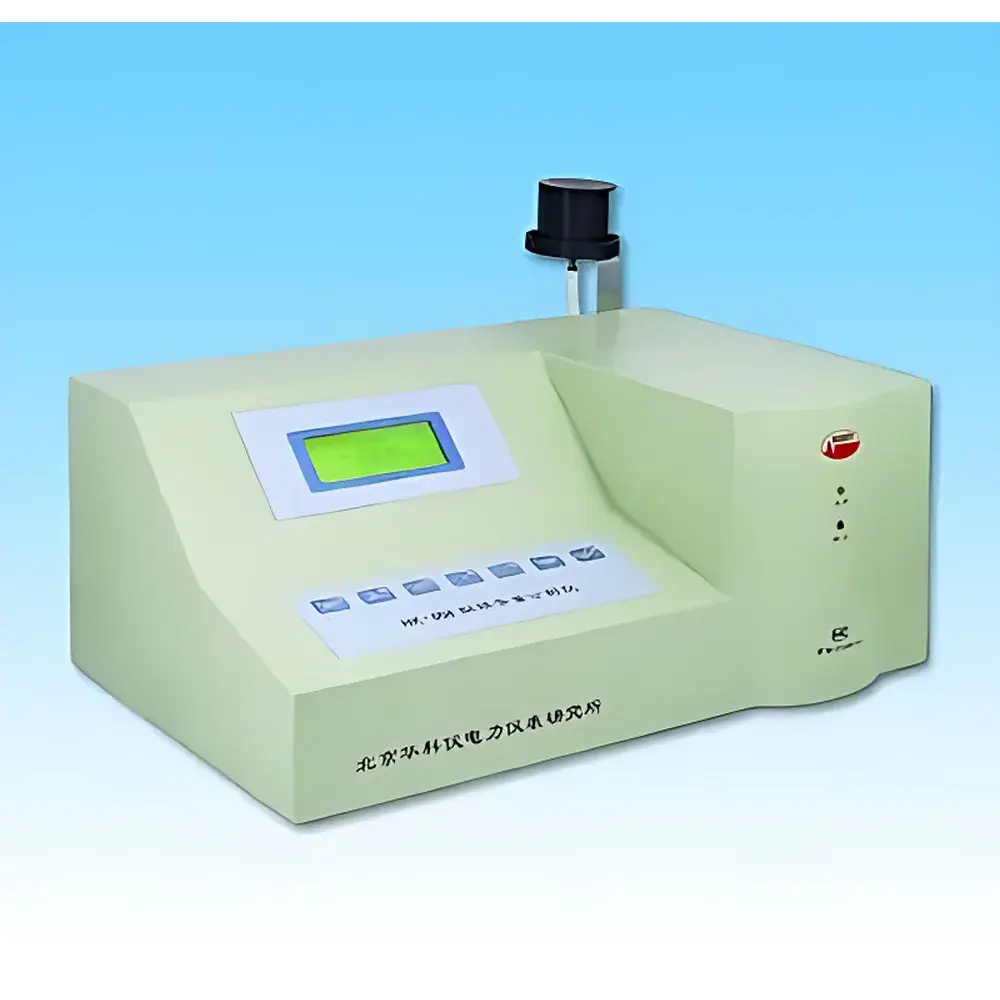
HK-228 Hydrazine Analyzer
| Origin | Beijing |
|---|---|
| Manufacturer Type | Distributor |
| Origin Category | Domestic (China) |
| Model | HK-228 |
| Price | Upon Request |
| Display | Chinese-language dot-matrix LCD |
| Measurement Range | 0–100 µg/L |
| Accuracy | ±2% F.S. |
| Resolution | 0.1 µg/L |
| Repeatability | ≤1% |
| Stability | ±1% F.S. / 4 h |
| Operating Temperature | 5–45 °C |
| Relative Humidity | ≤90% RH (non-condensing) |
| Dimensions (L×W×H) | 420 × 190 × 280 mm |
| Power Supply | AC 220 ± 22 V, 50 ± 1 Hz |
| Power Consumption | 30 W |
| Weight | 5 kg |
Overview
The HK-228 Hydrazine Analyzer is a dedicated photometric measurement instrument engineered for trace-level quantification of hydrazine (N2H4) in ultrapure water systems—primarily deployed in thermal power plant boiler feedwater, nuclear reactor coolant circuits, and high-purity steam generation loops. It operates on the principle of selective colorimetric reaction: hydrazine reacts with p-dimethylaminobenzaldehyde (DMAB) under acidic conditions to form a yellow azine derivative, the absorbance of which is measured at 455 nm using a stable solid-state light source and precision photodetector. This method conforms to established industrial protocols including ASTM D1317 and ISO 10523 for hydrazine determination in low-conductivity aqueous matrices. The analyzer delivers continuous, real-time monitoring capability with minimal operator intervention, supporting critical corrosion control strategies by maintaining hydrazine residuals within the 10–50 µg/L range recommended for oxygen scavenging without excess amine-induced stress corrosion cracking.
Key Features
- High-stability monochromatic LED light source (U.S.-sourced), delivering narrow spectral bandwidth (50,000 h)
- Photodiode detector with U.S.-manufactured silicon photovoltaic cell, optimized for signal-to-noise ratio and long-term gain stability
- 64×128 dot-matrix LCD with native Chinese character support—enabling intuitive navigation, parameter configuration, and real-time trend visualization
- Zero-reagent calibration protocol: baseline offset correction performed using certified blank deionized water (resistivity ≥18.2 MΩ·cm), eliminating reagent lot variability and reducing consumable dependency
- Multi-point calibration curve option (up to 6 points), supporting non-linear response compensation across the full 0–100 µg/L dynamic range
- Role-based access control with configurable password protection (administrator/operator levels), ensuring data integrity and compliance with internal QA/QC procedures
- Integrated data logger with 6 independent memory channels—storing timestamped concentration values, calibration events, and system diagnostics for retrospective analysis
Sample Compatibility & Compliance
The HK-228 is validated for use with low-conductivity water samples (conductivity <0.2 µS/cm) containing no interfering species above threshold concentrations: chloride <100 µg/L, iron <50 µg/L, and dissolved oxygen <10 µg/L. Sample introduction is via gravity-fed or low-pressure peristaltic flow (0.5–2 mL/min); no sample filtration or pretreatment is required for particulate-free feedwater. The instrument meets electromagnetic compatibility requirements per IEC 61326-1 (industrial environment), and its enclosure complies with IP20 ingress protection. While not certified to FDA 21 CFR Part 11, its audit trail functionality—including user ID logging, calibration history timestamps, and immutable data storage—supports alignment with GLP and GMP documentation expectations for regulated utility and pharmaceutical water systems.
Software & Data Management
Data output is provided through an RS-232 serial interface (ASCII protocol) compatible with SCADA, DCS, and LIMS platforms. Optional USB-to-serial adapters enable direct connection to Windows-based PCs for local data export in CSV format. The onboard firmware implements automatic zero-drift compensation every 2 hours and triggers alert flags upon deviation exceeding ±1.5% F.S. over consecutive 30-minute intervals. All stored records include UTC timestamps synchronized via internal real-time clock (RTC), and memory retention persists for ≥3 months without power. Firmware updates are performed via secure UART bootloading—no external software installation required.
Applications
- Real-time hydrazine residual monitoring in high-pressure boiler feedwater circuits
- Corrosion inhibitor dosing verification in fossil-fuel and nuclear power generation facilities
- Commissioning and performance validation of hydrazine injection skids and online chemical feed systems
- Periodic verification of laboratory-grade hydrazine standard solutions (e.g., NIST-traceable 10 µg/mL reference material, Lot No. 04.06.07)
- Field-based QA/QC auditing of demineralized water quality prior to turbine entry
FAQ
What is the minimum detectable hydrazine concentration?
The instrument achieves a practical limit of detection (LOD) of 0.3 µg/L based on 3σ of blank measurements (n=10), consistent with its 0.1 µg/L resolution specification.
Does the analyzer require daily maintenance?
No routine optical cleaning or lamp replacement is required; only quarterly verification of flow path integrity and annual calibration against certified reference standards are recommended.
Can it operate continuously for 7×24 monitoring?
Yes—the thermal design and power regulation architecture support uninterrupted operation within the specified ambient temperature and humidity ranges.
Is third-party calibration certification available?
Calibration certificates traceable to CNAS-accredited laboratories (e.g., Beijing Institute of Metrology) can be issued upon request, including uncertainty budgets per ISO/IEC 17025.
How is interference from monomethylhydrazine (MMH) or unsymmetrical dimethylhydrazine (UDMH) handled?
The DMAB-based chemistry exhibits >200:1 selectivity for hydrazine over MMH and UDMH; cross-reactivity is negligible at typical power plant water concentrations.