
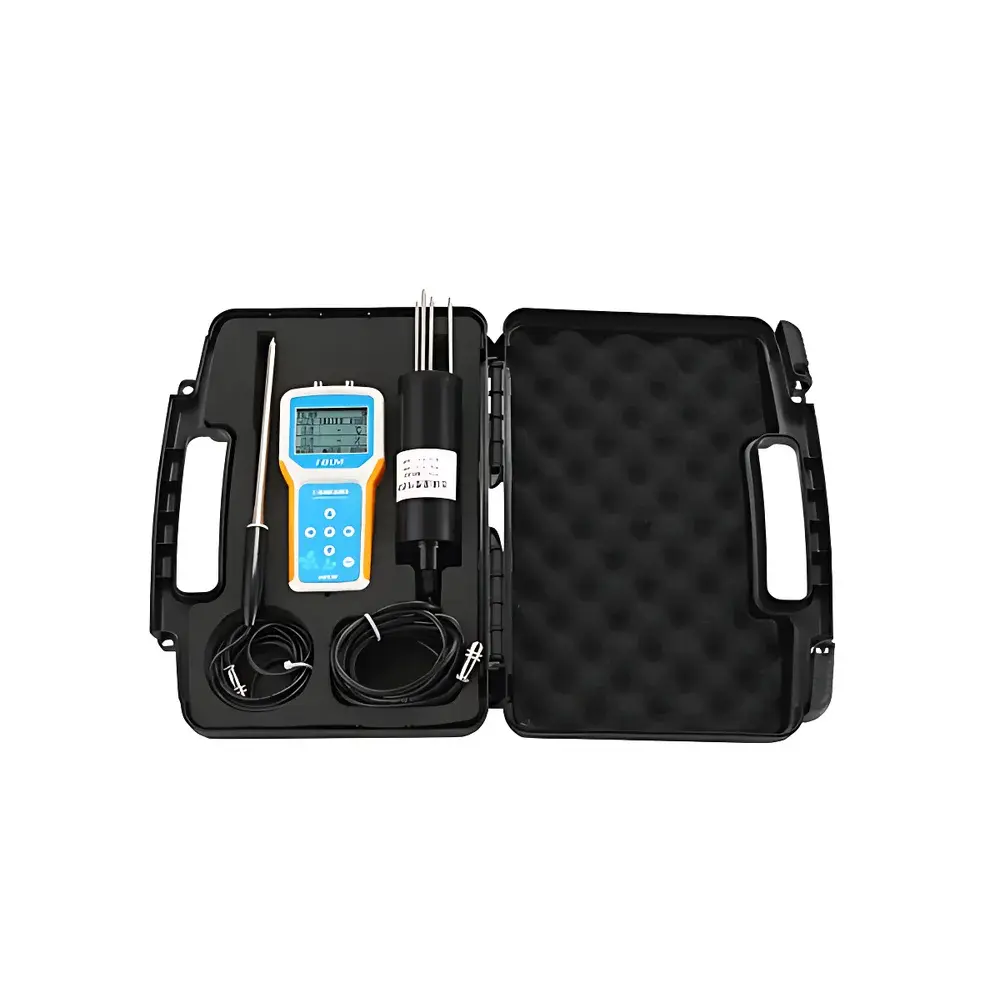
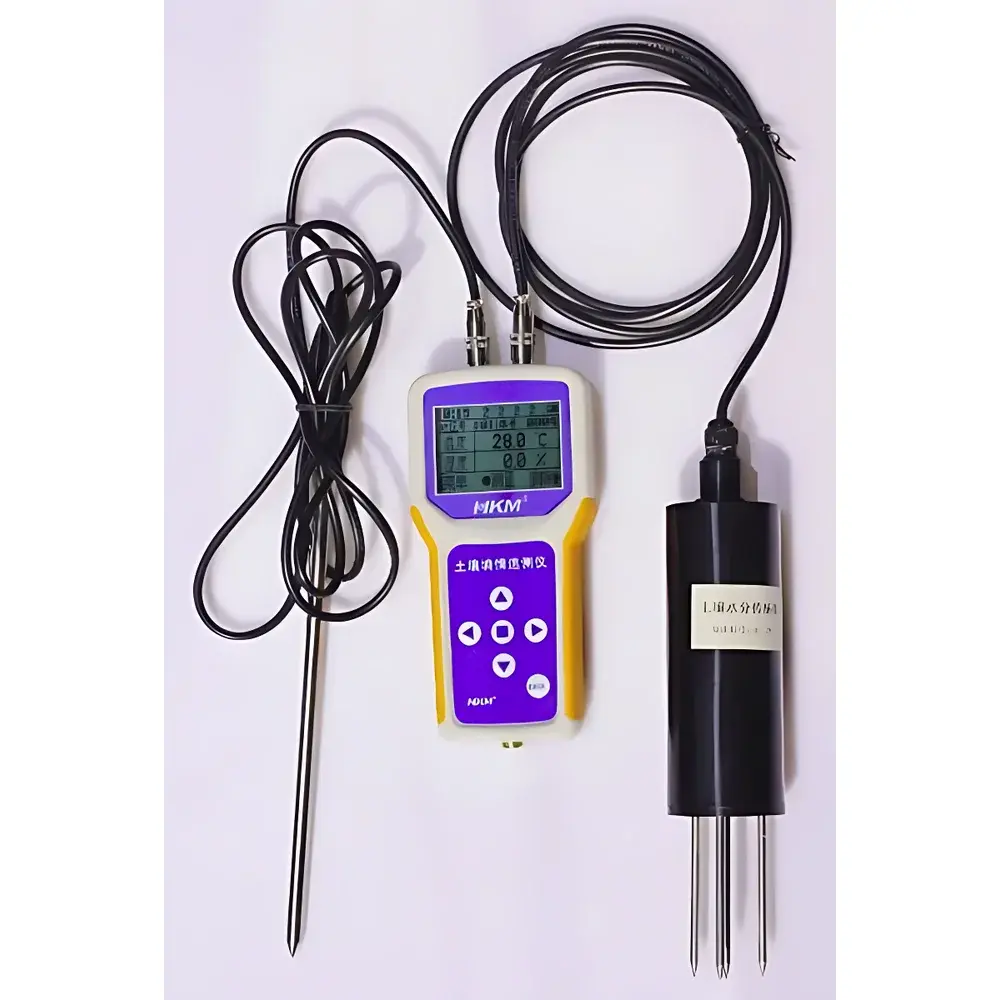
HKM SMT Series Portable Soil Moisture and Temperature Tester
| Brand | HKM |
|---|---|
| Origin | Guangdong, China |
| Manufacturer Type | Authorized Distributor |
| Country of Origin | China |
| Model | SMT Series |
| Instrument Type | Soil Moisture and Temperature Analyzer |
| Measurement Principle | Frequency Domain Reflectometry (FDR) |
| Soil Moisture Range | 0–60% (±2% accuracy, 0.1% resolution) |
| Soil Temperature Range | −10 to +85 °C (±0.3 °C accuracy, 0.1 °C resolution) |
| Sensor Active Zone | Cylindrical volume 4 cm diameter × 7 cm length centered on probe |
| Probe Material | Stainless steel |
| Sensor Housing | ABS |
| Cable Length | 2 m |
| Data Storage Capacity | 16,000 records |
| Sampling Interval | 1 minute to 24 hours (user-configurable) |
| Display | 2.6-inch backlit LED screen |
| Power Supply | Four 10440 Li-ion batteries (3.6 V total), >12 h continuous operation |
| Communication Interface | USB 2.0 (SM-100A model only) |
| Software Features | Data export to Excel, time-series curve visualization, multi-site comparative analysis, configurable upper/lower limits, GLP-compliant audit trail generation, bilingual (EN/CN) UI, lifetime free updates |
Overview
The HKM SMT Series Portable Soil Moisture and Temperature Tester is a field-deployable, dual-parameter environmental monitoring instrument engineered for rapid, non-destructive assessment of volumetric water content (θv) and soil temperature in situ. It employs Frequency Domain Reflectometry (FDR), a robust dielectric sensing technique standardized in ISO 11274 and ASTM D7928, to determine soil moisture by measuring the dielectric permittivity of the surrounding medium—primarily governed by water’s high relative permittivity (~80) compared to dry soil (~3–5) and air (~1). The integrated stainless-steel temperature sensor conforms to IEC 60751 Class B tolerances, ensuring traceable thermal measurement at the critical 1 cm depth from probe tip—a position validated for representative root-zone thermal profiling in agronomic studies. Designed for operational resilience in variable outdoor conditions, the SMT series supports mission-critical applications including irrigation scheduling, drought stress monitoring, soil hydrological modeling, and long-term ecological site characterization.
Key Features
- Field-portable architecture with ergonomic handheld design, weighing under 500 g (excluding sensors), enabling single-operator deployment across heterogeneous terrain.
- Configurable multi-parameter logging: independent setting of sampling intervals (1 min – 24 h), automatic timestamping, and group-based data segmentation (2–99 user-defined batches).
- Energy-efficient embedded system featuring auto-sleep mode (<5 µA standby current) and non-volatile memory retention—data integrity preserved during battery replacement or unexpected power loss.
- High-contrast 2.6-inch backlit LED display with intuitive icon-driven menu navigation; bilingual interface (English/Chinese) supports international field teams and multilingual training environments.
- FDR sensor with 4 cm × 7 cm cylindrical sensitivity zone ensures spatially representative measurement while minimizing edge effects common in point-probe systems; stainless-steel probe body resists corrosion in saline or acidic soils.
- USB 2.0 interface (SM-100A variant) enables direct host communication without external adapters; firmware and software maintain full backward compatibility across SMT firmware revisions.
Sample Compatibility & Compliance
The SMT series is validated for use in mineral soils (sand, loam, clay), organic substrates (peat, compost), and managed horticultural media (coco coir, perlite blends). It is not intended for saturated sediments, frozen soils, or highly conductive industrial waste matrices where bulk electrical conductivity exceeds 5 dS/m—conditions that may induce phase-shift artifacts in FDR signal interpretation. Regulatory alignment includes adherence to ISO/IEC 17025 documentation practices for field instrument calibration records, and software functionality meets foundational requirements for data integrity per FDA 21 CFR Part 11 (electronic signatures, audit trails, version-controlled exports). While not certified for GMP manufacturing environments, its data export structure (CSV/Excel) and timestamped metadata support GLP-aligned environmental monitoring protocols in research and regulatory field studies.
Software & Data Management
The included PC application provides secure, structured data ingestion via unique instrument ID registration—ensuring traceability across multi-unit deployments. Raw datasets are stored with embedded metadata: acquisition timestamp, sensor ID, location tag (user-assigned), and environmental context flags. Analytical capabilities include statistical summary (mean, SD, min/max), temporal interpolation, customizable threshold alerts, and overlay-capable multi-site trend visualization. Export functions generate ISO 8601-compliant CSV files and native Excel (.xlsx) workbooks containing both raw values and derived indices (e.g., soil water deficit, degree-day accumulation). All software updates are distributed digitally with SHA-256 checksum verification; no subscription or license key is required—consistent with open-data principles in public-sector environmental monitoring.
Applications
- Precision Irrigation Management: Real-time θv feedback enables dynamic adjustment of drip emitter timing and flow rates, reducing water use by 15–30% while maintaining yield parity in field trials across maize, wheat, and vegetable cropping systems.
- Ecological Research: Long-term sensor networks utilize SMT units for phenological correlation studies—linking soil thermal inertia shifts to plant dormancy onset, frost risk assessment, and microbial activity windows.
- Soil Health Monitoring: Paired moisture–temperature profiles serve as input parameters for pedotransfer functions estimating hydraulic conductivity and matric potential, supporting digital soil mapping initiatives compliant with GlobalSoilMap.net specifications.
- Educational Fieldwork: Integrated curriculum modules (available in English and Chinese) provide laboratory-grade measurement practice aligned with AP Environmental Science and undergraduate soil physics syllabi.
- Disaster Response: Rapid deployment for post-flood saturation mapping and pre-drought baseline establishment—units operate continuously for >12 h without grid access, supporting remote telemetry integration via optional cellular gateways.
FAQ
What calibration standards are used for factory verification?
Each SMT unit undergoes gravimetric calibration against NIST-traceable reference soils (sand, silt loam, clay) across the full 0–100% range, with certificate of conformance supplied per unit.
Can the FDR sensor be used in rocky or gravelly soils?
Yes—provided the probe makes full contact with fine-earth fraction; we recommend pre-drilling with a 1.5 cm auger and tamping to ensure minimal air gaps around the 4 cm diameter active zone.
Is sensor cable extension supported?
No—cable length is fixed at 2 m to preserve signal integrity; extending beyond specification introduces impedance mismatch and degrades FDR phase accuracy.
Does the software support automated report generation for regulatory submissions?
The application exports fully formatted PDF reports containing instrument ID, calibration date, operator ID, location metadata, and statistical summaries—compatible with EPA Region 6 QA/QC reporting templates.
How often should field recalibration be performed?
Annual verification is recommended using in-situ gravimetric samples; more frequent checks (quarterly) are advised when operating in high-salinity or high-organic-matter soils (>5% OM) where dielectric behavior deviates from standard calibration curves.







