
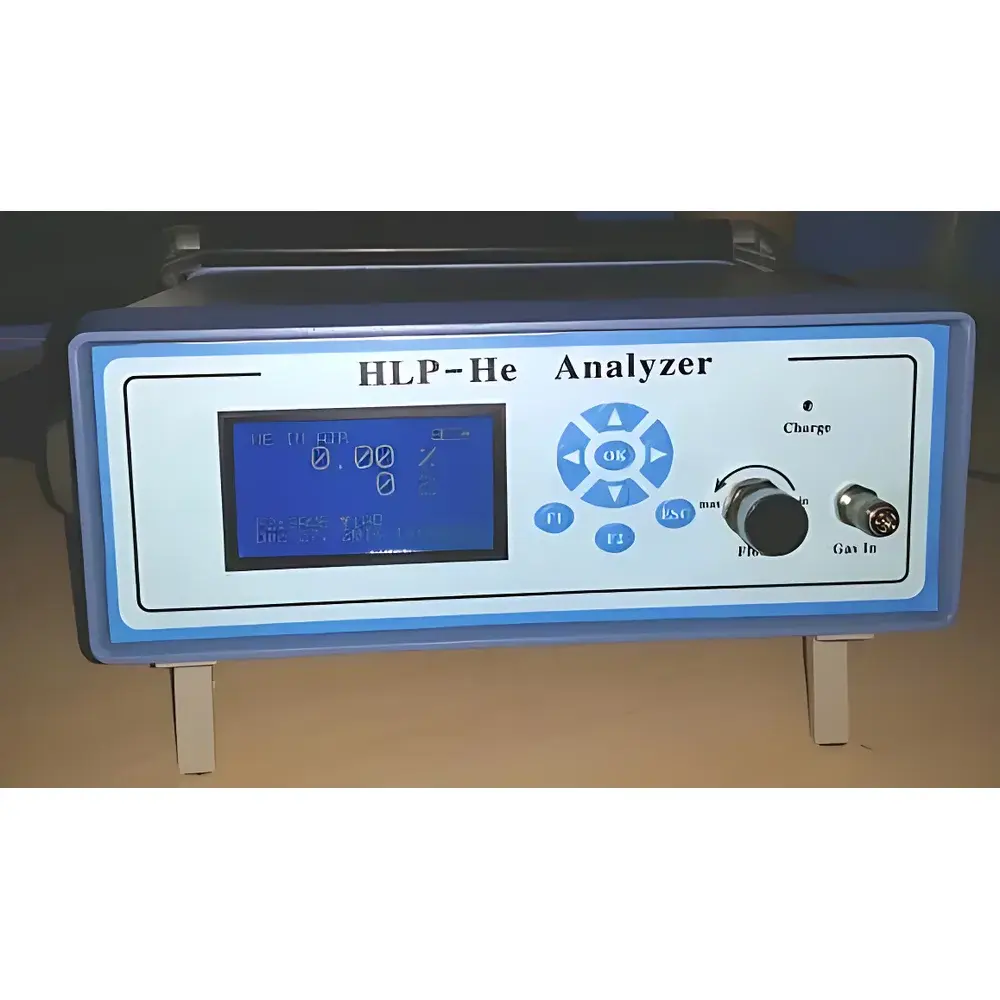
HLP-H2 Portable Hydrogen Purity Analyzer
| Origin | Italy |
|---|---|
| Manufacturer Type | Authorized Distributor |
| Origin Category | Imported |
| Model | HLP-H2 |
| Price | USD 12,200 (FOB) |
| Sensor Technology | Temperature-Compensated Constant-Temperature Thermal Conductivity Cell (ADEV-SRL) |
| Measurement Ranges | H₂ in Air: 90–100% vol |
| CO₂ (or N₂) in Air | 0–100% vol |
| H₂ in CO₂/N₂ | 0–100% vol |
| Accuracy | ±0.1% FS |
| Repeatability | ±0.1% FS |
| Response Time | 5–15 s |
| Operating Pressure | 0–1 MPa |
| Sample Flow Rate | 100–300 mL/min |
| Power Supply | AC 220 V / Rechargeable Li-ion Battery (≥4 h continuous operation) |
| Ambient Temperature Range | −30 to +50 °C |
| Data Storage | 50 measurement records |
| Display | Backlit Graphic LCD with Menu Navigation |
| Interface | USB 1.1 (PC connectivity & report export) |
| Dimensions | 258 × 240 × 88 mm |
| Weight | 2.5 kg |
| Accessories | Foam-lined portable carry case |
Overview
The HLP-H2 Portable Hydrogen Purity Analyzer is an intrinsically robust, field-deployable thermal conductivity gas analyzer engineered for real-time, high-fidelity monitoring of hydrogen (H₂) purity in turbine generator cooling systems. It operates on the principle of differential thermal conductivity — measuring the relative heat dissipation rate of a gas mixture across a precisely temperature-stabilized sensing cell. Because hydrogen exhibits thermal conductivity approximately seven times greater than ambient air and significantly higher than CO₂ or N₂, the instrument delivers unambiguous, linear response across critical transition phases: air-to-CO₂ purge, CO₂-to-H₂ replacement, and steady-state H₂ operation. Designed specifically for power generation maintenance protocols, the HLP-H2 ensures compliance with IEC 60034-7 and IEEE Std 115 guidelines governing generator gas purity management. Its constant-temperature thermal conductivity cell (supplied by ADEV-SRL, Italy) incorporates active temperature compensation to eliminate drift caused by ambient fluctuations — a critical requirement during outdoor or unconditioned plant-floor deployment.
Key Features
- True portability: Integrated rechargeable lithium-ion battery enables ≥4 hours of uninterrupted field operation; optional AC adapter supports extended benchtop use.
- Pressure-insensitive measurement: Equipped with a precision pressure regulator (0–1 MPa range) and laminar-flow needle valve, ensuring stable sample delivery regardless of upstream pressure variation.
- Multi-range capability: Simultaneously configurable for three operational modes — H₂-in-air (90–100%), CO₂/N₂-in-air (0–100%), and H₂-in-CO₂/N₂ (0–100%) — eliminating need for sensor swapping or recalibration between purge stages.
- Industrial-grade ruggedness: IP54-rated enclosure, −30 °C to +50 °C operating envelope, and shock-absorbing foam-lined carrying case certified for transport per ISTA 2A standards.
- Traceable metrology: Factory-calibrated against NIST-traceable reference gases; accuracy maintained at ±0.1% full scale with repeatability ≤±0.1% FS across all ranges.
- Real-time diagnostics: Onboard self-test routine verifies thermal cell stability, flow integrity, and battery health prior to each measurement cycle.
Sample Compatibility & Compliance
The HLP-H2 accepts non-corrosive, dry, particle-free gas streams typical of turbine generator sealed cooling circuits. It is compatible with hydrogen, nitrogen, carbon dioxide, and ambient air — including transitional mixtures encountered during sequential purging. An optional oil mist filter (recommended for installations downstream of compressor discharge) prevents hydrocarbon contamination of the thermal cell. The analyzer meets electromagnetic compatibility requirements per EN 61326-1:2013 and safety standards per EN 61010-1:2010. While not intrinsically safe (ATEX/IECEx), it is routinely deployed in non-hazardous zones adjacent to generator housings under controlled access procedures aligned with NFPA 51B and OSHA 1910.134. Data logging functionality supports audit readiness for ISO 55001 asset management systems and internal GLP-aligned maintenance documentation.
Software & Data Management
Measurements are displayed on a high-contrast graphic LCD with intuitive icon-driven menu navigation. All readings — including timestamp, gas composition, pressure, flow rate, and battery status — are stored locally (50 records, non-volatile memory). Via USB 1.1 interface, raw data exports directly to Windows-based PCs as CSV files for integration into CMMS platforms (e.g., IBM Maximo, SAP PM) or custom QA/QC dashboards. No proprietary software installation is required; exported files comply with ASTM E2500-15 Annex A2 for electronic record integrity. Audit trail metadata (operator ID, location tag, calibration date) may be appended manually prior to export — supporting FDA 21 CFR Part 11–aligned documentation workflows where electronic signatures are implemented externally.
Applications
- Hydrogen purity verification during initial commissioning and post-maintenance recharging of synchronous generators.
- Monitoring CO₂ displacement efficiency during air-to-CO₂ purge sequences to prevent explosive limits (LEL) breaches.
- Quantifying residual CO₂ content before final H₂ charging to minimize rotor windage losses and avoid thermal gradient-induced vibration.
- Routine spot-checking of sealed cooling circuits to detect slow leaks or seal degradation over time.
- Validation support for predictive maintenance programs tracking long-term H₂ purity trends correlated with bearing temperature and vibration spectra.
- Training and procedural validation for plant engineers conducting ANSI/IEEE C50.12-compliant generator gas handling operations.
FAQ
Does the HLP-H2 require periodic recalibration with certified gas standards?
Yes — recommended annually or after 500 operational hours, using traceable binary mixtures (e.g., H₂ in N₂ at 95.0% vol) per ISO 6141. Field zero/span checks can be performed with pure N₂ and certified 99.999% H₂.
Can the analyzer measure moisture or oxygen content?
No — it is dedicated solely to thermal-conductivity-based binary/multi-component concentration analysis of H₂, CO₂, and N₂. For O₂ or H₂O, a paramagnetic or tunable diode laser (TDLAS) module must be deployed separately.
Is the flow control system compatible with existing generator sampling panels?
Yes — the integrated needle valve, rotameter, and 0–1 MPa pressure regulator interface seamlessly with standard 6-mm compression fittings and DIN 4760-compliant sampling manifolds.
What is the minimum detectable H₂ concentration in CO₂ background?
The lower limit of quantitation (LLOQ) is 0.5% H₂ in CO₂, validated per ISO 11843-2, with signal-to-noise ratio ≥10:1 at 1% H₂.
How does temperature compensation affect long-term stability?
The ADEV-SRL thermal cell maintains sensor bridge temperature within ±0.05 °C via PID-controlled heater — reducing thermal drift to <0.02% FS/month under continuous operation.
Related Products







