
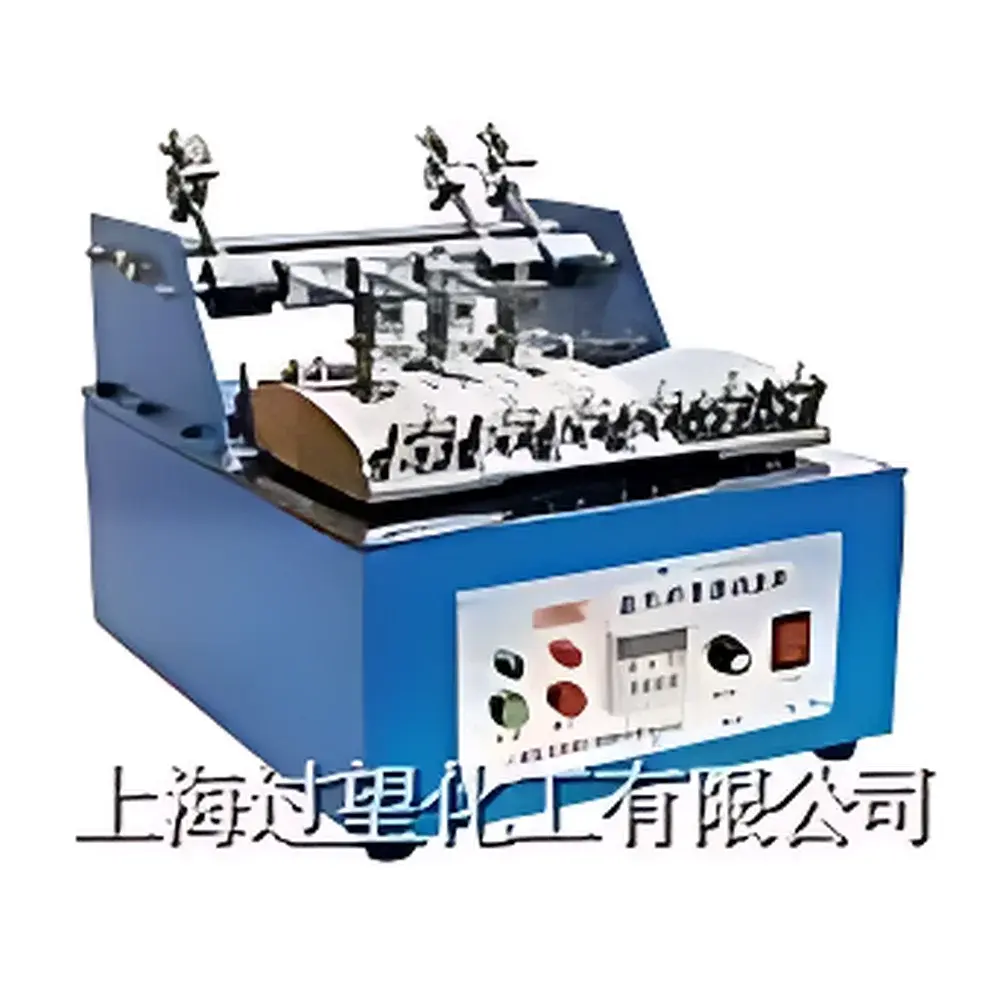
HNMC HNMC Arc-Type Ink Abrasion Tester
| Origin | Shanghai, China |
|---|---|
| Manufacturer Type | Distributor |
| Origin Category | Domestic |
| Model | HNMC |
| Pricing | Upon Request |
| Reciprocating Speed | 30 cycles/min |
| Load | 200 ±10 g (6 abrasive heads), 300 ±5 g (6 additional weights), 500 ±5 g (2 additional weights) |
| Counter Range | 0–9999 |
| Stroke Length | 120 mm |
| Arc Radius of Test Bed | R200 mm |
| Motor Power | 25 W |
| Dimensions (L×W×H) | 350 × 470 × 310 mm |
| Weight | 34 kg |
Overview
The HNMC Arc-Type Ink Abrasion Tester is a precision-engineered tribological testing instrument designed to quantitatively evaluate the mechanical durability of ink layers printed on paper-based decorative and packaging substrates. It operates on the principle of controlled reciprocating abrasion under defined normal load and geometric constraint—specifically, a fixed-radius arc-shaped test bed (R200 mm) that replicates curvature-induced stress distribution encountered in real-world handling, folding, and stacking of printed materials. Unlike linear or rotary abrasion testers, this arc-type configuration subjects the ink film to consistent tangential shear and compressive loading across the entire stroke length (120 mm), enabling repeatable assessment of surface cohesion, pigment adhesion, and binder integrity. The device complies with multiple Japanese Industrial Standards—including JIS L-0801 (rubbing fastness of textiles), JIS L-0823 (abrasion resistance of leather), JIS L-0849 (abrasion testing of coated fabrics), JIS L-1084 (abrasion of paper and board), and JIS P-8136 (rubbing fastness of printed paper)—making it suitable for quality assurance laboratories operating under internationally aligned test protocols.
Key Features
- Fixed-radius arc test bed (R200 mm) ensures uniform contact geometry and realistic simulation of curvature-dependent wear mechanisms in folded or rolled printed media.
- Adjustable normal load system comprising six standardized abrasive heads (200 ±10 g each) and calibrated supplementary weights (300 ±5 g ×6; 500 ±5 g ×2) for graded severity testing per ASTM D5264 and ISO 11640.
- Precise electromechanical drive delivering stable reciprocating motion at 30 cycles per minute, with low-vibration 25 W motor ensuring long-term operational stability and minimal thermal drift.
- Digital counter with 0–9999 cycle range supports both endpoint-based pass/fail evaluation and progressive wear profiling over extended test durations.
- Robust aluminum-and-steel frame (34 kg total mass) provides mechanical rigidity and vibration damping essential for high-reproducibility inter-laboratory comparisons.
- Modular design allows rapid head replacement and alignment verification—critical for maintaining compliance with GLP audit requirements during routine calibration checks.
Sample Compatibility & Compliance
The tester accommodates standard sheet specimens up to A4 size (210 × 297 mm), with clamping fixtures engineered to prevent lateral slippage during oscillation. It is validated for use with offset, gravure, flexographic, and digital inks applied to coated/uncoated papers, cardboard, corrugated board, and laminated substrates. All mechanical tolerances—including stroke repeatability (±0.3 mm), load accuracy (±0.5% full scale), and arc radius deviation (±0.2 mm)—are traceable to national metrology standards. The instrument meets functional equivalence requirements of JIS-compliant test methods and supports documentation workflows aligned with ISO/IEC 17025 accreditation criteria for testing laboratories.
Software & Data Management
While the base model features standalone hardware control, optional RS-232 or USB interface modules enable integration with laboratory information management systems (LIMS) and electronic lab notebooks (ELN). Raw cycle counts and operator-assigned pass/fail annotations can be exported in CSV format for statistical process control (SPC) analysis. When deployed in regulated environments—such as ISO 9001-certified print production facilities or FDA-audited pharmaceutical packaging labs—the system supports audit-trail-enabled data logging compatible with 21 CFR Part 11 principles when paired with validated third-party software platforms.
Applications
- Quantitative ranking of ink formulations for rub resistance prior to commercial press trials.
- Quality conformance testing of finished packaging against customer-specified JIS or internal durability thresholds.
- Root-cause analysis of ink delamination observed during carton folding or shrink-wrapping operations.
- Validation of UV-curable ink crosslink density via correlation between abrasion cycles and gloss retention (measured separately with a 60° glossmeter).
- Supporting technical documentation for ISO 15378 (primary packaging for pharmaceuticals) where ink adhesion must withstand sterilization and handling stresses.
FAQ
What standards does the HNMC Arc-Type Ink Abrasion Tester comply with?
It is designed and verified to meet the mechanical and procedural requirements of JIS L-0801, L-0823, L-0849, L-1084, and P-8136. Its test methodology is functionally equivalent to ASTM D5264 (Standard Practice for Determining Rub Resistance of Printed Materials) and ISO 11640 (Rub Resistance of Printing Inks).
Can the tester accommodate non-standard substrate thicknesses?
Yes—the adjustable clamping mechanism accepts specimens from 0.1 mm to 3.0 mm thickness. For substrates exceeding 1.5 mm, optional spacer inserts ensure consistent vertical alignment of the abrasive head relative to the arc centerline.
Is calibration certification included with purchase?
Each unit ships with a factory calibration report documenting load verification (using NIST-traceable deadweight standards), stroke length measurement (laser interferometry), and counter accuracy validation. On-site recalibration services are available upon request.
How is wear progression assessed during testing?
Visual inspection per JIS P-8136 grading scale (1–5) is the primary method. Optional accessories include a portable USB microscope (200× magnification) and spectrophotometric reflectance analyzer for objective ΔE*ab tracking of ink fading or scuff-induced color shift.



