
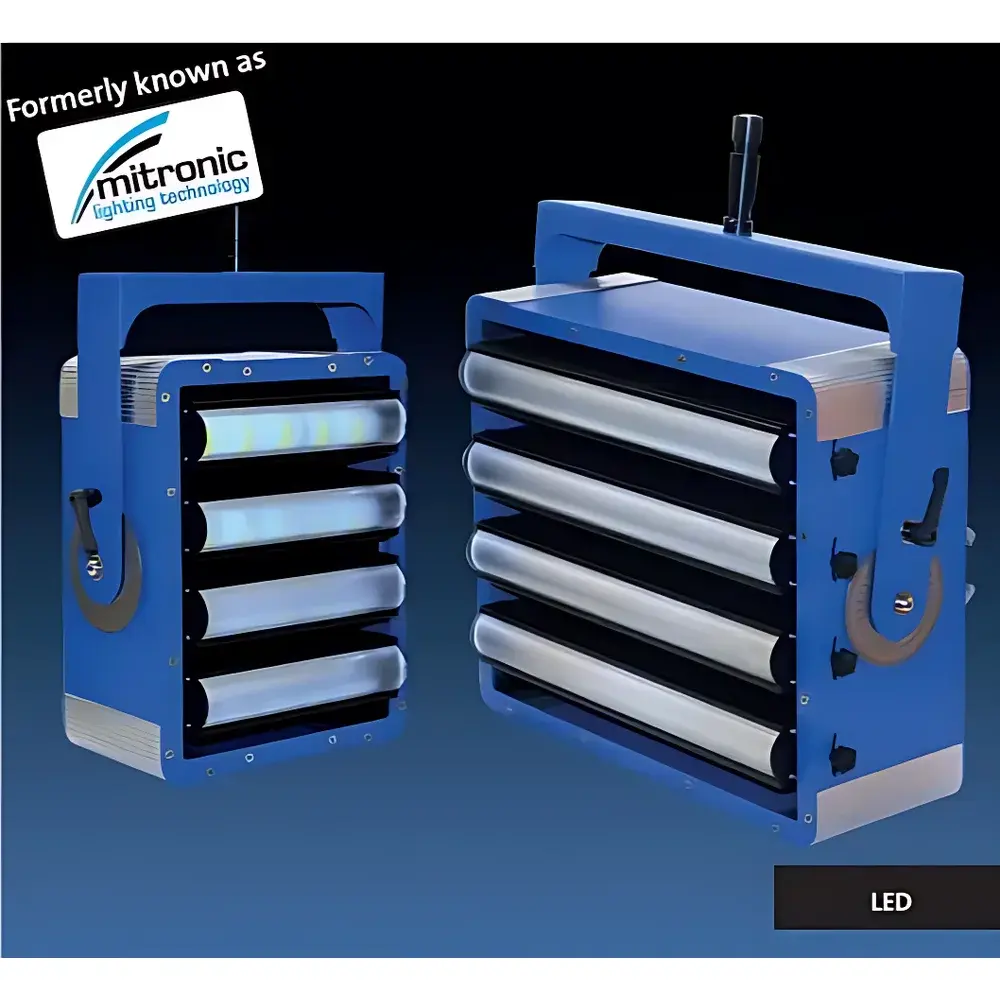
Hoenle LED Floodlight System for High-Speed Imaging – 1500 W per Channel, Model 6000
| Brand | Hoenle |
|---|---|
| Origin | Germany |
| Configuration | 4-Channel Modular LED Array with Integrated Air Cooling |
| Max. Boost Power | 1500 W per Channel (up to 15 s) |
| Standard Operating Power | 750–3000 W total |
| Beam Angle Options | 5 Interchangeable Optical Lenses |
| Control Interface | TTL-compatible On/Off Input, Programmable Auto-Timer for Boost Mode |
| Compliance | Designed for ISO/IEC 17025-aligned test laboratories |
Overview
The Hoenle LED Floodlight System Model 6000 is a purpose-engineered illumination platform optimized for ultra-high-speed imaging applications requiring temporal stability, spectral consistency, and precise power modulation. Unlike conventional continuous-output lighting, this system employs a modular four-channel architecture—each channel integrating high-luminance, narrow-bin white LEDs mounted on thermally optimized aluminum substrates—and operates under active air-cooled thermal management to sustain photometric repeatability across extended acquisition sequences. Its core measurement principle relies on flicker-free DC-driven LED emission (0% RMS ripple), eliminating motion-induced intensity artifacts critical in frame rates exceeding 10,000 fps. The system is not a generic light source but a synchronized subsystem engineered for integration into validated crash-test environments—including frontal impact, side-impact, pedestrian protection (ISO 19508, GTR 9), and occupant restraint evaluation—where illumination uniformity, radiometric stability, and deterministic timing are prerequisites for quantitative image-based deformation analysis.
Key Features
- Four independently controllable LED channels, each rated for 1500 W boost output (15 s max) and 750–1500 W sustained operation, enabling dynamic range adaptation between setup and capture phases
- Modular aluminum LED strip assembly with integrated heat-sink geometry and forced-air convection cooling—designed to maintain junction temperature ≤65°C during continuous 3000 W aggregate output
- Five interchangeable collimating lenses (10°, 25°, 40°, 60°, 90° full-angle) supporting field-of-view optimization without mechanical repositioning of fixtures
- Dedicated control unit featuring TTL-level trigger input, programmable auto-timer for boost-mode activation, and real-time status feedback via LED indicators
- Service-oriented mechanical design: tool-less access to LED modules and driver compartments; conformal-coated PCBs for dust/moisture resistance in industrial test bays
- EMC-compliant power supply architecture meeting EN 61000-6-3 (radiated emissions) and EN 61000-6-2 (immunity)
Sample Compatibility & Compliance
This lighting system is deployed exclusively in controlled physical testing environments where optical calibration traceability and operational reproducibility are mandated. It supports standardized test protocols including FMVSS 208/214 (US), ECE R94/R95 (EU), and ISO 27389 (pedestrian headform impact). The system’s stable correlated color temperature (5600 K ±150 K) and CRI >92 ensure compatibility with monochrome and RGB high-speed cameras calibrated per ISO 12232 and EMVA 1288. All firmware and control logic are architected to support audit-ready operation: timestamped mode transitions, non-volatile logging of power-state history, and configurable lockout periods aligned with FDA 21 CFR Part 11 electronic record requirements for regulated automotive safety validation labs.
Software & Data Management
While the floodlight system operates as a hardware-controlled peripheral, its interface layer enables seamless synchronization with third-party test orchestration platforms (e.g., National Instruments VeriStand, dSPACE SCALEXIO, or Siemens Testlab). The TTL-triggered boost mode allows direct coupling with high-speed camera start signals or accelerometer-based event detection. Internal state logs—including channel voltage/current, heatsink temperature, and timer activation timestamps—are accessible via RS-485 Modbus RTU for ingestion into centralized test data management systems (TDMS). No proprietary software installation is required; configuration is performed via DIP-switch settings and front-panel encoder navigation. All operational parameters adhere to IEC 62443-3-3 SL2 cybersecurity baseline for industrial control devices.
Applications
- Automotive crashworthiness testing: illumination of full-scale vehicle impacts at 20,000–100,000 fps for digital image correlation (DIC) and high-resolution deformation mapping
- Passive safety component validation: airbag deployment sequencing, seatbelt pretensioner kinematics, and A-pillar intrusion analysis under controlled lighting conditions
- Biomechanical impact simulation: pedestrian lower-leg and headform tests per Euro NCAP and IIHS protocols, where consistent irradiance (±2% spatial uniformity over 2 m × 2 m area) is essential for photogrammetric reconstruction
- Composite material fatigue assessment: long-duration cyclic loading experiments requiring stable illumination across multi-hour acquisition windows
- Aerospace structural testing: bird-strike simulation and turbine blade containment verification using ultra-high-speed schlieren or shadowgraph imaging
FAQ
Is this system compatible with Genlock or external sync signals beyond TTL triggering?
No—synchronization is limited to TTL-level rising-edge triggers. For phase-locked applications, external signal conditioning hardware is required.
What is the maximum allowable ambient temperature for continuous operation?
Rated for continuous use up to 35°C ambient with ≥1.2 m/s airflow around the enclosure; derating applies above this threshold per IEC 60068-2-14.
Can individual LED channels be calibrated independently for radiometric output?
Yes—each channel includes factory-calibrated current regulation with ±1.5% linearity; NIST-traceable calibration certificates are available as an optional add-on.
Does the system support remote monitoring via Ethernet or USB?
Not natively—monitoring is RS-485 only. Ethernet-to-RS-485 gateways may be deployed at system integration level.
Are replacement lenses and LED modules stocked by Hoenle’s authorized distributors?
Yes—standard lens sets and channel modules are maintained in EU distribution hubs with typical lead time of 5 business days.





