
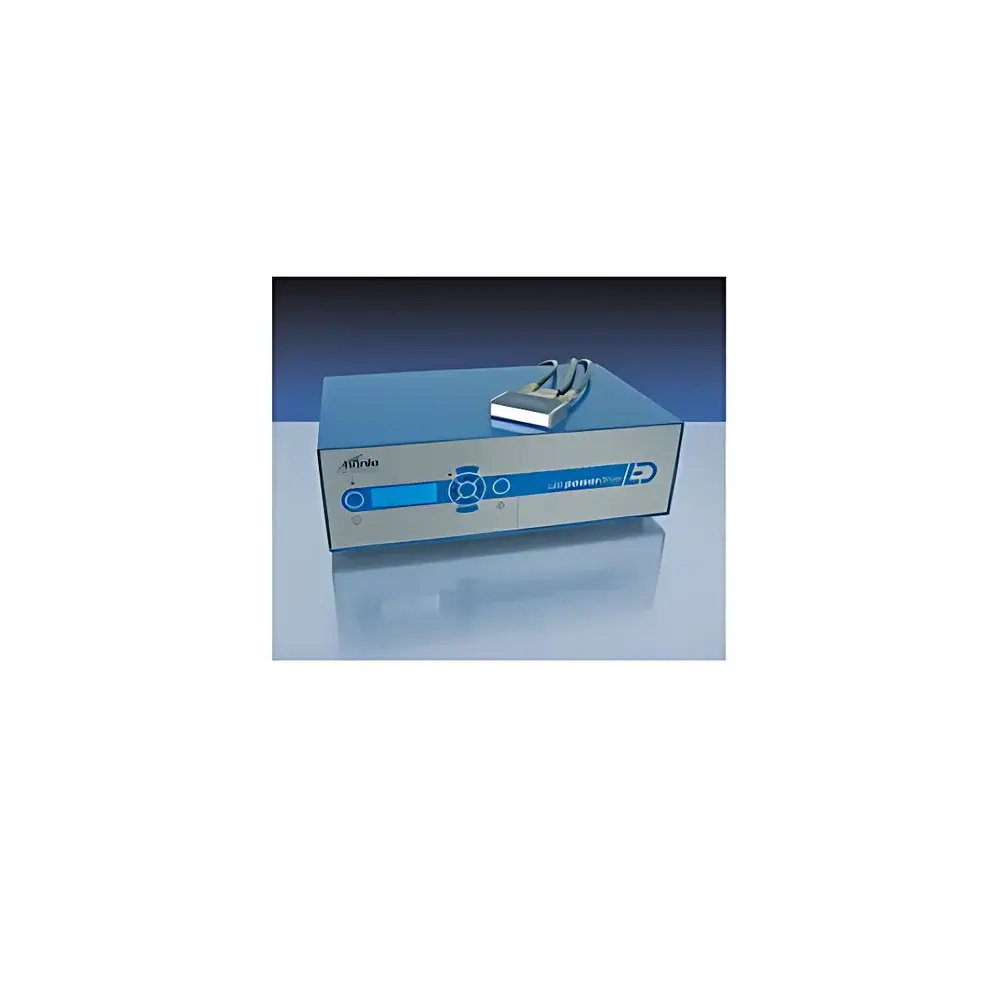
Hoenle LED Powerline UV LED Curing System
| Brand | Hoenle |
|---|---|
| Origin | Germany |
| Model | LED Powerline |
| Cooling Options | Air-cooled (AC/IC 410, AC/IC 820), Water-cooled (LC), Flexible (Flexo), Focused (Focus) |
| Wavelength Options | 365 nm, 385 nm, 395 nm, 405 nm |
| Control Interface | Integrated LED Powerdrive IC with Desktop LED Control Unit |
| Compliance | CE, RoHS, IEC 62471 (Photobiological Safety) |
Overview
The Hoenle LED Powerline UV LED Curing System is an engineered platform for high-precision, low-thermal-load ultraviolet curing in industrial manufacturing environments. Unlike traditional mercury arc or broad-spectrum UV sources, the LED Powerline series employs monochromatic solid-state UV LEDs operating at discrete peak wavelengths—typically 365 nm, 385 nm, 395 nm, and 405 nm—enabling selective photoinitiator activation with minimal infrared emission. This spectral specificity ensures efficient polymerization of acrylate-based inks, coatings, adhesives, and encapsulants while maintaining substrate temperature rise below 10 °C under standard operational conditions. The system architecture integrates modular lamp heads with compact, fan-cooled (AC/IC 410 and AC/IC 820) or water-cooled (LC) thermal management, supporting continuous-duty operation at irradiance levels up to 12 W/cm² (measured at 1 cm working distance, depending on configuration). Designed for seamless integration into inline production lines—including inkjet, flexographic, offset, and screen printing—each LED Powerline variant complies with IEC 62471 for UV radiation safety and meets CE and RoHS directives for electromagnetic compatibility and hazardous substance restriction.
Key Features
- Modular lamp head design enabling rapid reconfiguration for varying web widths, print zones, or spatial constraints (e.g., narrow-gap installations)
- Integrated LED Powerdrive IC control unit with desktop interface, supporting real-time intensity modulation (0–100% PWM), exposure time programming, and interlock signaling via 24 V DC I/O
- Low thermal load operation: surface temperature rise < 10 °C on heat-sensitive substrates (e.g., PET, thin films, electronics assemblies) during sustained 100% power output
- Wavelength-selective output optimized for common photoinitiators: 365 nm for deep-penetration cationic systems; 385–405 nm for free-radical acrylates used in inkjet and conformal coatings
- Robust mechanical construction with IP54-rated housing (AC/IC models) and stainless-steel coolant manifolds (LC models), rated for industrial ambient temperatures from 5 °C to 40 °C
- Scalable system architecture: individual lamp modules support daisy-chained synchronization for multi-zone intensity profiling across wide-format applications
Sample Compatibility & Compliance
The LED Powerline series is validated for use with UV-curable formulations compliant with ISO 11997-2 (radiation curing of coatings), ASTM D4060 (abrasion resistance of cured coatings), and ISO 9001-certified manufacturing processes. It supports direct integration into OEM equipment meeting UL 508A (industrial control panels) and IEC 61800-5-1 (adjustable speed electrical power drive systems). All configurations undergo photometric calibration per CIE S 026/E:2019 and are supplied with traceable irradiance certificates (NIST-traceable spectroradiometer validation). The system meets FDA 21 CFR Part 11 requirements when paired with Hoenle’s optional audit-trail-enabled firmware (v3.2+), providing electronic signature support and change history logging for regulated pharmaceutical packaging or medical device adhesive bonding workflows.
Software & Data Management
Operation is managed through the Hoenle LED Control Software Suite (v4.1), a Windows-based application supporting USB and Ethernet communication. The software enables full parameter scripting—including ramp profiles, duty-cycle sequences, and fault-event logging—with export capability to CSV and XML formats for LIMS or MES integration. Firmware updates are delivered via secure HTTPS channel with SHA-256 signature verification. For automated line control, the system provides Modbus TCP and EtherNet/IP protocol stacks, allowing bidirectional data exchange with PLCs (Siemens S7-1500, Rockwell ControlLogix) and SCADA platforms. All operational logs—including lamp-on hours, thermal sensor readings, and intensity deviation alerts—are timestamped and stored locally with 32 GB onboard flash memory (retention ≥ 12 months at 1 Hz sampling).
Applications
- Inkjet pre-cure and final cure in digital textile, ceramic tile, and packaging printing
- Flexographic and gravure drying of water- and solvent-based UV inks on flexible packaging webs
- Conformal coating and potting compound curing on PCB assemblies and automotive sensors
- Adhesive bonding of optical lenses, touch panels, and microfluidic devices requiring low-temperature processing
- UV varnish curing in sheetfed offset (Powerline Focus) and rotary letterpress (Powerline Flexo) configurations
- Encapsulation of OLED displays and thin-film photovoltaics where IR-induced delamination must be avoided
FAQ
What wavelength options are available for the LED Powerline series?
Standard configurations include 365 nm, 385 nm, 395 nm, and 405 nm. Custom wavelengths between 350–420 nm are available upon request with minimum order quantity.
Is the LED Powerline compatible with existing UV-curable chemistry?
Yes—provided the photoinitiator system exhibits absorption maxima within ±5 nm of the selected LED peak wavelength. Spectral matching reports are available upon submission of formulation datasheets.
Does the system support regulatory compliance for medical device manufacturing?
When configured with audit-trail firmware and connected to a validated network infrastructure, it satisfies FDA 21 CFR Part 11 and ISO 13485 documentation requirements for process validation records.
How is thermal management handled in air-cooled versus water-cooled models?
AC/IC models use forced-air convection with intelligent fan speed control tied to junction temperature feedback; LC models employ closed-loop deionized water circulation with PID-regulated chiller interface (0.5–2.0 L/min flow rate).
Can multiple LED Powerline units be synchronized for uniform curing across wide substrates?
Yes—via master-slave daisy-chain mode using RS-485 or EtherNet/IP, with timing jitter < 10 µs across up to 32 synchronized zones.




