
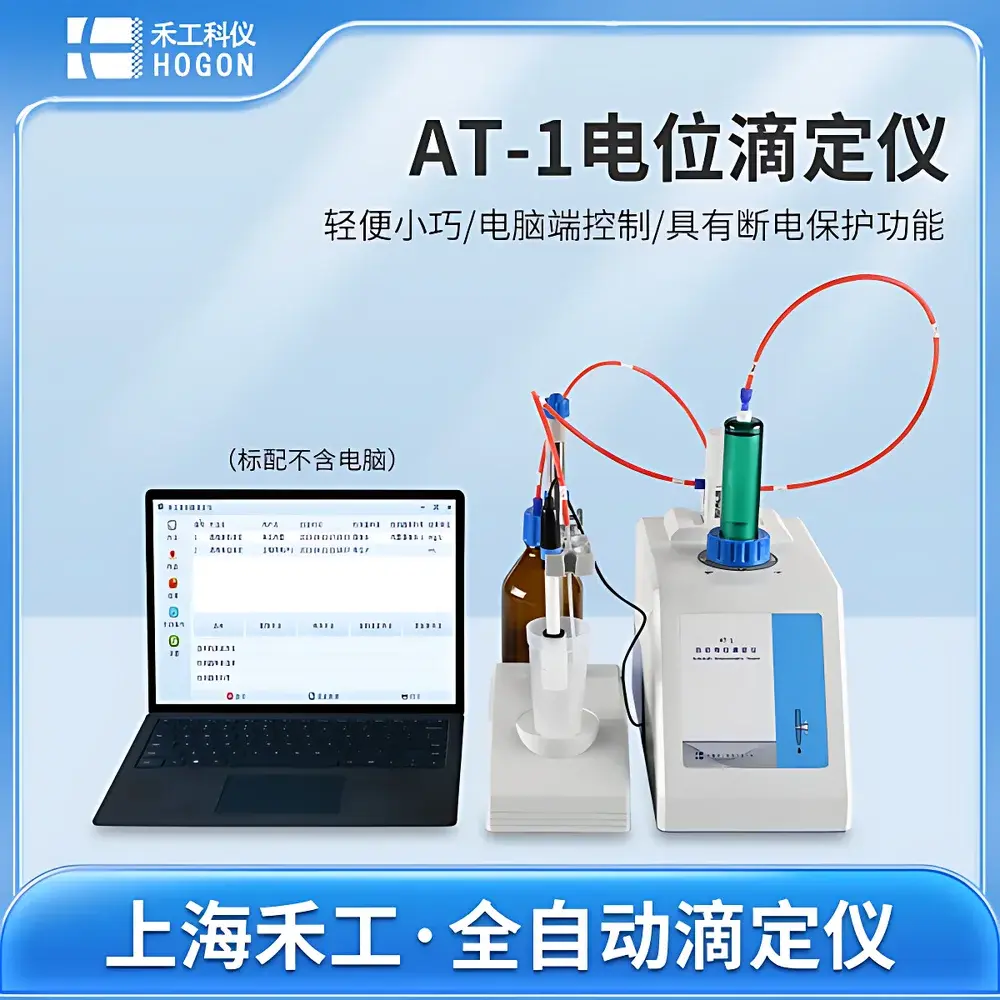
HOGON AT-1 Automatic Potentiometric Titrator (Single pH/Conductivity Module)
| Brand | HOGON |
|---|---|
| Origin | Shanghai, China |
| Manufacturer Type | Direct Manufacturer |
| Instrument Type | General-Purpose Potentiometric Titrator |
| Model | AT-1 (Single pH/Conductivity Module) |
| Measurement Range | −2000 mV to +2000 mV |
| Meter Accuracy | ±0.5% of full scale |
| Meter Resolution | 0.1 mV |
| Titration Accuracy | 0.8 mV/h |
| Titration Resolution | 0.1 mV |
| Compatible Buret Volumes | 10 mL, 20 mL |
| Minimum Dispensed Volume | 3 µL |
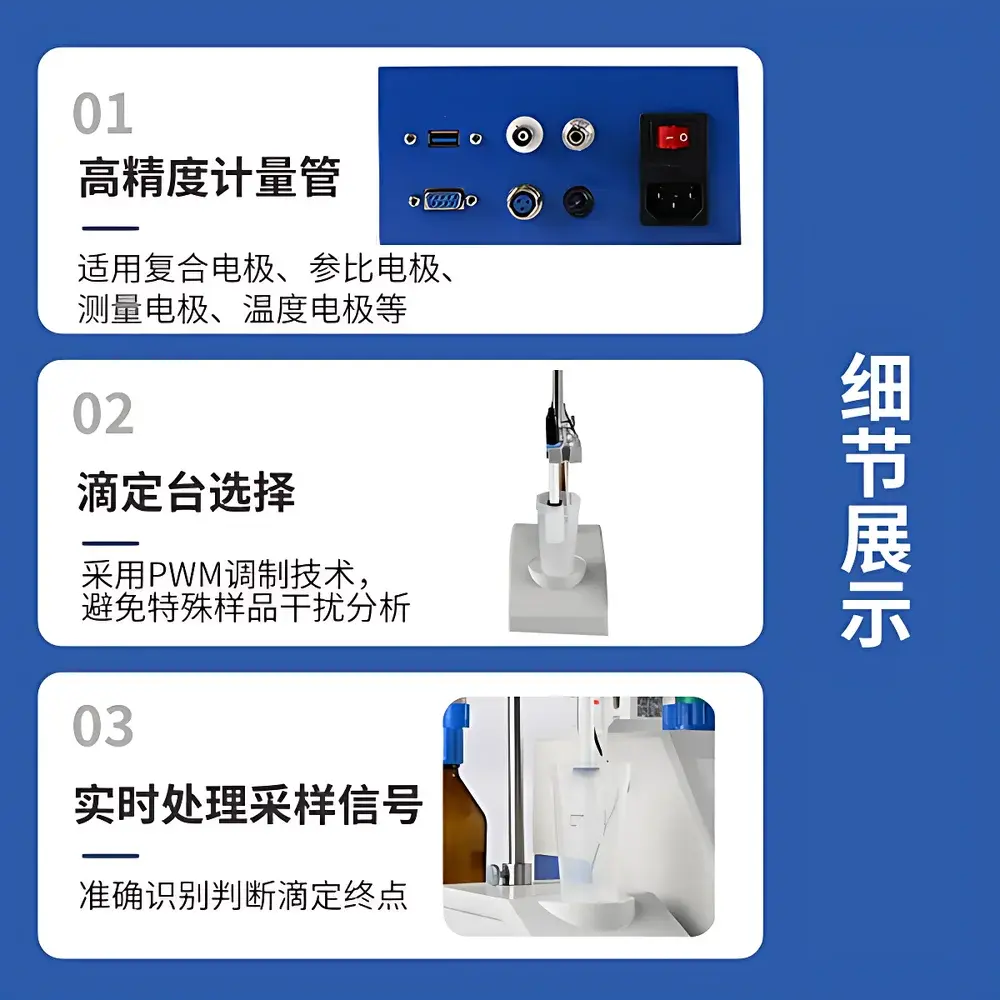
| Electrode Interfaces | Multi-port universal electrode connector (pH, reference, indicator, temperature) |
| Temperature Compensation | Integrated Pt1000 thermistor with automatic pH compensation |
| Data Export Format | PDF, CSV |
| Compliance | GLP-compliant audit trail, user authentication & role-based access control |
Overview
The HOGON AT-1 Automatic Potentiometric Titrator is a compact, benchtop-capable analytical instrument engineered for precision potentiometric and conductometric titrations in regulated and research laboratory environments. It operates on the fundamental principle of monitoring potential difference (mV) or conductivity changes across a reaction system as titrant is incrementally delivered—enabling automated endpoint detection via first- or second-derivative analysis of the titration curve. Designed as a general-purpose titrator, the AT-1 supports classical volumetric analysis methods including acid-base, redox, complexometric, non-aqueous, and pH-metric titrations. Its architecture integrates a maintenance-free, high-precision syringe-type buret with sub-microliter dispensing capability (down to 3 µL), coupled with real-time signal acquisition and digital differentiation algorithms that ensure robust endpoint recognition—even in low-slope or multi-step reactions. The system connects exclusively via USB to a host PC, eliminating embedded display hardware and enabling centralized instrument control, method deployment, and raw data archival within a validated software environment.
Key Features
- High-resolution potentiometric measurement: 0.1 mV resolution, ±0.5% full-scale accuracy over −2000–+2000 mV range, with simultaneous 0.001 pH and 0.1 °C resolution for temperature-compensated pH titrations
- Dual-mode detection: Configurable for potentiometric (ion-selective or redox electrodes) or conductometric (two-electrode cell) endpoints—optimized for applications where pH electrodes are unsuitable (e.g., non-aqueous solvents, turbid suspensions)
- Intelligent buret system: Precision syringe-driven delivery with 10 mL and 20 mL interchangeable burets; minimum dispensing volume of 3 µL; chemically resistant wetted materials (including high-chloric-acid-compatible components for non-aqueous titrations)
- Dynamic endpoint algorithms: Real-time calculation of first and second derivatives to identify equivalence points in steep, shallow, or overlapping inflection regions—supporting dynamic, incremental, fixed-pH, and EP-mode titrations
- GLP-ready operation: Full user authentication with role-based permissions (administrator, analyst, reviewer); time-stamped audit trail for all method edits, titration runs, and parameter changes; PDF report generation with embedded metadata (operator ID, timestamp, method version, raw curve data)
- Stirring control: PWM-modulated magnetic stirrer with adjustable speed and torque stability—minimizing vortex formation and electrode interference during sensitive redox or precipitation titrations
- Fail-safe operation: Integrated drip protection, overfill prevention, and automatic electrode cleaning cycles reduce manual intervention and safeguard critical components during unattended runs
Sample Compatibility & Compliance
The AT-1 accommodates a broad spectrum of sample matrices—including aqueous buffers, organic solvents (e.g., glacial acetic acid, methanol), heterogeneous suspensions, and viscous pharmaceutical formulations—when paired with appropriate electrode configurations (e.g., non-aqueous pH electrodes, platinum redox sensors, or conductivity cells). It meets core requirements for analytical traceability under Good Laboratory Practice (GLP) and current Good Manufacturing Practice (cGMP) frameworks, supporting 21 CFR Part 11 readiness through electronic signature capture, immutable data logging, and controlled method versioning. While not pre-certified to ISO 8655 or ASTM E2063, its metrological performance aligns with the accuracy and repeatability expectations defined in those standards for Class A buret-based titration systems. All firmware and software updates undergo internal verification per ICH Q9 principles, ensuring continued compliance during instrument lifecycle.
Software & Data Management
Control and data acquisition are managed through dedicated Windows-based software that provides a modular interface for method development, sequence programming, and real-time visualization. Users define titration parameters—including initial delay, addition volume strategy (fixed, dynamic, or variable), stop conditions (mV threshold, slope criterion, or volume limit), and post-run calculations (normality, concentration, % purity)—via intuitive wizards or direct script editing. Raw potential vs. volume curves, derivative plots (dE/dV and d²E/dV²), and annotated endpoint markers are rendered in real time. Data files are stored in a structured local database with optional network backup; reports export natively to PDF (with embedded graphical curves and metadata) and CSV (for statistical analysis in JMP, Minitab, or Python). Audit logs record every action—including login/logout events, method modifications, and result approvals—with hash-verified integrity to satisfy internal QA and external regulatory review.
Applications
The AT-1 delivers validated quantitative results across diverse sectors: in pharmaceutical QC labs for assay of active ingredients (e.g., ibuprofen by non-aqueous titration), in food safety testing for titratable acidity (TA) and chloride content (Mohr method), in environmental water analysis for alkalinity and hardness (EDTA complexometry), and in petrochemical QA for total acid number (TAN) in lubricants. Academic laboratories utilize it for teaching fundamental electrochemical concepts—including Nernst equation validation, buffer capacity determination, and redox stoichiometry—while industrial R&D groups deploy it for method development in battery electrolyte characterization and catalyst activity profiling. Its modularity supports rapid reconfiguration between pH and conductivity modes without hardware modification—reducing capital expenditure versus dedicated single-function instruments.
FAQ
What electrode types are supported?
The AT-1 accepts standard BNC and mini-DIN connectors for combination pH electrodes, separate reference/measuring electrodes (Ag/AgCl, calomel), redox (Pt) electrodes, conductivity cells, and temperature probes (Pt1000). Non-aqueous and solid-contact electrodes are compatible with appropriate cable adapters.
Is the software compliant with FDA 21 CFR Part 11?
The software supports electronic signatures, audit trails, and role-based access control—core technical controls required for Part 11 compliance. Full validation documentation (IQ/OQ/PQ protocols) is available upon request for site-specific implementation.
Can the instrument perform back-titrations or multi-step titrations?
Yes. Method scripting allows conditional logic—for example, adding excess titrant, waiting for reaction completion, then back-titrating with a second reagent—enabling Karl Fischer-style two-reagent workflows and sequential endpoint detection.
How is temperature compensation handled during pH titrations?
An integrated Pt1000 temperature sensor continuously monitors solution temperature and applies Nernstian correction in real time using the built-in pH calibration curve (slope = −(2.303RT/F)), ensuring accurate [H⁺] calculation across 5–60 °C.
What maintenance is required for long-term reliability?
The syringe buret requires no routine lubrication or recalibration. Recommended practices include weekly electrode storage in appropriate solution, monthly cleaning of stir bar and electrode junctions, and annual verification of buret delivery accuracy using certified gravimetric standards per ISO 8655-3.




