
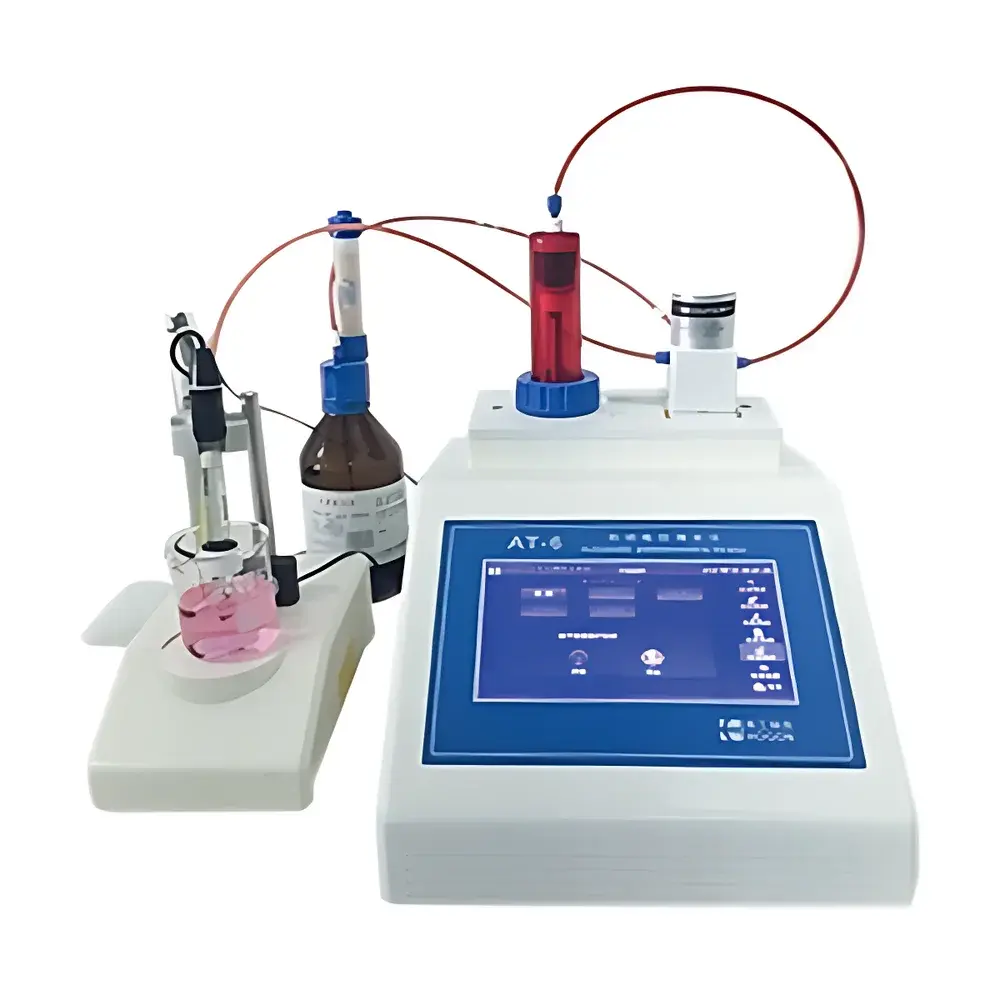
HOGON AT-6 Fully Automatic Potentiometric Titrator with Karl Fischer Moisture Module
| Brand | HOGON |
|---|---|
| Origin | Shanghai, China |
| Manufacturer Type | Original Equipment Manufacturer (OEM) |
| Product Category | Domestic |
| Model | AT-6 Karl Fischer Module |
| Instrument Type | General-purpose Potentiometric Titrator |
| Application Scope | Universal |
| Measurement Range | −2000 mV to +2000 mV |
| Meter Accuracy | ±0.35% of full scale |
| Meter Resolution | 0.1 mV |
| Titration Precision | ±0.01 pH over 3 h |
Overview
The HOGON AT-6 Fully Automatic Potentiometric Titrator with Karl Fischer Moisture Module is a modular, CE-compliant laboratory titration platform engineered for high-reproducibility quantitative chemical analysis. It operates on the fundamental principle of potentiometric endpoint detection—measuring real-time potential shifts across an ion-selective or redox electrode pair to identify stoichiometric equivalence points in acid-base, redox, complexometric, non-aqueous, and precipitation reactions. Integrated with a dedicated Karl Fischer (KF) moisture determination module, the system supports both volumetric and coulometric KF titration protocols per ASTM E203, ISO 8534, and USP , enabling trace water quantification down to 10 ppm in solvents, pharmaceuticals, polymers, and hygroscopic materials. The instrument employs a closed-loop feedback control architecture, where a high-resolution microprocessor continuously evaluates first- and second-order derivatives of the titration curve to determine endpoints with sub-microliter precision. Its design complies with GLP and GMP documentation requirements, including audit-trail-enabled method storage, electronic signature support, and time-stamped result logging.
Key Features
- 7-inch full-color capacitive touchscreen interface with intuitive icon-driven navigation and built-in power-failure protection—retains all method parameters and measurement data after unexpected shutdown
- High-precision glass syringe burette (standard 20 mL; optional 5 mL and 10 mL), certified to ISO 8655 Class A (±0.15% accuracy), constructed from PTFE and Hastelloy C-276 for resistance to perchloric acid and other aggressive reagents
- Dual stirring options: PWM-controlled magnetic stirrer with lift-and-lower mechanism or rod-type helical stirrer—both minimize vortex formation and electrode shielding in viscous or heterogeneous samples
- Multi-mode titration engine supporting dynamic equivalence point (EP) detection, incremental EP mode, fixed-endpoint (potentiometric or pH-based) dead-stop titration, and automatic pH calibration with temperature compensation (integrated Pt100 sensor)
- Electrode connectivity via standardized BNC, direct-insertion, and dedicated temperature probe ports—compatible with pH, redox, silver, ion-selective, and double-junction reference electrodes
- Real-time graphical display of titration curves and first-derivative plots; onboard storage for up to 200 analytical records with batch export via USB flash drive
- Integrated safety interlocks—including overfill prevention, reagent depletion alerts, and motor stall detection—to ensure unattended operation during overnight or multi-sample runs
Sample Compatibility & Compliance
The AT-6 accommodates a broad spectrum of sample matrices without modification: aqueous solutions, organic solvents (e.g., methanol, chloroform, DMF), suspensions, oils, solid powders (via homogenization), and thermally sensitive biomolecules. Its KF module enables accurate moisture determination in APIs, excipients, lyophilized proteins, lithium battery electrolytes, and catalysts per ICH Q5C stability guidelines. All firmware and data handling routines conform to FDA 21 CFR Part 11 requirements for electronic records and signatures when configured with password-protected user roles and immutable audit trails. Electrical safety meets IEC 61010-1; electromagnetic compatibility complies with EN 61326-1. Calibration certificates traceable to NIM (National Institute of Metrology, China) are provided with each unit.
Software & Data Management
The embedded operating system supports creation, modification, and validation of custom titration methods—including pre-titration scouting, adaptive volume incrementing, and slope-threshold-based endpoint confirmation. Methods may be duplicated, parameter-adjusted, and saved as new versions without overwriting originals. Data export formats include CSV, PDF reports (with instrument ID, operator ID, timestamp, and raw curve data), and XML for LIMS integration. Communication interfaces include RS-232 (for thermal printer output), USB 2.0 (for mass storage and firmware updates), and IEEE 802.11 b/g/n WLAN (for remote monitoring and centralized instrument fleet management via HOGON LabLink™ software). All exported files retain cryptographic hash integrity verification.
Applications
- Pharmaceutical QC: assay of active ingredients (e.g., amine titration in antibiotics), chloride content in saline formulations, residual solvent moisture per ICH Q3C
- Chemical manufacturing: acid number (ASTM D974) and base number (ASTM D2896) in lubricants; peroxide value in edible oils (AOAC 965.33)
- Food & beverage: titratable acidity in wines and dairy products; sodium chloride quantification in processed foods
- Materials science: hydroxyl value in polyols (ASTM D4294), saponification number in resins, and water content in silica gels
- Environmental testing: cyanide and fluoride determination in wastewater (EPA Method 325B), alkalinity profiling in surface waters
FAQ
Does the AT-6 support both volumetric and coulometric Karl Fischer titration?
Yes—the integrated KF module is configurable for either mode, with selectable generator anode/cathode cell assemblies and reagent compatibility verification logic.
Can the instrument validate method transfer between laboratories?
Yes—method files include embedded metadata (reagent lot numbers, electrode serial IDs, environmental conditions), enabling cross-site reproducibility assessment per ICH Q2(R2).
Is temperature compensation applied automatically during pH titrations?
Yes—the built-in Pt100 sensor feeds real-time temperature data to the Nernst equation solver, correcting pH readings per ISO 3696 and DIN 19268.
What is the minimum detectable volume increment per dispensing step?
The 20 mL burette achieves 1 µL resolution (1/20,000 of full scale), validated per ISO 8655-3 using gravimetric dispensing tests.
How does the system handle electrode drift during long-duration titrations?
The firmware performs periodic zero-point recalibration using internal reference potentials and applies real-time baseline correction to derivative calculations.




