
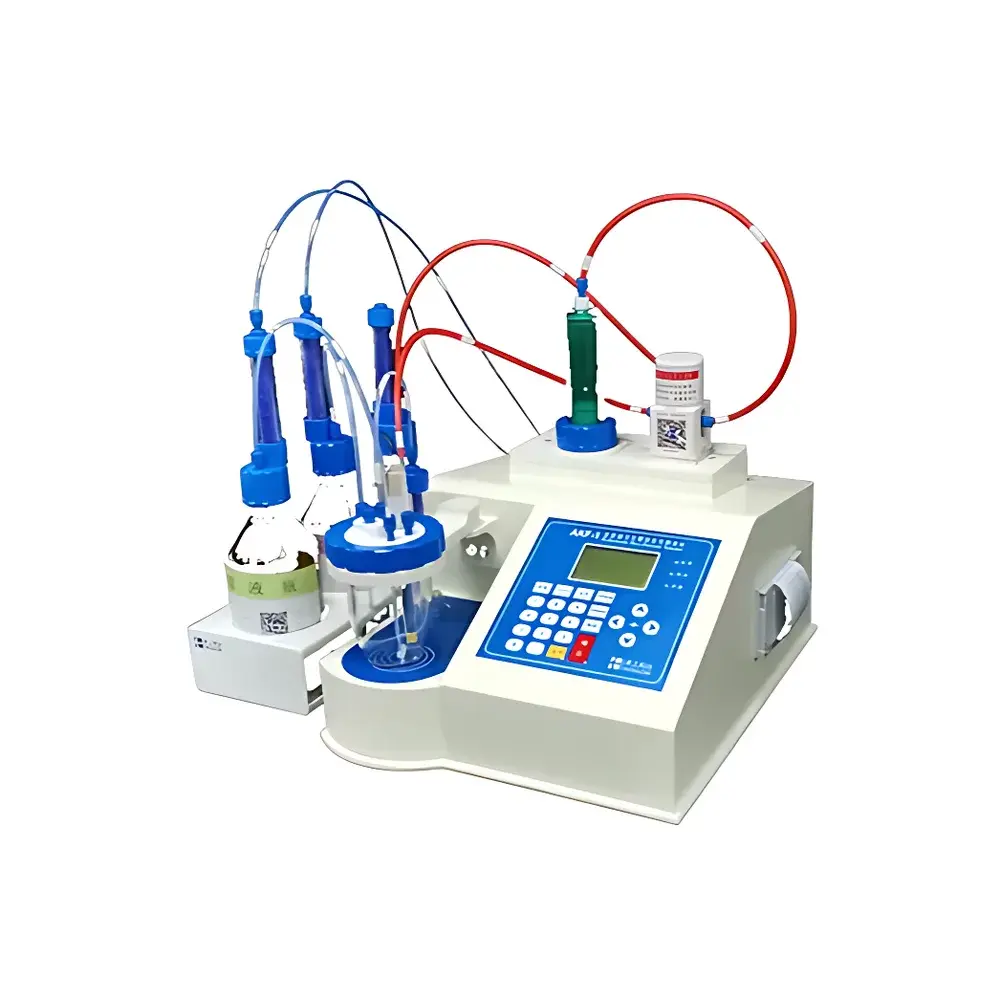
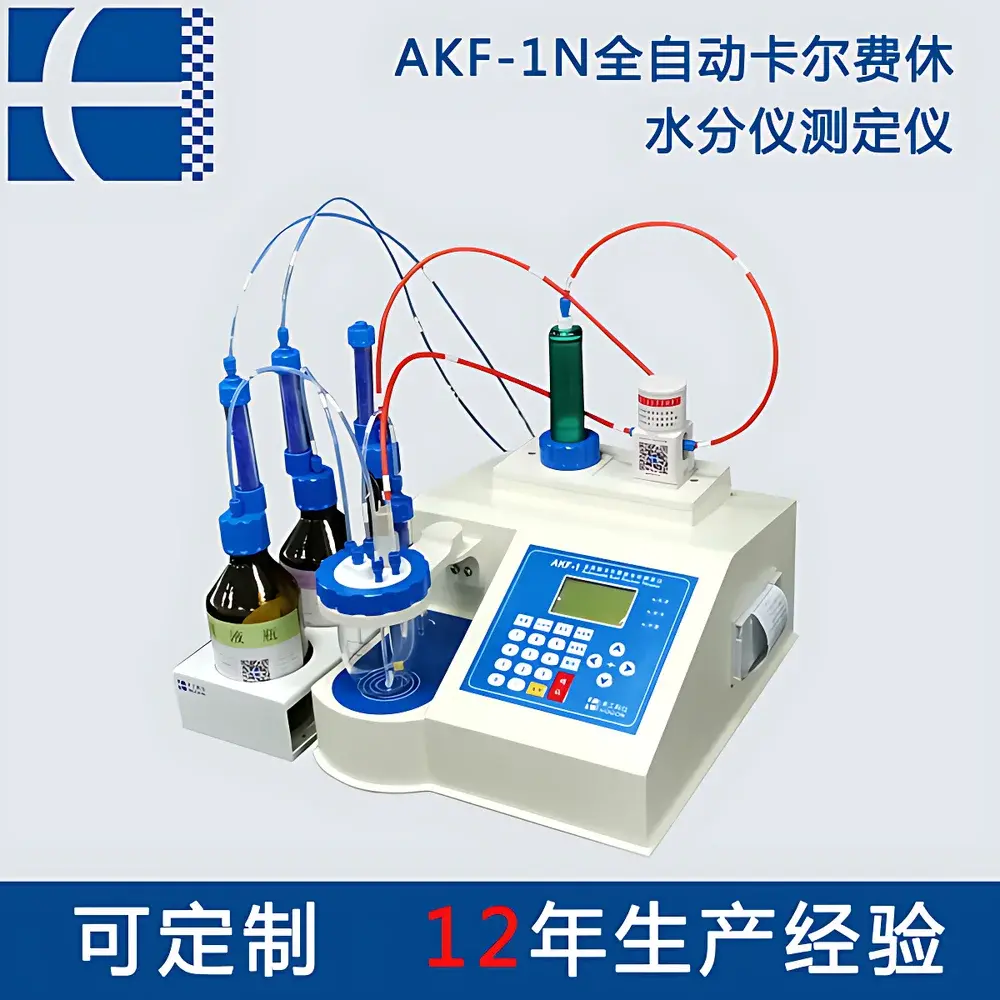
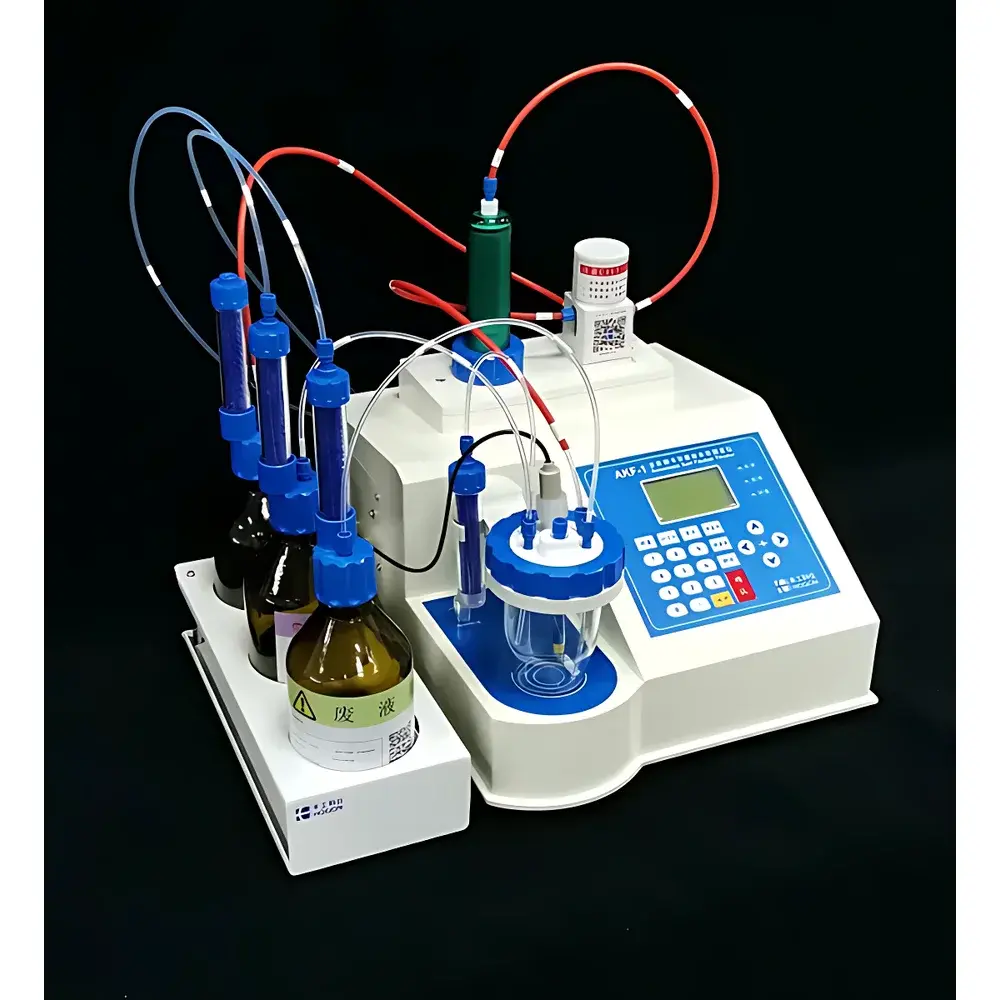
HOGON AKF-1N Fully Automatic Volumetric Karl Fischer Moisture Analyzer
| Brand | HOGON |
|---|---|
| Origin | Shanghai, China |
| Manufacturer Type | Direct Manufacturer |
| Instrument Type | Volumetric Karl Fischer Moisture Analyzer |
| Titration Method | Fully Automatic |
| Measurement Resolution | 1 ppm |
| Moisture Content Range | 0.001–100.000% (w/w) |
| Accuracy | ≤0.3% RSD |
| Minimum Dispensing Volume | 1/20,000 of burette volume |
| Titration Control Precision | 1.0 µL |
| Sample Analysis Time | < 2 min (avg.) |
| Method Storage | 5 methods |
| Data Storage | 20 test records |
| Burette Capacity | 20 mL with patented piston-driven syringe |
| Electrode | Dual Platinum Electrode |
| Display | Button-operated LCD (Chinese interface) |
| Environmental Humidity Limit | ≤80% RH |
| Power Supply | 110–220 V AC, 50 Hz |
| Net Weight | 5.5 kg |
| Compliance | Designed for GLP-compliant laboratories |
Overview
The HOGON AKF-1N is a fully automatic volumetric Karl Fischer (KF) moisture analyzer engineered for precision, reliability, and operational simplicity in routine and regulated laboratory environments. It operates on the fundamental electrochemical principle of volumetric Karl Fischer titration—where iodine generated in situ reacts stoichiometrically with water in the sample matrix. The instrument employs coulometric-free, reagent-based quantification using standardized KF reagents (e.g., single-component or two-component methanol-based solutions), ensuring compatibility across diverse sample types without method recalibration. Its closed-cup titration cell design minimizes ambient moisture intrusion and reagent degradation, while integrated solvent delivery and waste evacuation systems eliminate manual handling of hygroscopic or hazardous reagents—enhancing both operator safety and measurement stability.
Key Features
- Fully automated titration sequence: solvent aspiration, drift measurement, sample injection, endpoint detection, reagent dispensing, waste expulsion, and cell rinsing—all executed without user intervention.
- Patented high-precision piston-driven 20 mL burette with 1.0 µL dispensing resolution, enabling sub-microliter control and long-term volumetric consistency over >10,000 injections.
- Dual platinum electrode system with adaptive polarization for robust endpoint detection across low- and high-water-content samples (0.001–100.000%).
- Intelligent dynamic titration algorithm: automatically adjusts titration speed based on real-time water concentration and reagent titer, eliminating manual fast/slow titration mode selection.
- Hermetically sealed titration vessel with corrosion-resistant fluoropolymer tubing, triple-sealed fittings, and electromagnetic 3-way valves—designed to withstand aggressive KF solvents (e.g., imidazole, chloroform, pyridine-free formulations).
- Low-noise suspended drive mechanism and modular mechanical architecture reduce vibration-induced drift and simplify maintenance access.
- Onboard LCD display (Chinese-language interface) shows real-time parameters including cumulative reagent consumption, elapsed time, current water mass (µg), drift rate (µg/min), and titration curve progression.
Sample Compatibility & Compliance
The AKF-1N accommodates solid, liquid, and viscous samples—including pharmaceutical excipients, polymers, lithium battery electrolytes, petrochemicals, food powders, and active pharmaceutical ingredients (APIs). Sample introduction is compatible with standard glass syringes (1–5 mL) or optional automated samplers (not included). The system meets foundational requirements for ISO 8533:2017 (determination of water content by volumetric KF titration) and ASTM D6304. While the base firmware does not include full 21 CFR Part 11 compliance out-of-the-box, its hardware architecture supports traceable audit trails, electronic signatures, and user-access controls when paired with HOGON’s optional LIMS-integrated software suite—making it suitable for GLP and GMP environments where documentation integrity is critical.
Software & Data Management
Data is stored locally in non-volatile memory (20 test results, 5 user-defined methods). Each record includes date/time stamp, sample ID, moisture content (% w/w and µg H₂O), reagent consumption (mL), drift correction value, and endpoint stability index. Optional RS-232 or USB connectivity enables export to CSV format for external validation or statistical analysis (e.g., ANOVA, trend monitoring). The embedded printer (battery-powered, no external power required) provides immediate hardcopy output with calibration verification fields. All firmware updates are delivered via USB flash drive—ensuring version control and reproducibility in multi-instrument labs.
Applications
- Pharmaceutical QC: Water content verification in lyophilized products, tablet granules, and sterile injectables per USP <921>.
- Electrolyte quality control: Moisture quantification in Li-ion battery cathode/anode slurries and separator films (critical for SEI layer formation).
- Polymer manufacturing: Residual monomer and catalyst hydration level assessment in polyamide, PET, and polyurethane synthesis.
- Fuel and lubricant testing: Detection of trace water in aviation turbine fuels (ASTM D6304 Class I) and transformer oils (IEC 60814).
- Food & feed analysis: Water activity correlation studies and shelf-life modeling for hygroscopic commodities (e.g., milk powder, starch derivatives).
FAQ
Is the AKF-1N compliant with 21 CFR Part 11?
The base instrument supports core data integrity functions (user login, timestamped records, and immutable storage); full Part 11 compliance requires installation of HOGON’s optional validated software module with electronic signature and audit trail capabilities.
Can it use two-component Karl Fischer reagents?
Yes—the AKF-1N is chemically agnostic and fully compatible with both single-solution (imidazole-based) and two-component (iodine + base/solvent) KF reagents without hardware modification.
What is the typical maintenance interval for the 20 mL burette?
Under normal usage (≤10 samples/day), the piston assembly requires cleaning every 6 months; full recalibration is recommended annually or after 5,000 titrations.
Does the system support external sample changers?
Not natively—the AKF-1N is designed as a benchtop manual-injection platform. However, its RS-232 command protocol is documented and can be integrated with third-party autosamplers via custom scripting.
How is drift correction handled during analysis?
The instrument performs automatic pre-titration drift measurement for 60 seconds, applies real-time background subtraction during titration, and flags results if drift exceeds 10 µg/min—ensuring data validity per ISO 8533 Annex C.







