
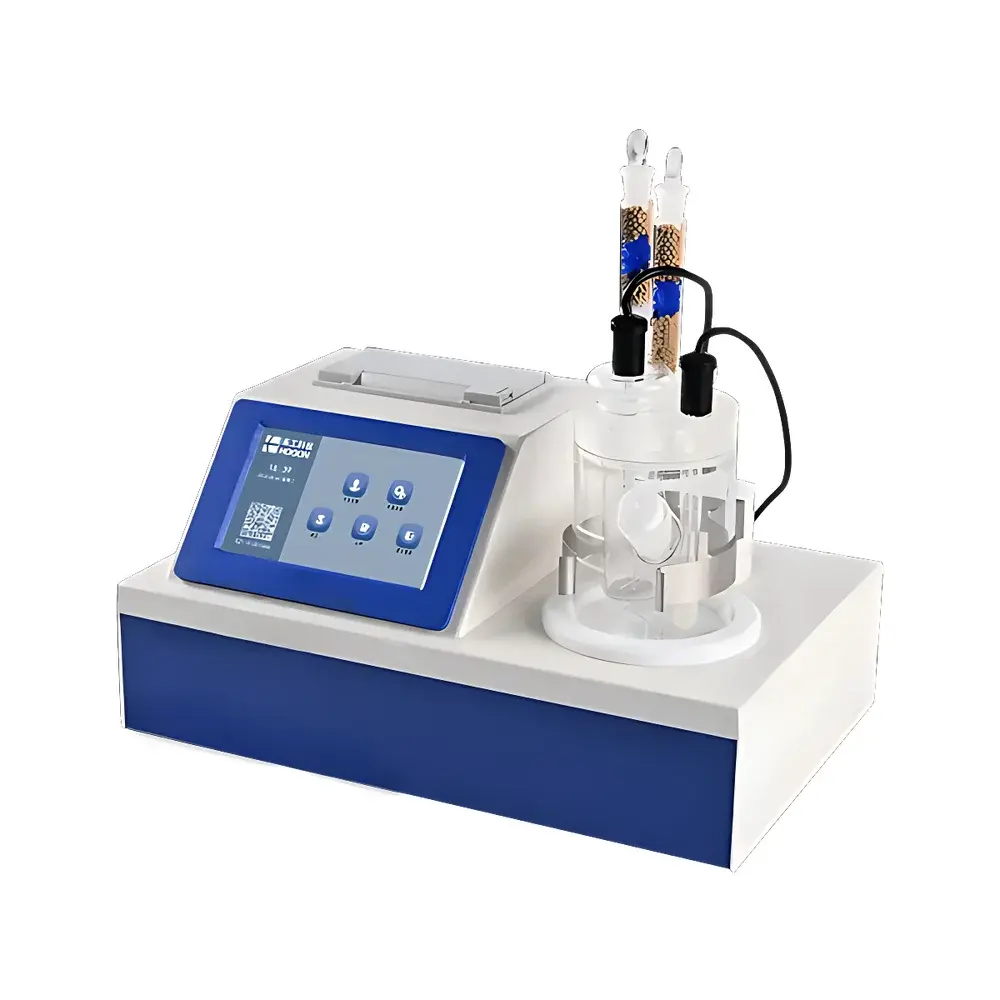
HOGON AKF-3B Bromine Number and Bromine Index Analyzer
| Brand | HOGON |
|---|---|
| Origin | Shanghai, China |
| Manufacturer Type | Direct Manufacturer |
| Instrument Type | Coulometric Karl Fischer Analyzer |
| Measurement Principle | Microcoulometric Titration (Electrolytic Bromine Generation) |
| Bromine Number Range | 0–300 g Br/100 g sample |
| Bromine Index Range | 1–1000 mg Br/100 g sample |
| Resolution | 0.01 mg Br |
| Accuracy | ±3% (±0.3 mg Br when bromine index < 1 mg Br/100 g) |
| Repeatability | ±3% |
| Titration Control Precision | ±3% (±0.3 mg Br at low-level detection) |
| Power Supply | 220 V AC / 50 Hz |
| Data Storage Capacity | Internal memory supporting >1000 test records |
| Compliance Standards | SH/T 0630, GB/T 11136, ASTM D1492 |
| Endpoint Detection | Potentiometric (dual-platinum electrode system) |
| Electrolyte Compatibility | Benzene-free electrolyte formulations |
| Display | 7-inch color TFT touchscreen interface |
| Average Analysis Time | ≤60 seconds per sample |
Overview
The HOGON AKF-3B Bromine Number and Bromine Index Analyzer is a dedicated microcoulometric titration instrument engineered for the precise quantification of unsaturated hydrocarbons in petroleum-based samples. It operates on the fundamental principle of controlled electrochemical generation of bromine within a sealed titration cell: upon sample introduction, bromine is generated *in situ* via constant-current electrolysis of bromide-containing electrolyte; the bromine reacts stoichiometrically with carbon–carbon double bonds in the sample; the endpoint is detected potentiometrically by a dual-platinum electrode pair monitoring the redox potential shift as free bromine accumulates. The total charge consumed during electrolysis—measured in coulombs—is directly proportional to the bromine reacted, enabling calculation of bromine number (g Br/100 g) or bromine index (mg Br/100 g) using Faraday’s law. This method eliminates volumetric reagent handling, minimizes reagent consumption, and delivers inherently high sensitivity and reproducibility for trace-level unsaturation analysis in fuels and lubricants.
Key Features
- Microcoulometric Precision: Utilizes a stable, low-noise constant-current power supply and high-fidelity potentiometric endpoint detection to achieve ±3% accuracy across the full dynamic range, with enhanced low-level precision (±0.3 mg Br) below 1 mg Br/100 g.
- Benzene-Free Operation: Fully compatible with modern, low-toxicity electrolytes—eliminating occupational exposure risks associated with traditional benzene-based solvents and supporting laboratory safety compliance (OSHA 29 CFR 1910.1200, GHS).
- High-Throughput Workflow: Intelligent endpoint recognition and multi-stage electrolysis current control reduce typical analysis time to under 60 seconds per sample, significantly increasing lab throughput without compromising data integrity.
- Robust Electrochemical Architecture: Sealed titration cell design with inert PTFE components and corrosion-resistant electrodes ensures long-term stability and resistance to aggressive petrochemical matrices.
- Intuitive Human-Machine Interface: 7-inch capacitive touchscreen with graphical real-time titration curve display, on-screen method editing, and context-sensitive help reduces operator training time and minimizes procedural errors.
Sample Compatibility & Compliance
The AKF-3B is validated for direct analysis of liquid hydrocarbon samples including gasoline, kerosene, diesel fuel, base oils, lubricants, naphthas, light and heavy aromatic streams, and alkylate fractions. Its measurement range (bromine index: 1–1000 mg Br/100 g; bromine number: 0–300 g Br/100 g) covers both highly refined products and feedstocks with significant olefin content. The instrument conforms to internationally recognized standard test methods—including SH/T 0630 (China), GB/T 11136 (China), and ASTM D1492 (Standard Test Method for Bromine Number of Petroleum Hydrocarbons)—ensuring analytical results are technically defensible and accepted in regulatory, quality control, and R&D contexts. Its design supports GLP-compliant operation through secure user access levels, audit-trail-enabled data logging, and electronic signature-ready reporting.
Software & Data Management
Embedded firmware provides comprehensive data handling capabilities: all raw titration curves, calculated results, method parameters, operator ID, date/time stamps, and environmental metadata are stored internally in non-volatile memory (capacity >1000 records). Data export is supported via USB interface in CSV format for external LIMS integration or statistical review. The system maintains full traceability—each record includes unique test ID, sample weight, electrolysis charge (C), calculated bromine value, and pass/fail status against user-defined specification limits. While not FDA 21 CFR Part 11 certified out-of-the-box, the architecture supports future validation for regulated environments through optional software upgrades and documented IQ/OQ protocols.
Applications
- Quality assurance of finished gasoline and jet fuel for oxidation stability prediction (ASTM D2274, D525)
- Monitoring olefin content in alkylation unit feed and product streams to optimize catalyst life and selectivity
- Assessing hydrogenation efficiency in refinery hydrotreaters and hydrocrackers
- Research and development of novel lubricant additives and synthetic base stocks
- Compliance testing for biodiesel blends (ASTM D6751) where residual unsaturation affects oxidative degradation
- Batch release testing in petrochemical manufacturing per internal QC specifications aligned with ISO/IEC 17025 requirements
FAQ
What electrochemical principle does the AKF-3B employ?
It uses microcoulometric titration: bromine is generated electrolytically from bromide ions in the titration cell, reacting quantitatively with unsaturated bonds; the total charge consumed determines the bromine content.
Can the AKF-3B analyze solid or viscous samples?
No—it is designed exclusively for low-viscosity liquid hydrocarbons soluble in the electrolyte matrix; samples must be homogeneous and free of particulates or water-insoluble contaminants.
Is method validation support available?
Yes—HOGON provides application notes, standard operating procedures (SOPs), and performance verification protocols aligned with SH/T 0630 and ASTM D1492 for laboratory method validation and accreditation readiness.
How is data integrity ensured during long-term operation?
All measurements are timestamped, user-logged, and stored with full parameter traceability; internal memory retains data even after power loss, and USB export enables offline backup and version-controlled archiving.
Does the instrument require routine calibration with certified reference materials?
While no daily calibration is required, periodic verification using NIST-traceable bromine index standards (e.g., 100–2000 mg Br/100 g) is recommended per ISO/IEC 17025 clause 7.7 to confirm ongoing accuracy and measurement uncertainty.





