
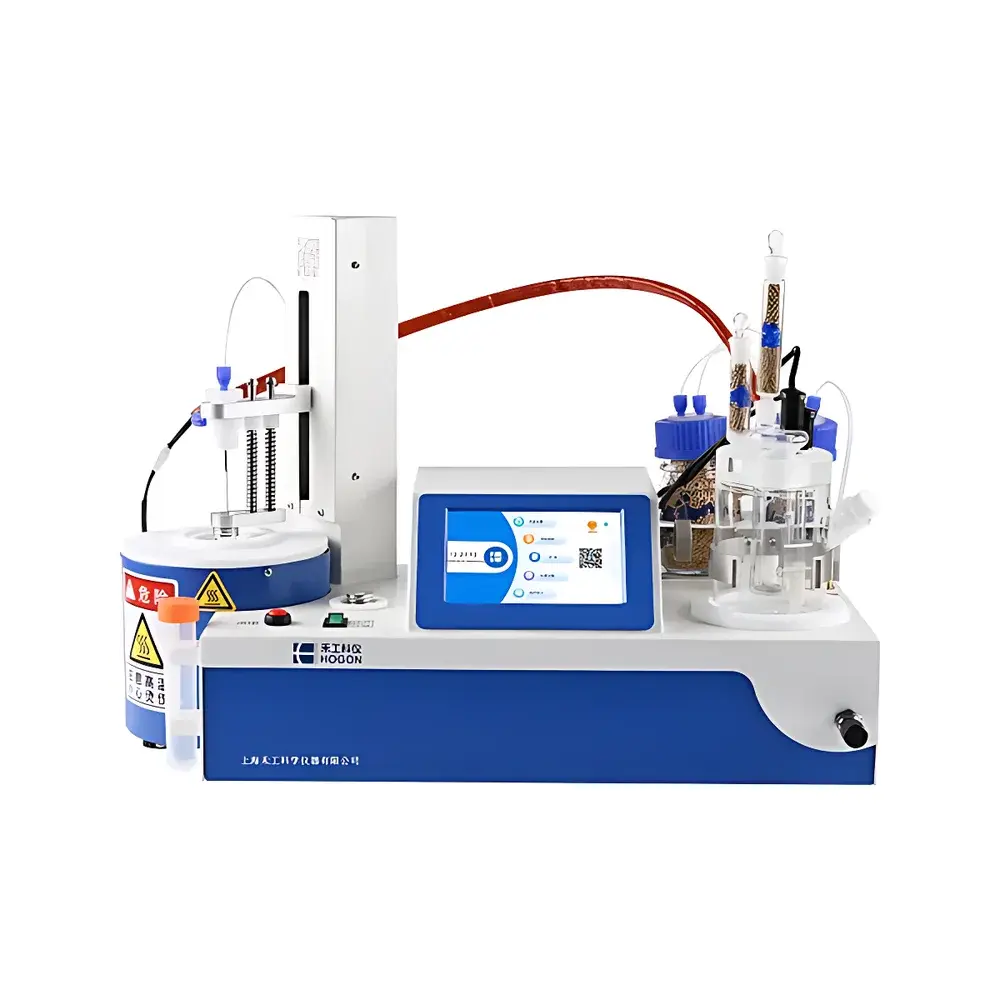
HOGON AKF-CH6 Coulometric Karl Fischer Moisture Analyzer for Lithium Sulfide (Li₂S) Solid-State Battery Materials
| Brand | HOGON |
|---|---|
| Origin | Shanghai, China |
| Manufacturer | Yes |
| Type | Domestic |
| Model | AKF-CH6 |
| Price | USD 9,500 (approx.) |
Overview
The HOGON AKF-CH6 Coulometric Karl Fischer Moisture Analyzer is a purpose-engineered instrument designed to quantify trace moisture in air- and moisture-sensitive solid-state battery materials—specifically lithium sulfide (Li₂S) and related sulfide-based solid electrolytes. These materials exhibit exceptional ionic conductivity but undergo rapid hydrolysis upon exposure to ambient humidity, generating H₂S gas and degrading ionic transport pathways. Accurate quantification of residual moisture at the ppm level is therefore critical for process development, raw material qualification, and final product release in solid-state battery manufacturing. The AKF-CH6 implements coulometric Karl Fischer titration—a primary-standard electrochemical method—where water reacts stoichiometrically with iodine generated in situ via controlled electrolysis of iodide ions. This principle ensures absolute quantification without reliance on reagent calibration curves, delivering metrological traceability aligned with ISO 8533 and ASTM E203 requirements.
Key Features
- Coulometric detection limit of ≤0.1 µg H₂O, enabling reliable measurement of moisture content in Li₂S samples down to 1–5 ppm (w/w) with <2% RSD across replicate analyses.
- Integrated heating oven module (temperature range: 50–250 °C, ±0.5 °C stability) with programmable ramp/hold profiles, optimized for quantitative water release from non-soluble, hygroscopic sulfide powders under inert carrier gas (N₂ or Ar).
- Hermetically sealed, double-compartment titration cell featuring dual platinum indicator electrodes and a diaphragm-separated generator electrode—prevents reagent contamination and eliminates cross-talk between oxidation/reduction zones.
- Automated syringe-based sample introduction with needle-penetration detection; supports both direct liquid injection and headspace vapor transfer from sealed vials (10–20 mL capacity).
- Real-time current monitoring and endpoint determination via dynamic polarization threshold algorithm, minimizing over-titration and ensuring consistent endpoint reproducibility.
- Compliant with GLP/GMP documentation standards: full audit trail, user access levels, electronic signatures, and data export in CSV/PDF formats per FDA 21 CFR Part 11 requirements.
Sample Compatibility & Compliance
The AKF-CH6 is validated for use with lithium sulfide (Li₂S), Li₃PS₄, Li₁₀GeP₂S₁₂ (LGPS), and other thio-LISICON-type electrolytes. Sample forms include dry powders, slurry-coated electrodes, and pressed pellets. All handling procedures assume glovebox integration (O₂/H₂O < 0.1 ppm) during sample weighing and vial loading. The system meets IEC 62660-1 for electric vehicle battery component testing and supports compliance with USP <921>, Ph. Eur. 2.5.12, and ISO/IEC 17025 for accredited moisture testing laboratories.
Software & Data Management
HOGON’s proprietary AKF-Control v4.2 software provides intuitive workflow-driven operation: method setup, real-time titration curve visualization, automatic calculation of moisture concentration (ppm or % w/w), and statistical summary (mean, SD, RSD, confidence intervals). Raw data—including current vs. time, temperature logs, and gas flow rates—are stored with immutable timestamps. Data integrity safeguards include encrypted local storage, optional network backup, and role-based permissions (administrator, analyst, reviewer). Exported reports include instrument ID, operator ID, calibration history, and environmental condition metadata.
Applications
- Optimization of sulfide electrolyte synthesis routes (e.g., mechanochemical milling, solution-phase precipitation) by correlating residual moisture with ionic conductivity and interfacial stability.
- In-process quality control of Li₂S feedstock batches prior to solid electrolyte pelletization or composite cathode blending.
- Stability assessment of packaged electrolyte powders under accelerated aging (40 °C / 75% RH) per IEC 61434 guidelines.
- Verification of drying efficacy in vacuum ovens and solvent-free processing lines used in solid-state battery pilot production.
- Root-cause analysis of premature cell failure linked to H₂S evolution during cycling—traced back to initial moisture load in active materials.
FAQ
What is the recommended sample mass range for Li₂S analysis?
For optimal signal-to-noise ratio and sub-ppm precision, use 0.3–0.6 g of homogenized Li₂S powder per test. Smaller masses increase relative weighing uncertainty; larger masses may exceed the cell’s water capacity (max. 500 µg H₂O per titration).
Can the AKF-CH6 be operated inside an argon-filled glovebox?
Yes—the instrument’s external dimensions (W×D×H: 420 × 380 × 280 mm) and rear-mounted gas inlet/outlet ports allow seamless integration into standard glovebox antechambers. Optional low-profile oven extension kits are available for restricted-height environments.
How often must the Karl Fischer reagent be replaced?
Under typical usage (10–15 tests/day), the coulometric anolyte remains stable for ≥6 weeks when stored under nitrogen. Reagent exhaustion is automatically detected via rising baseline current (>2 µA sustained >60 s) and triggers a visual alert in the software interface.
Is method validation support available for regulatory submissions?
HOGON provides IQ/OQ documentation templates, system suitability test protocols (including repeatability, intermediate precision, and robustness per ICH Q2(R2)), and application notes referenced in peer-reviewed journals (e.g., Journal of Power Sources, Vol. 512, 2021).





