
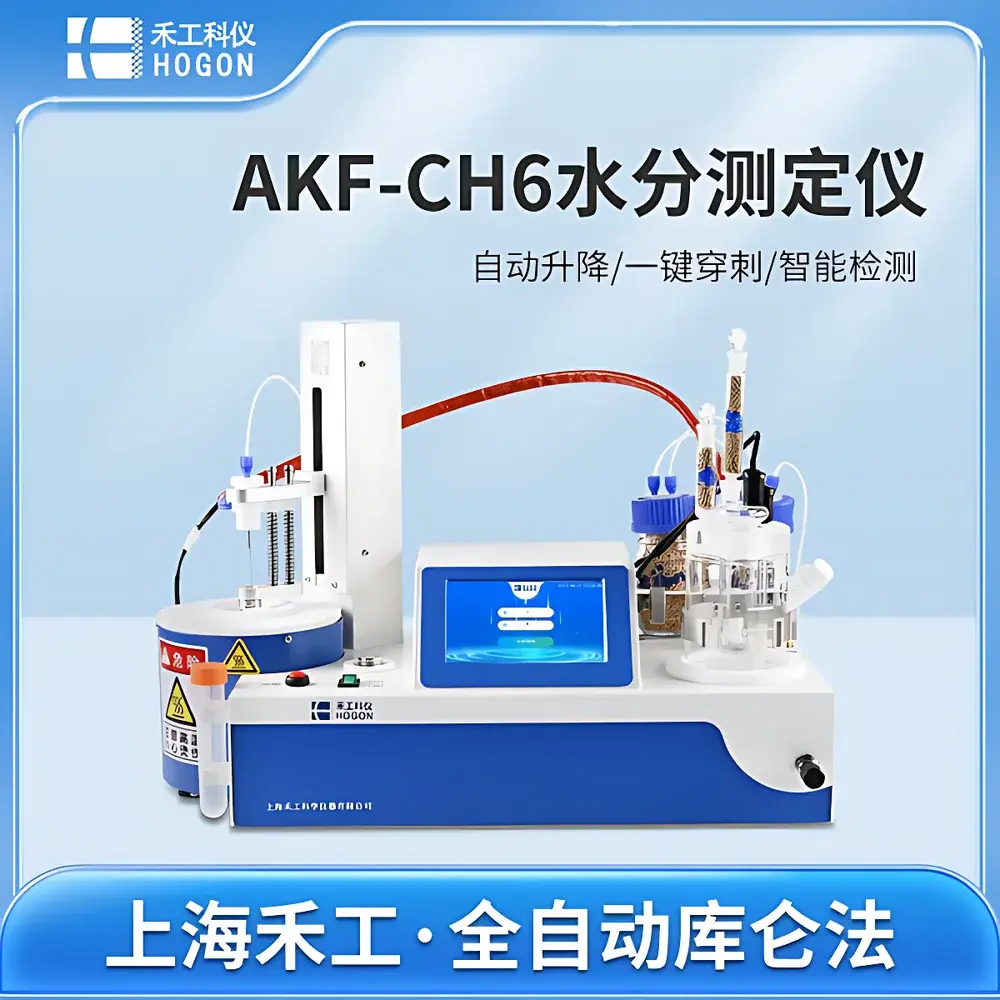
HOGON AKF-CH6 Surgical Suture-Specific Coulometric Karl Fischer Moisture Analyzer
| Brand | HOGON |
|---|---|
| Origin | Shanghai, China |
| Manufacturer Type | Direct Manufacturer |
| Instrument Type | Coulometric Karl Fischer Titrator |
| Moisture Range | 1 ppm to 100% (w/w) |
| Resolution | 0.01 µg H₂O |
| Accuracy | ≥99.7% at 1000 µg H₂O |
| Minimum Sample Injection | 3 µg |
| Repeatability | ≤0.3% RSD |
| Linearity (r²) | ≥0.998 |
| Polarization Voltage Adjustment Range | ±10% |
| Electrode Configuration | Dual Platinum Electrolysis Electrodes |
| Titration Control Precision | 0.01 µg H₂O |
| Power Supply | 220 V / 50 Hz, 300 W |
| Data Storage | Internal non-volatile memory with timestamped audit trail |
Overview
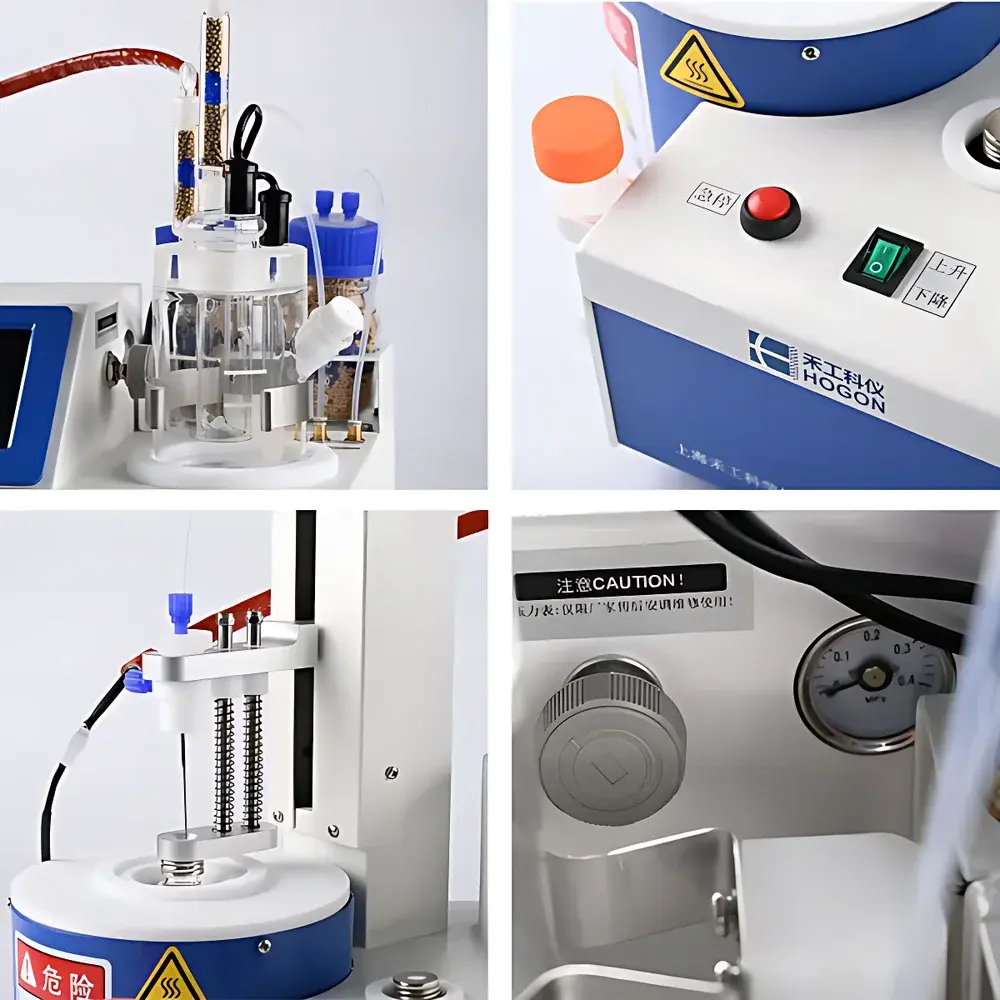
The HOGON AKF-CH6 Surgical Suture-Specific Coulometric Karl Fischer Moisture Analyzer is an engineered solution for trace-level water quantification in high-value biomedical polymer materials—specifically designed for regulatory-compliant moisture analysis of absorbable surgical sutures such as poly(lactic acid) (PLA), poly(glycolic acid) (PGA), and poly(vinyl alcohol) (PVA). Unlike volumetric KF systems, the AKF-CH6 employs coulometric titration, where iodine is electrogenerated in situ at the anode via Faraday-controlled oxidation of iodide ions. This principle enables ultra-trace detection down to 1 ppm (µg/g) with exceptional sensitivity and minimal reagent consumption. The instrument’s architecture integrates a sealed, moisture-tight titration cell, dual-platinum electrolysis electrodes, and real-time current monitoring to ensure stoichiometric generation and precise endpoint detection per the Karl Fischer reaction: I₂ + SO₂ + H₂O + 3RN + CH₃OH → 2RN·HI + RN·HSO₄CH₃. Its design addresses the critical need for reproducible, low-bias moisture data in suture manufacturing—where residual water content directly influences hydrolytic degradation kinetics, tensile strength retention, and shelf-life validation under ISO 13485 and ASTM F2102.
Key Features
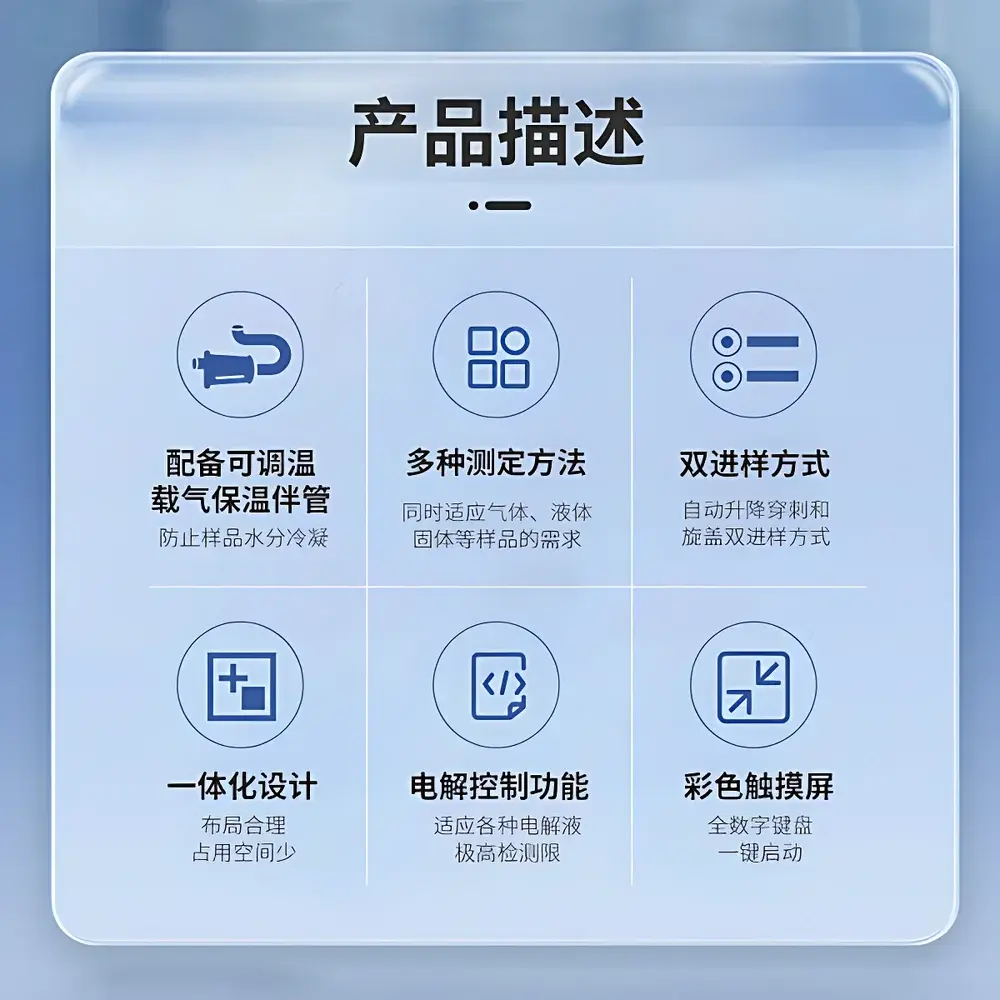
- Coulometric titration mode optimized for sub-milligram water quantification in hygroscopic, low-moisture polymers (1 ppm–100% w/w)
- Dual-platinum electrolysis electrode assembly with adjustable polarization voltage (±10%) for stable current control and minimized overpotential effects
- High-precision micro-dosing capability: minimum detectable water mass of 0.01 µg, supported by 3 µg minimum injection volume compatibility
- Automated titration sequence with adaptive endpoint recognition based on dynamic current decay profiling
- Integrated non-volatile memory storing full measurement records—including date/time stamps, operator ID, method parameters, raw current-time curves, and final moisture results
- Rugged, modular cell design with quick-release fittings and inert PTFE/PFA wetted materials compliant with USP and ISO 8573-1 Class 2 purity requirements
Sample Compatibility & Compliance
The AKF-CH6 is validated for direct analysis of solid suture monofilaments, braided strands, and sterilized packaging matrices without derivatization or solvent extraction. It accommodates samples up to 5 g using standardized oven-drying pre-treatment (optional) or direct dissolution in KF-compatible anhydrous solvents (e.g., chloroform/methanol mixtures per ASTM D6304 Annex A2). All measurement protocols adhere to ISO 8573-3 (compressed air moisture), USP , and EP 2.5.12. The system supports GLP/GMP documentation workflows: audit trails are immutable, user access levels are configurable, and electronic signatures comply with FDA 21 CFR Part 11 requirements when paired with validated LIMS integration.
Software & Data Management
The embedded firmware provides intuitive touchscreen navigation with preloaded suture-specific methods (e.g., “PLA_Suture_Standard”, “PGA_Braided_QC”). Each method defines solvent volume, stirring speed, drift compensation threshold, and endpoint stabilization criteria. Raw data—including current vs. time plots, cumulative charge integration, and stoichiometric water mass calculation—are exportable via USB to CSV or PDF formats. Optional PC software enables multi-instrument fleet monitoring, statistical process control (SPC) charting (X-bar/R), and automated report generation aligned with ISO/IEC 17025 clause 7.8.2.
Applications
- Release testing of absorbable sutures per manufacturer specifications and pharmacopoeial monographs
- Stability study support: moisture ingress evaluation during accelerated aging (40°C/75% RH per ICH Q1A)
- In-process QC of polymer extrusion and fiber drawing stages where residual solvent or ambient humidity affects crystallinity
- Comparative assessment of packaging barrier performance (e.g., Tyvek® vs. foil-laminate pouches)
- Root cause analysis of premature suture degradation observed in clinical or simulated physiological environments
FAQ
Is the AKF-CH6 compatible with non-aqueous solvents commonly used for polymer dissolution?
Yes—the titration cell and electrode housing are chemically resistant to anhydrous methanol, chloroform, formamide, and other KF-compatible solvents per ASTM D1364 guidelines.
Can the system be validated for GMP-regulated environments?
Yes—full IQ/OQ documentation templates are provided; the instrument meets 21 CFR Part 11 requirements for electronic records and signatures when configured with password-protected user roles and audit-trail-enabled firmware.
What maintenance is required for long-term operational stability?
Daily: cell cleaning with dry acetone and electrode polishing. Quarterly: replacement of molecular sieve drying tubes and verification of electrolyte conductivity. Annual: calibration against certified water standards (e.g., Hydranal® 1.00 mg/mL).
Does it support automatic sample changers?
No—the AKF-CH6 is a benchtop single-position analyzer optimized for manual, high-accuracy suture testing; however, its RS-232/USB interface allows external robotic arm triggering via TTL signal handshake.
How is linearity verified across the 1 ppm–100% range?
Using gravimetrically prepared water standards (0.1–10,000 µg H₂O) dissolved in dry solvent, following ISO 12099:2017 Annex B procedures; correlation coefficient ≥0.998 confirms linear response under defined cell conditions.





