
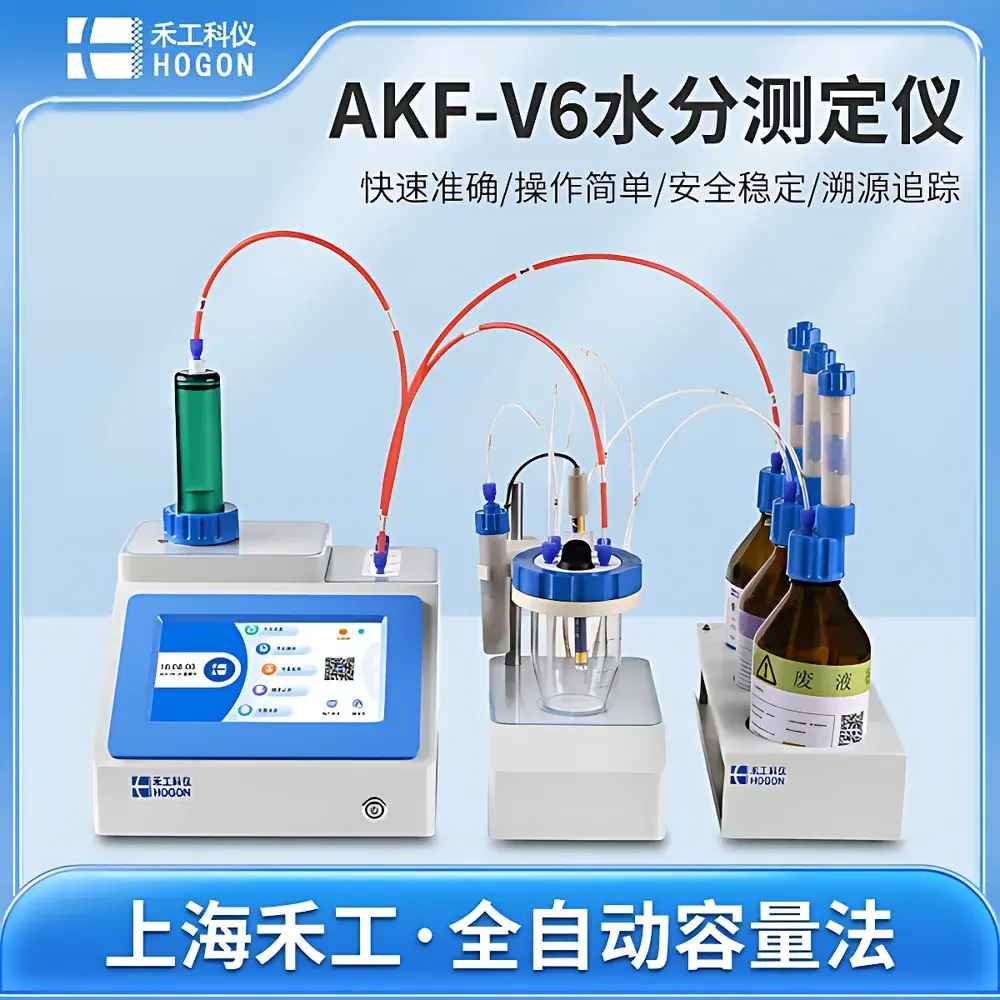
HOGON AKF-V6 Karl Fischer Moisture Analyzer with Integrated Heating & Stirring Platform for Butter Analysis
| Brand | HOGON |
|---|---|
| Origin | Zhejiang, China |
| Manufacturer Type | Direct Manufacturer |
| Instrument Type | Volumetric Karl Fischer Titrator |
| Moisture Range | 10 ppm to 100% (0.001–100% H₂O) |
| Resolution | 0.1 ppm |
| Accuracy | RSD ≤ 0.3% (at 1500 µL reagent consumption) |
| Minimum Dispensing Volume | 0.5 µL (20 mL burette) |
| Repeatability | ±0.3% |
| Linearity (r²) | ≥0.999 |
| Polarization Voltage Range | 0–120 mV |
| Burette Options | 20 mL / 10 mL |
| Titration Precision | ±0.5 µL (20 mL burette) |
| Power Supply | 110–240 V AC, 50–65 Hz |
| Data Storage Capacity | 200 test records |
Overview
The HOGON AKF-V6 Karl Fischer Moisture Analyzer is a fully automated volumetric titrator engineered for high-precision water content determination in challenging, low-solubility matrices—particularly butter and other high-fat dairy products. It operates on the stoichiometric iodine-based redox reaction defined by the Karl Fischer method (ISO 8534, ASTM E203), where water reacts quantitatively with iodine, sulfur dioxide, and a base in anhydrous methanol medium. The AKF-V6 employs bipotentiometric endpoint detection via dual-platinum electrodes and adjustable polarization voltage (0–120 mV), enabling robust discrimination of true endpoints even in viscous, emulsified, or thermally sensitive samples. Its integrated heating and stirring platform (HS-2) actively enhances sample dissolution kinetics at controlled temperatures (up to 80 °C), ensuring complete release and accessibility of bound water from lipid-rich matrices—thereby eliminating underestimation due to incomplete extraction.
Key Features
- Fully automated volumetric titration with real-time endpoint recognition and adaptive dosing logic
- Dual-platinum electrode system with user-adjustable polarization voltage for optimized sensitivity across diverse sample types
- Integrated HS-2 heating/stirring platform (temperature range: ambient to 80 °C; stir speed: 0–1200 rpm) for homogeneous dispersion and accelerated water liberation from butter and similar fatty matrices
- High-precision 20 mL glass burette with ±0.5 µL dispensing accuracy and 0.5 µL minimum step volume
- Hermetically sealed titration cell assembly with desiccant guard and moisture-trap inlet to maintain anhydrous internal environment
- Pre-programmed titration methods—including solvent blanking, reagent standardization (using certified 10 µL water standards), and sample analysis—with audit-trail-capable execution logging
- Onboard calculation engine compliant with ISO 760 and USP for automatic conversion of titrant volume to % H₂O or ppm, with uncertainty propagation per GUM guidelines
Sample Compatibility & Compliance
The AKF-V6 is validated for direct analysis of solid, semi-solid, and viscous food-grade samples without prior solvent extraction—especially critical for butter (typical moisture: 12–18% w/w), margarine, cheese spreads, and cocoa butter derivatives. Its heating/stirring capability enables full compatibility with ISO 17363:2022 (milk fat products), AOAC Official Method 985.17 (moisture in fats/oils), and Codex Alimentarius Standard 206-1999. All firmware and data handling routines support GLP/GMP traceability requirements: time-stamped method logs, electronic signatures, and immutable storage of raw titration curves, endpoint thresholds, and calibration history. The system meets electromagnetic compatibility (EMC) per IEC 61326-1 and safety standards per IEC 61010-1.
Software & Data Management
The embedded control interface supports bilingual operation (English/Chinese) and provides full method parameterization—including pre-titration solvent volume (e.g., 30 mL anhydrous methanol), blank correction duration, endpoint stability window (10 s), and post-endpoint delay (30 s). Each assay generates a structured data file containing titrant consumption (µL), calculated water mass (µg), normalized concentration (% w/w or ppm), RSD per replicate, and raw potential-vs.-time curve export (CSV). Up to 200 test records are retained with metadata (operator ID, timestamp, sample ID, method version). Optional USB export enables integration into LIMS environments; audit trails comply with FDA 21 CFR Part 11 when paired with external identity management.
Applications
- Quantitative moisture verification in finished butter batches per national food safety standards (e.g., GB 19641–2015, EU Regulation (EC) No 1234/2007)
- In-process monitoring during churning and working stages to optimize yield and texture consistency
- Stability assessment of salted vs. unsalted butter formulations under accelerated shelf-life testing
- Raw material screening of cream and cultured buttermilk inputs
- QC/QA release testing in dairy co-ops and industrial spread manufacturers requiring <±0.05% absolute repeatability
- Method transfer validation between central labs and production-floor units using identical AKF-V6 configurations
FAQ
What sample preparation is required for butter analysis?
No solvent extraction or homogenization is needed. Solid butter samples (1–3 g) are weighed directly into the heated titration vessel and dissolved in situ using the HS-2 platform at 60–70 °C.
Can the AKF-V6 validate compliance with ISO 17363?
Yes—the instrument’s measurement uncertainty profile, documented repeatability (RSD ≤ 0.3%), and traceable calibration protocol satisfy the precision and reporting requirements of ISO 17363:2022.
How does the heating/stirring platform improve accuracy for high-fat samples?
It prevents localized thermal degradation while ensuring uniform dispersion, accelerating hydrolysis of water-lipid complexes and minimizing endpoint drift caused by slow diffusion-limited reaction kinetics.
Is reagent standardization mandatory before each batch?
Per ISO 8534, daily standardization using certified water standards is recommended; the AKF-V6 automates this process with multi-point averaging and auto-acceptance criteria (r² ≥ 0.999).
Does the system support remote diagnostics or firmware updates?
Firmware updates are performed via USB drive; remote diagnostic access is not enabled by default but can be configured under secure IT-admin protocols for enterprise deployments.






