
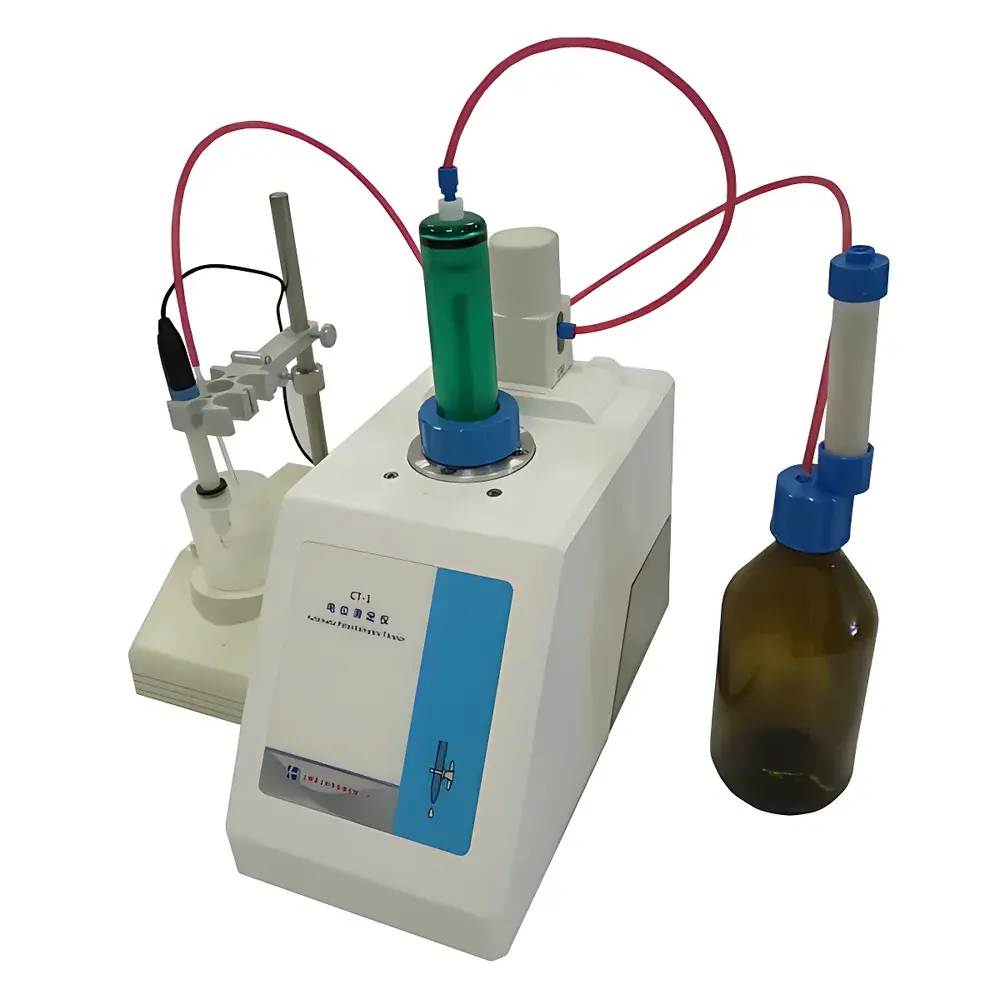
HOGON AT-1 Advanced Automatic Potentiometric Titrator
| Brand | HOGON |
|---|---|
| Origin | Shanghai, China |
| Manufacturer Type | Direct Manufacturer |
| Model | AT-1 Advanced |
| Instrument Type | General-purpose Potentiometric Titrator |
| Application Scope | Universal |
| Measurement Range | mV: −2000 to +2000 mV |
| pH | 0.000–14.000 |
| Temperature | −55 to +125 °C |
| Meter Accuracy | ±0.5% of full scale |
| Meter Resolution | 0.1 mV |
| Titration Precision | 0.8 mV/h |
| Input Impedance | >1 × 10¹² Ω |
| Bias Current | <1 × 10⁻¹² A |
| Titration Volume Resolution | 1 µL (with 20 mL burette) |
| Electrode Interfaces | Composite, Reference, Indicator, and Temperature Electrode Ports |
| GLP Compliance | User authentication, audit trail, electrode & titrant logging, PDF report export, method versioning |
Overview
The HOGON AT-1 Advanced Automatic Potentiometric Titrator is a microprocessor-controlled analytical instrument engineered for precision potentiometric endpoint detection in volumetric titration. It operates on the fundamental electrochemical principle of measuring potential difference (mV) or hydrogen ion activity (pH) across a galvanic cell formed by indicator and reference electrodes immersed in the analyte solution. As titrant is incrementally dispensed, the system continuously monitors the potential shift; endpoint determination is achieved via first-derivative analysis (dE/dV) or fixed-threshold EP detection, enabling accurate quantification of acid-base, redox, complexometric, precipitation, and non-aqueous reactions. Designed for routine QC laboratories, academic research facilities, and industrial process control environments, the AT-1 delivers metrological consistency aligned with ISO/IEC 17025 calibration requirements and supports traceable measurement practices under GLP and GMP frameworks.
Key Features
- PC-based operation via high-speed USB interface with dedicated Windows software—enabling real-time visualization of titration curves, first-derivative plots, and dynamic endpoint recognition.
- Dual stirring options: PWM-controlled magnetic stirrer (standard) or rod-type helical stirrer—both featuring programmable speed profiles and anti-interference modulation for viscous or heterogeneous samples.
- Modular electrode architecture supporting simultaneous connection of composite pH electrodes, separate reference/indicator electrodes, and Pt or Ag/AgCl redox electrodes—fully compatible with temperature compensation via integrated Pt1000 sensor.
- High-resolution dispensing system with 1 µL volumetric resolution (at 20 mL burette capacity), utilizing chemically inert tubing and pump components resistant to perchloric acid, acetic anhydride, and other aggressive non-aqueous reagents.
- Intelligent endpoint algorithms including dynamic equivalence point (EQP), incremental EQP, fixed-potential (EP) stop, constant-pH titration, and manual stepwise addition—each configurable with user-defined thresholds, delay times, and slope criteria.
- Robust mechanical design featuring PBT+PP housing, motorized burette lift mechanism, and automatic post-run rinse cycle—minimizing carryover and operator intervention.
- Comprehensive data integrity safeguards: power-fail recovery, encrypted user accounts (admin/operator/reviewer roles), timestamped audit logs, and PDF report generation compliant with FDA 21 CFR Part 11 Annex 11 expectations.
Sample Compatibility & Compliance
The AT-1 accommodates diverse sample matrices—including aqueous buffers, organic solvents (e.g., glacial acetic acid, DMF), suspensions, and emulsions—without compromising electrode stability or signal fidelity. Its wide temperature range (−55 to +125 °C) permits direct integration with thermostatted reaction vessels for kinetic or thermally sensitive titrations. All electrical specifications meet IEC 61010-1 safety standards for laboratory equipment. The system adheres to ASTM E2087 (Standard Practice for Potentiometric Titration), ISO 8655-6 (Piston burettes), and USP <771> (Acid-Base Titrations). Built-in GLP features include mandatory user login, electronic signature support, reagent lot tracking, electrode calibration history, and immutable record retention—facilitating internal audits and regulatory inspections.
Software & Data Management
The proprietary TitraSoft™ platform provides intuitive workflow navigation, customizable method templates, and scalable data handling. Users may define multi-step titration sequences, assign conditional logic (e.g., “if ΔpH > 0.5, pause for 30 s”), and embed metadata (sample ID, batch number, analyst name). Raw mV/pH/time datasets are stored in open-format CSV and internally archived with checksum validation. Software updates are delivered via secure firmware upgrade packages, preserving method continuity during version transitions. All reports comply with ALCOA+ principles (Attributable, Legible, Contemporaneous, Original, Accurate, Complete, Consistent, Enduring, Available) and support digital archiving in LIMS or ELN systems.
Applications
- Pharmaceutical QC: assay of active ingredients (e.g., ibuprofen, ascorbic acid), chloride content in saline solutions, residual catalyst quantification in API synthesis.
- Food & Beverage: titratable acidity in wines and dairy products, peroxide value in edible oils, sulfite determination in preserved fruits.
- Environmental Testing: alkalinity and hardness profiling in wastewater, cyanide detection in effluents via silver nitrate titration.
- Materials Science: free acid number (TAN) in lubricants, hydroxyl value in polyols, chloride ingress testing in concrete pore solutions.
- Academic Research: equilibrium constant determination, pKa mapping of weak acids, stoichiometric studies in coordination chemistry.
FAQ
Does the AT-1 support automated calibration and electrode diagnostics?
Yes—the software includes guided pH/mV calibration routines with two- or three-point buffer selection, automatic slope calculation, and offset verification. Electrode impedance and asymmetry potential are logged per measurement session.
Can the instrument perform back-titrations or multi-stage titrations?
Yes—method editor allows sequential titrant additions, conditional pauses, and intermediate endpoint evaluations within a single run.
Is remote monitoring or network deployment possible?
While native Ethernet or Wi-Fi is not integrated, the USB-connected PC can be accessed remotely via institutional VDI or RDP infrastructure, provided local security policies permit.
What maintenance intervals are recommended for long-term reliability?
Daily: electrode cleaning and storage solution refresh. Quarterly: burette seal inspection and pump tube replacement. Annually: full system verification against NIST-traceable standards.
How does the AT-1 handle volatile or low-boiling-point solvents?
The closed-system design with vapor-tight connections and optional fume hood mounting minimizes evaporation artifacts; temperature-controlled titration vessels further stabilize baseline drift.




