
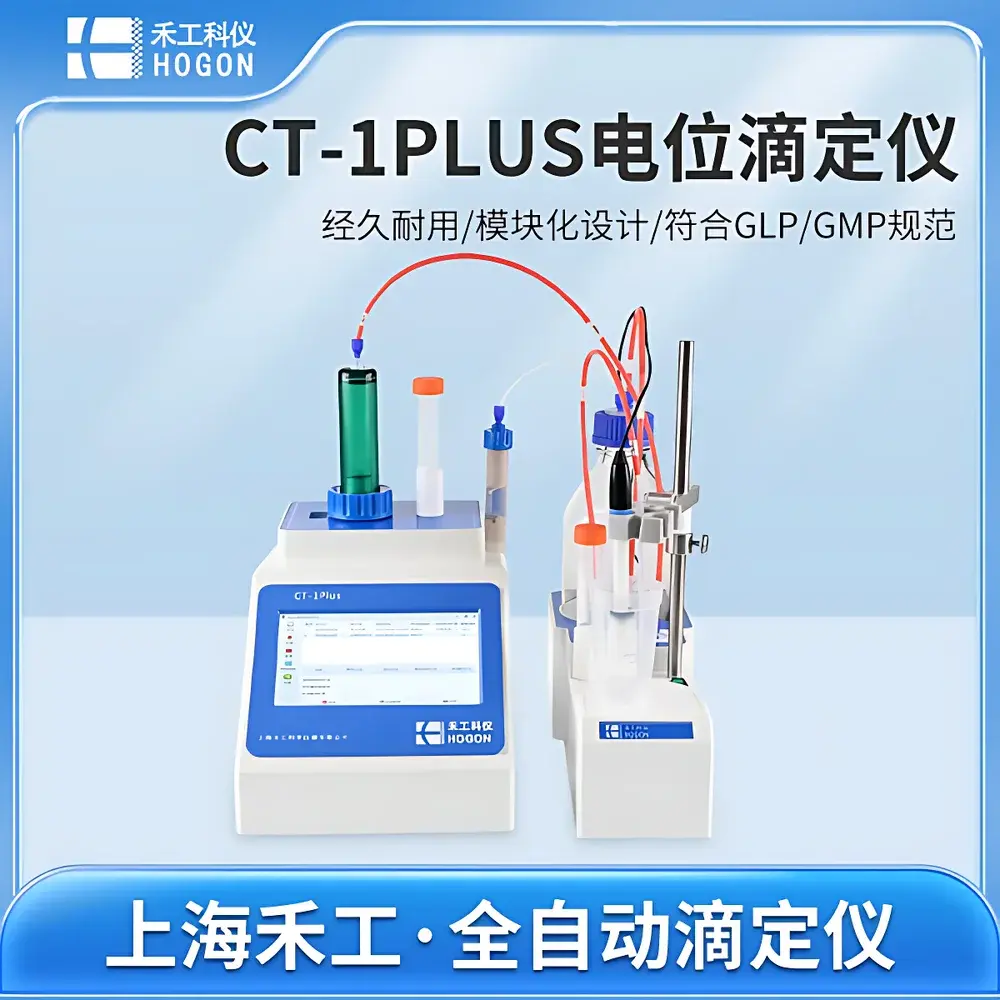
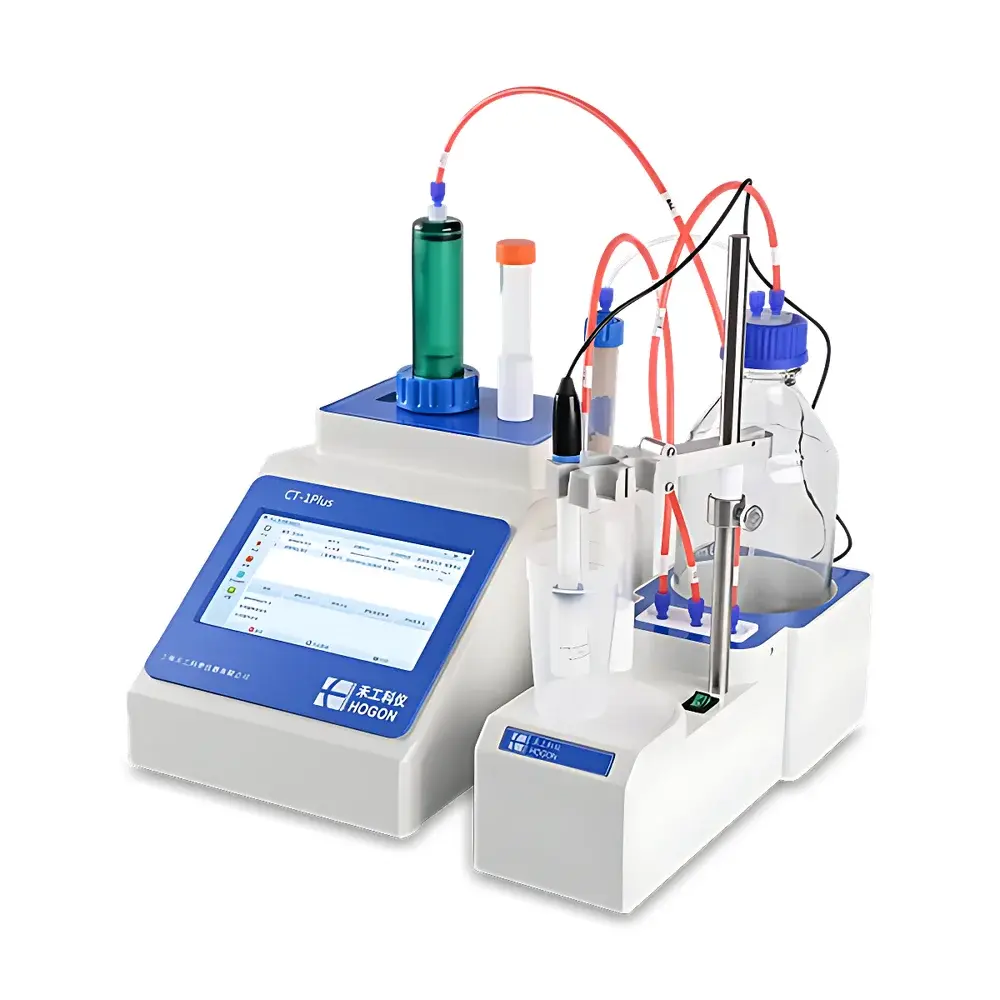
HOGON CT-1PLUS Advanced Fully Automatic Potentiometric Titrator
| Brand | HOGON |
|---|---|
| Origin | Shanghai, China |
| Manufacturer Type | Direct Manufacturer |
| Product Category | Domestic (China-made) |
| Model | CT-1PLUS Advanced |
| Instrument Type | General-purpose Potentiometric Titrator |
| Application Scope | Universal |
| Measurement Ranges | Potential: ±2000 mV |
| pH | 0–14 pH |
| Temperature | −5 to 125 °C |
| Meter Accuracy | ±0.3% of full scale |
| Meter Resolution | Potential: 0.1 mV |
| pH | 0.001 pH |
| Temperature | 0.1 °C |
| Titration Accuracy | (±0.3 mV ±1 digit) over 3 h |
| Titration Resolution | ±2000 mV range, 0.1 mV resolution, ±0.2 mV absolute accuracy |
Overview
The HOGON CT-1PLUS Advanced Fully Automatic Potentiometric Titrator is a dual-mode analytical platform engineered for precision and operational flexibility in modern quality control, research, and regulatory-compliant laboratories. It integrates potentiometric endpoint detection with optional colorimetric endpoint recognition—enabling reliable titration across analytes where conventional electrode-based detection is impractical (e.g., turbid, colored, or non-conductive samples). The instrument operates on classical potentiometric principles: continuous monitoring of potential difference between a reference electrode and an indicator electrode during reagent addition, with endpoint determination via first-derivative (ΔE/ΔV) or second-derivative (Δ²E/ΔV²) algorithms, inflection point detection, or fixed-potential thresholds. Its modular architecture separates fluid handling (high-precision burette module), control logic (embedded real-time OS), and sensing subsystems (electrode interface, optional RGB vision sensor), ensuring serviceability, traceable calibration, and long-term metrological stability.
Key Features
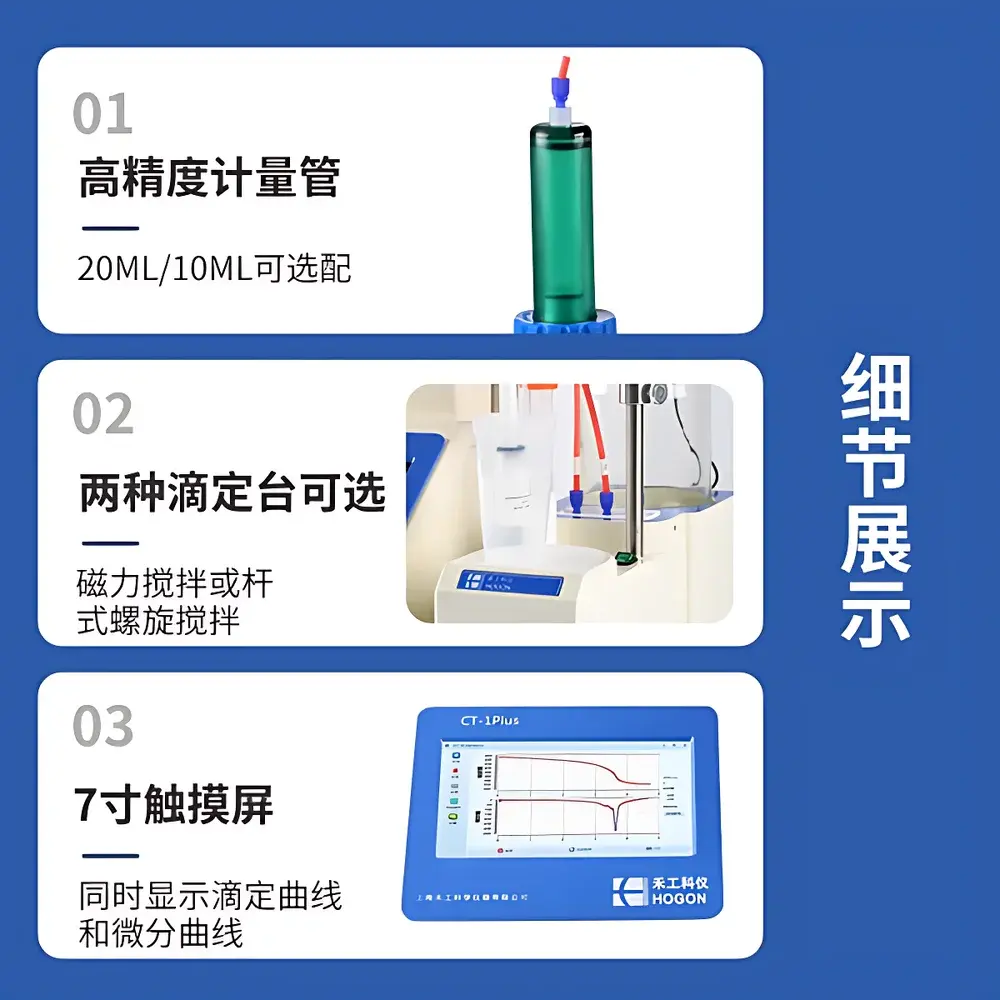
- Modular hardware design with independent burette, controller, and sensor modules—facilitating field maintenance, component replacement, and functional upgrades without system downtime.
- Dual-endpoint detection capability: standard high-stability Ag/AgCl and glass pH electrodes supported; optional integrated color-sensing module employs calibrated RGB imaging and machine vision algorithms to detect subtle hue shifts in indicator-based titrations (e.g., phenolphthalein, methyl orange), eliminating subjective visual interpretation.
- Sub-microliter dispensing precision: volumetric burette with ≤1 µL minimum dispensing increment and gravimetric validation protocol ensures volumetric accuracy traceable to ISO 8655-3, supporting reproducible stoichiometric calculations per IUPAC recommendations.
- Endpoint flexibility: supports fixed-endpoint, dynamic (adaptive rate), crossover (multi-step), and manual override titration modes—all programmable via intuitive touch interface or remote software.
- Hardware-level safety: emergency stop circuit interrupts motor drive, valve actuation, and pump operation within <50 ms upon activation; over-pressure and dry-run protection embedded in fluid path firmware.
- GLP/GMP-ready data integrity: all method parameters, raw sensor signals, calculated endpoints, and audit trails are timestamped, digitally signed, and exported as non-editable PDF reports with embedded cryptographic checksums.
Sample Compatibility & Compliance
The CT-1PLUS accommodates aqueous and mixed-solvent systems across pH 0–14 and temperatures from −5 °C to 125 °C, compatible with standard double-junction reference electrodes, ion-selective electrodes (e.g., F⁻, Cl⁻, CN⁻), and redox sensors (Pt, Au). It complies with ISO 7870-2 (control charts for titrimetric analysis), ASTM E202 (standard test methods for titration), and supports 21 CFR Part 11 compliance when deployed with validated software configuration and user access controls. All electronic records meet ALCOA+ principles (Attributable, Legible, Contemporaneous, Original, Accurate, Complete, Consistent, Enduring, Available) for regulatory audits.
Software & Data Management
The embedded operating system provides on-device method creation, sequence programming, and real-time curve visualization (E vs. V, dE/dV vs. V). Data export supports CSV (raw values), XML (structured metadata), and UDF-encrypted PDF (tamper-evident reports). USB host port enables direct saving to encrypted USB drives; no cloud dependency ensures data sovereignty. Software architecture includes role-based access control (admin/operator/auditor), electronic signatures, and immutable audit logs recording every parameter change, calibration event, and report generation—fully aligned with GLP documentation requirements.
Applications
- Pharmaceutical QC: assay of active pharmaceutical ingredients (APIs) per USP and EP 2.2.20; chloride content in excipients; residual catalyst quantification in synthesis intermediates.
- Food & Beverage: titratable acidity (TA) in wines and juices; salt (NaCl) determination in dairy and canned goods; preservative (sorbic/benzoic acid) analysis via non-aqueous titration.
- Environmental Testing: alkalinity and hardness profiling in wastewater per EPA 310.1; cyanide speciation using silver nitrate titration; fluoride analysis in drinking water.
- Chemical Manufacturing: acid number (ASTM D974) and base number (ASTM D2896) in lubricants; saponification value in fatty acids; free fatty acid (FFA) content in biodiesel feedstocks.
FAQ
Does the CT-1PLUS support remote operation and integration into LIMS?
Yes—via RS-232, USB CDC, or optional Ethernet interface with Modbus TCP protocol; API documentation and HL7-compatible message templates available for LIMS integration.
Can the color-detection module be retrofitted to existing CT-1 units?
No—the CT-1PLUS color module requires dedicated optical housing, synchronized LED illumination control, and firmware-level image processing stack; retrofitting is not supported.
What electrode calibration protocols are implemented?
Two-point pH calibration (NIST-traceable buffers), single-point redox calibration (Quinhydrone or Fe²⁺/Fe³⁺ standard), and automatic slope/offset validation before each titration sequence.
Is temperature compensation applied during pH measurement?
Yes—automatic temperature compensation (ATC) using Pt1000 sensor input; Nernstian slope correction applied in real time per ISO 3696 and IUPAC Technical Report 2011.
How is data integrity verified during PDF report generation?
Each PDF embeds SHA-256 hash of raw data arrays, digital signature of operator ID, and hardware serial number; verification utility provided for third-party audit confirmation.




