
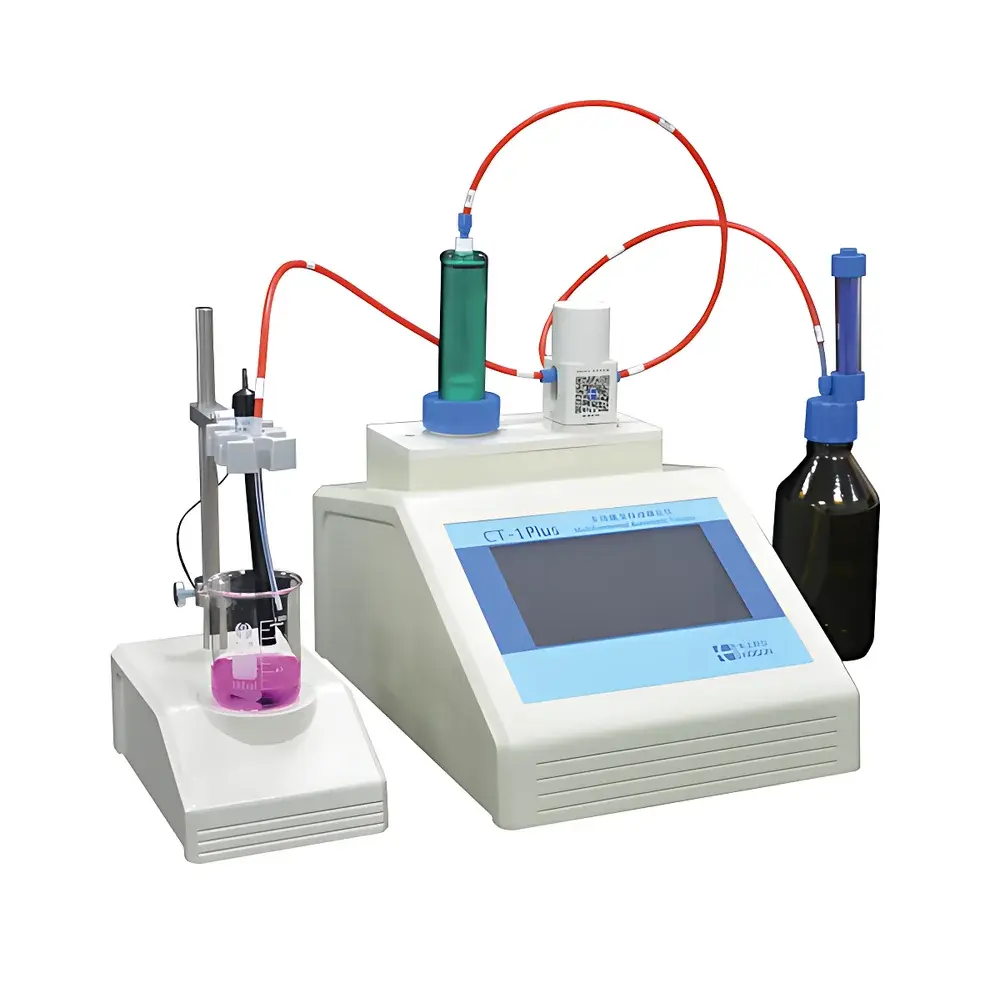
HOGON CT-1Plus Intelligent High-Precision Automatic Potentiometric Titrator
| Brand | HOGON |
|---|---|
| Origin | Shanghai, China |
| Manufacturer Type | Direct Manufacturer |
| Instrument Category | Domestic |
| Model | CT-1Plus Intelligent High-Precision |
| Instrument Type | General-purpose Potentiometric Titrator |
| Application Scope | Universal |
| Measurement Range | −2000 to +2000 mV |
| Meter Accuracy | ±0.35% |
| Meter Resolution | 0.1 mV |
| Titration Stability | ±0.01 pH over 3 h |
| Voltage Range & Resolution | ±2000 mV, 0.1 mV resolution, ±0.2 mV accuracy |
| pH Range & Accuracy | 0–14 pH, 0.001 pH resolution, ±0.003 pH accuracy |
| Temperature Range & Accuracy | −5 to 125 °C, 0.1 °C resolution, ±0.3 °C accuracy |
| Burette Resolution | 20 mL standard burette: 0.001 mL |
| 10 mL optional burette | 0.0005 mL |
| Repeatability | 0.2% (with 20 mL burette) |
| Burette Tolerance | 20 mL burette: ±0.035 mL |
| 10 mL burette | ±0.025 mL |
| Refill Time | 50 ± 10 s |
| Display | 7-inch capacitive touchscreen with real-time titration and first-derivative curve visualization |
Overview
The HOGON CT-1Plus Intelligent High-Precision Automatic Potentiometric Titrator is a dual-mode analytical platform engineered for rigorous quantitative chemical analysis in regulated and research-intensive laboratories. It implements potentiometric endpoint detection based on Nernstian response principles—measuring potential difference between indicator and reference electrodes during titrant addition—and integrates a complementary colorimetric endpoint module using machine vision algorithms to detect chromatic transitions in visually observable reactions. This hybrid architecture enables robust method coverage across classical acid-base, redox, precipitation, complexometric, non-aqueous, and pH-metric titrations, as well as legacy color-indicator-based assays where electrode interference or matrix opacity precludes electrochemical detection. The instrument operates under closed-loop feedback control, dynamically adjusting titrant delivery rate based on slope analysis of the dE/dV curve to achieve sub-microliter volumetric precision and high reproducibility in endpoint determination.
Key Features
- Modular hardware architecture comprising high-precision syringe-driven burette assemblies (standard 20 mL, optional 10 mL), intelligent control unit with embedded ARM processor, and multi-channel electrochemical detection system with auto-calibrating analog front-end
- Dual-mode endpoint recognition: potentiometric (mV/pH/µA) and vision-based colorimetric detection with adjustable hue-saturation-value (HSV) thresholds and real-time pixel intensity gradient analysis
- Sub-1 µL titration control precision achieved via micro-stepping motor actuation and gravimetric validation protocol; burette accuracy certified per ISO 8655-3 for piston burettes
- Comprehensive endpoint logic suite: automatic inflection point detection, fixed-endpoint titration, dynamic equivalence point search, cross-over titration for multi-step reactions, and manual override with live slope monitoring
- Integrated safety architecture including hardware-level emergency stop circuitry, flow obstruction detection, and over-pressure cutoff for peristaltic and syringe pump modules
- 7-inch industrial-grade capacitive touchscreen with glove-compatible operation, supporting both touch input and external USB keyboard for alphanumeric method entry and parameter configuration
Sample Compatibility & Compliance
The CT-1Plus accommodates aqueous, non-aqueous, turbid, colored, and high-ionic-strength samples without modification—enabling direct analysis of crude oils, digestates, polymer solutions, pharmaceutical suspensions, and environmental slurry extracts. Electrode compatibility spans glass pH, Ag/AgCl, Pt, redox, ion-selective (e.g., F⁻, Cl⁻, CN⁻), and combination sensors meeting ASTM D1129 and ISO 3696 water purity requirements. All data acquisition, processing, and reporting functions comply with GLP and GMP documentation standards per FDA 21 CFR Part 11 Annex 11 requirements: electronic signatures, audit trails with immutable timestamps, role-based user authentication (administrator/operator/analyst), and U.S. FDA-compliant PDF report generation with cryptographic hash integrity verification stored on removable USB media. Calibration records—including electrode slope, offset, and isopotential point verification—are time-stamped, version-controlled, and retained indefinitely within the onboard 1 GB flash memory (capacity for >100,000 assay records).
Software & Data Management
Firmware v3.2+ supports method-driven workflow automation with up to 255 programmable methods per user group. Each method encapsulates titrant concentration, electrode type, stirring speed, temperature compensation algorithm (linear or polynomial), endpoint criteria, and post-analysis calculation templates (e.g., % acidity, mg KOH/g, mmol/L Cl⁻). Raw sensor data (mV, pH, µA, °C vs. volume) are logged at ≥10 Hz and exported in CSV or proprietary .TIT binary format. The embedded report engine generates tamper-evident PDFs containing instrument ID, operator ID, calibration history, raw curve plots, derivative overlays, statistical summaries (RSD, confidence intervals), and digital signature blocks—all compliant with ISO/IEC 17025 clause 7.8 and EU GMP Annex 11 traceability mandates. Data export supports networked SMB/CIFS file sharing and local USB mass storage with AES-256 encryption option.
Applications
The CT-1Plus delivers validated performance across regulated sectors: In food testing, it quantifies free fatty acids (AOAC 940.28), sulfur dioxide (AOAC 990.22), total titratable acidity (AOAC 942.15), and chloride (AOAC 971.25); in pharmaceutical QC, it determines halide content in APIs (USP ), acid number in excipients (USP ), and residual catalyst metals; in environmental labs, it measures alkalinity (APHA 2320 B), COD (ISO 6060), chloride (ISO 9297), and hardness (ISO 6059); in petrochemical QA, it performs acid number (ASTM D974), iodine value (AOCS Cd 1c-50), and mercaptan sulfur (ASTM D3227); and in academic research, it supports kinetic titration studies, pKa determination, and stoichiometric coefficient validation in coordination chemistry.
FAQ
Does the CT-1Plus support ASTM or ISO-standardized titration methods out of the box?
Yes—preconfigured method templates for ASTM D974, ISO 6059, AOAC 940.28, and USP are included, with full traceability to original standard clauses.
Can the colorimetric module be used independently of the potentiometric system?
Yes—the vision module operates as a standalone endpoint detector; no electrode connection is required for color-based titrations.
Is remote monitoring or integration with LIMS possible?
The instrument provides RS-232, USB Device, and optional Ethernet interfaces with ASCII command protocol (SCPI-compliant) for bidirectional LIMS communication and centralized fleet management.
How is temperature compensation handled during pH titrations?
Real-time temperature measurement from integrated Pt1000 sensor feeds into Nernst equation correction; users may select automatic or manual temperature input with configurable linear or second-order polynomial compensation.
What validation documentation is provided for regulatory audits?
Factory-issued IQ/OQ documentation, metrological traceability certificates for burette and electrode calibration, and firmware validation summary aligned with GAMP5 Category 3 software classification are supplied with each unit.






