
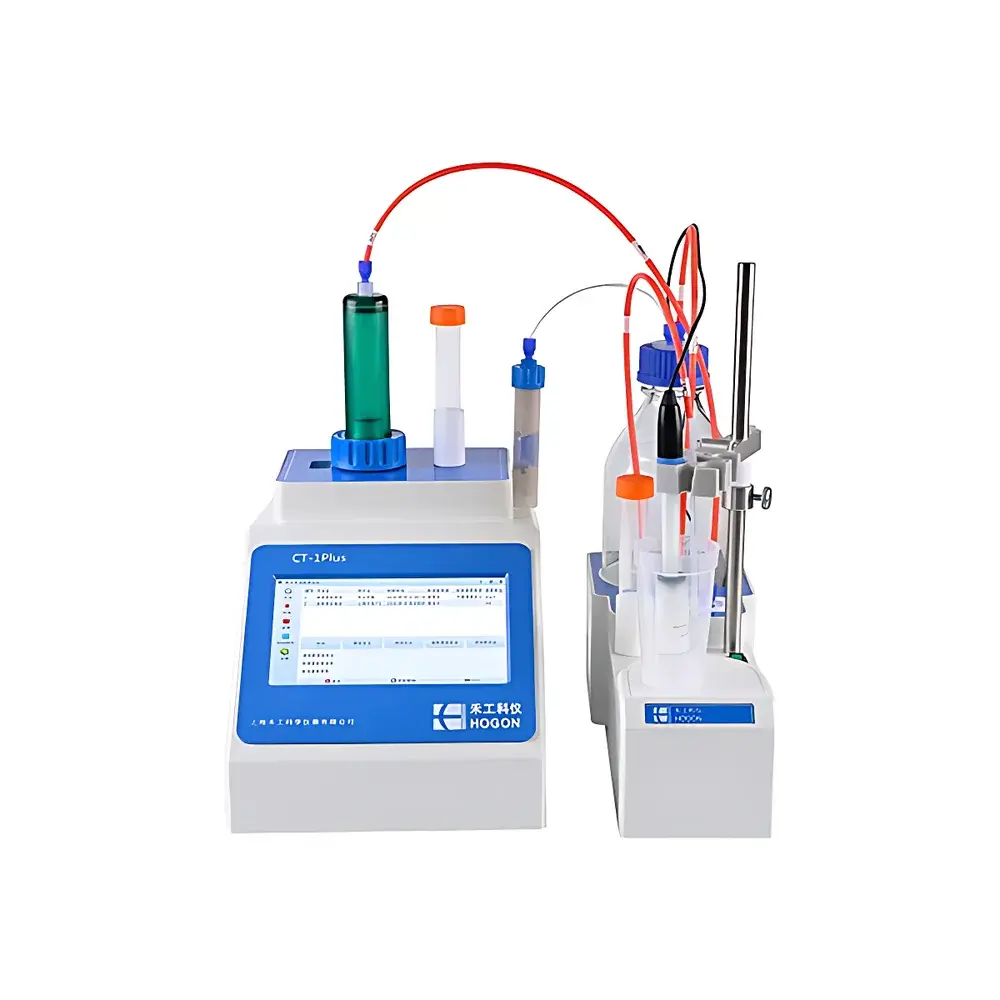
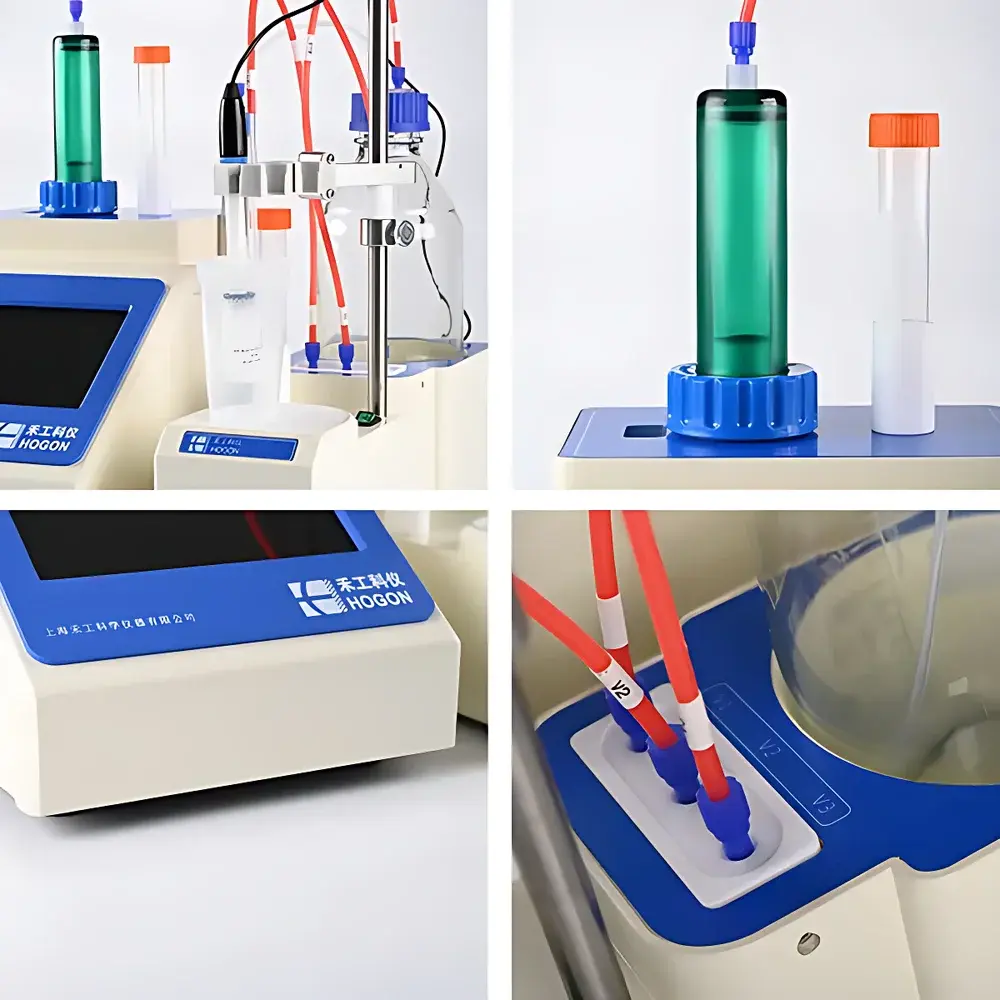
HOGON CT-1PLUS Modular Automatic Potentiometric Titrator
| Brand | HOGON |
|---|---|
| Origin | Shanghai, China |
| Manufacturer Type | Direct Manufacturer |
| Instrument Type | General-Purpose Potentiometric Titrator |
| Model | CT-1PLUS |
| pH Range | 1–14 |
| Potential Measurement Range | ±2000 mV |
| Potential Resolution | 0.1 mV |
| Potential Accuracy | ±0.2 mV |
| Titration Resolution (20 mL burette) | 0.001 mL |
| Titration Resolution (10 mL burette, optional) | 0.0005 mL |
Overview
The HOGON CT-1PLUS Modular Automatic Potentiometric Titrator is an integrated electrochemical analysis platform engineered for precision, flexibility, and regulatory compliance in modern analytical laboratories. It operates on the fundamental principle of potentiometric endpoint detection—measuring the potential difference between a reference electrode and an indicator electrode as titrant is incrementally delivered. This voltage shift, governed by the Nernst equation, enables highly reproducible identification of stoichiometric equivalence points across acid-base, redox, precipitation, and complexometric reactions. Unlike legacy single-mode titrators, the CT-1PLUS adopts a modular architecture: its core comprises three independently serviceable units—high-precision dosing module (with motorized burettes), intelligent control unit (embedded real-time processor), and multi-sensor detection unit (supporting pH, mV, temperature, and optional photometric/colorimetric inputs). This design ensures long-term stability, simplified maintenance, and field-upgradable functionality without system downtime.
Key Features
- Multi-Principle Endpoint Detection: Simultaneously supports potentiometric, photometric (colorimetric), and thermometric titration modes—enabling endpoint determination where traditional electrode response is insufficient (e.g., turbid samples, weakly dissociated systems, or non-aqueous media).
- Robust Dosing Architecture: Standard 20 mL glass burette with 0.001 mL resolution; optional 10 mL burette achieves 0.0005 mL resolution. All burettes feature PTFE-coated pistons, ceramic stopcocks, and electromagnetic switching valves rated for >500,000 cycles—ensuring volumetric accuracy per ISO 8655-3 and long-term repeatability (RSD < 0.1% at full scale).
- Intelligent Endpoint Recognition: Implements adaptive dynamic titration algorithms—including fixed-endpoint, dynamic stepwise addition, crossover titration, and manual override—with automatic termination upon slope threshold, first/second derivative maxima, or user-defined voltage/pH thresholds.
- 7-inch Full-Color Touch Interface: Industrial-grade capacitive touchscreen with intuitive icon-driven navigation. Supports multilingual UI (English default), method wizard setup, real-time titration curve visualization, and on-device parameter validation prior to run initiation.
- Comprehensive Calibration Management: Automated temperature compensation (0–100 °C, ±0.1 °C accuracy), electrode calibration history logging, scheduled recalibration reminders, and traceable calibration report generation (PDF export via USB).
Sample Compatibility & Compliance
The CT-1PLUS accommodates aqueous, non-aqueous, viscous, and heterogeneous samples across diverse matrices—including crude oils, polymer prepolymers, pharmaceutical excipients, lithium salt solutions, food extracts, and environmental water samples. Its open electrode interface accepts standard BNC-pH/mV electrodes, ion-selective electrodes (ISEs), and custom sensor assemblies. The system complies with key international standards: ASTM D974 (acid number), ASTM D664 (TAN), ISO 661 (acid value in fats), USP (titrimetric assays), and Chinese Pharmacopoeia Vol. IV (2020 Ed.) General Chapter 0701. All data handling adheres to GLP and GMP requirements, including full electronic audit trail (user actions, method changes, calibration events, result modifications) compliant with FDA 21 CFR Part 11 Annex 11 principles.
Software & Data Management
Data integrity is enforced through embedded firmware-level security: password-protected user roles (Operator, Supervisor, Administrator), immutable PDF report generation (digitally signed, timestamped, tamper-evident), and unlimited method storage (≥100 methods) and result records (≥10,000 entries). Reports include raw titration curves, derivative plots, equivalence point calculations, statistical summaries (mean, SD, RSD), and metadata (operator ID, instrument serial, environmental conditions). USB 2.0 host port enables direct export of reports and raw data (CSV, XML) without proprietary software dependency. Audit logs are retained onboard and exportable for internal QA review or regulatory inspection.
Applications
- Chemical & Polymer Industry: Acid value (AV) and hydroxyl number (OH#) of resins; NCO content in polyurethane prepolymers; chloride ion quantification in cement additives.
- Petroleum & Lubricants: Total acid number (TAN) and total base number (TBN) in engine oils and transformer fluids per ASTM D974/D2896.
- Food & Beverage: Free fatty acid (FFA) and peroxide value (PV) in edible oils; titratable acidity in dairy and fruit products.
- Pharmaceuticals: Assay of active ingredients (e.g., amine hydrochlorides), residual chloride in APIs, and dissolution testing support per USP monographs.
- Battery Materials: Residual alkali (Li₂CO₃/LiOH) quantification in cathode precursors; purity assessment of LiPF₆ and other lithium salts.
- Environmental Testing: Alkalinity, hardness, and cyanide determination in wastewater and drinking water per APHA Standard Methods.
FAQ
Does the CT-1PLUS support ISE measurements for ions such as fluoride or chloride?
Yes—the instrument’s mV input channel is fully compatible with standardized ion-selective electrodes and includes built-in calibration routines for single-point and multi-point ISE calibration.
Can the colorimetric module be used simultaneously with potentiometric detection?
No—photometric and potentiometric endpoints are selected per method, but the system allows seamless switching between modes without hardware reconfiguration.
Is remote monitoring or network connectivity available?
The CT-1PLUS operates as a standalone instrument with local USB storage; Ethernet or Wi-Fi modules are not included but can be added via third-party industrial gateways for lab network integration.
What electrode types are recommended for high-precision pH titrations?
We recommend double-junction pH electrodes with low-resistance Ag/AgCl reference systems and ceramic junctions for stability in complex matrices; all electrodes connect via standard BNC interface.
How is data integrity maintained during power interruption?
The system features non-volatile memory that preserves method parameters, calibration history, and ongoing titration state—allowing resumption from last valid step after reboot.






