
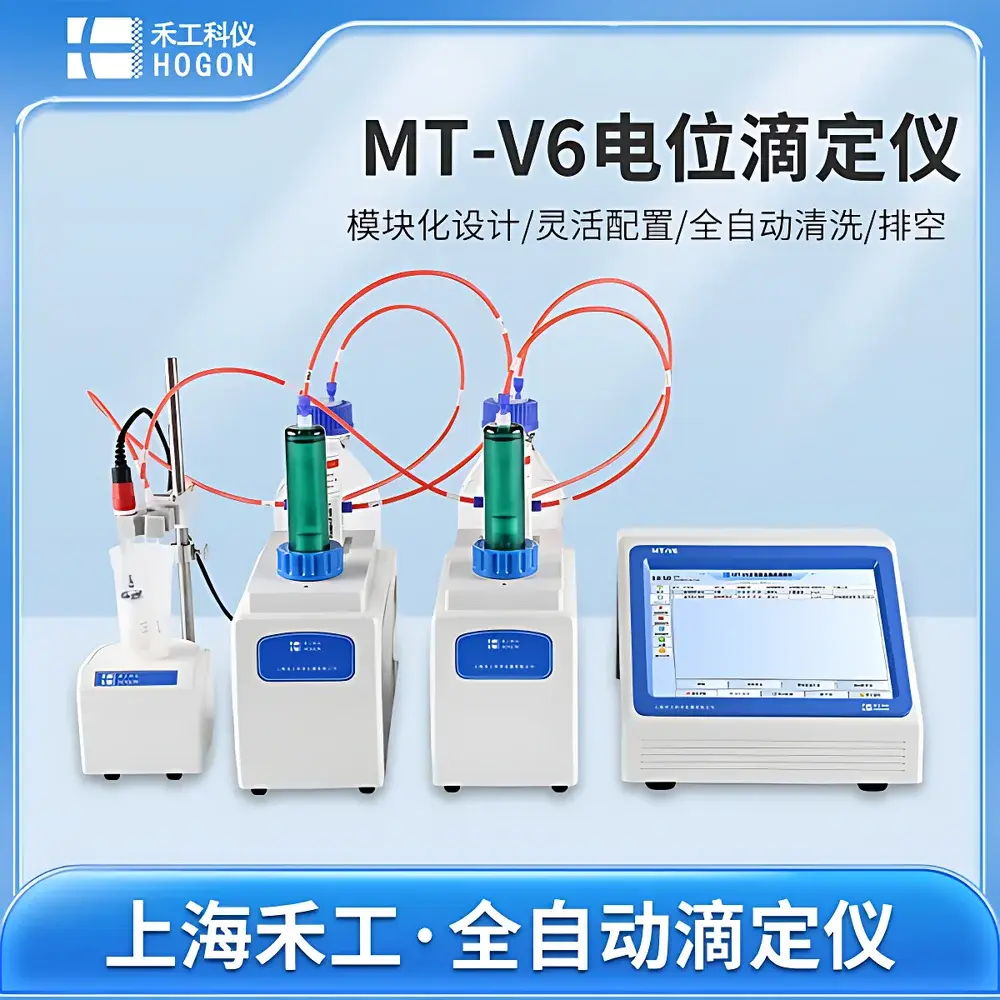
HOGON MT-V6 Automatic Dead-Stop Titration System
| Brand | HOGON |
|---|---|
| Origin | Shanghai, China |
| Manufacturer Type | Direct Manufacturer |
| Regional Classification | Domestic (China) |
| Model | MT-V6 Dead-Stop Titrator |
| Instrument Category | General-Purpose Potentiometric Titrator |
| Application Scope | Universal |
| pH Measurement Range | 0.000–14.000, Resolution: 0.001 pH |
| Meter Accuracy | ±0.1 mV |
| Meter Resolution | 0.1 mV |
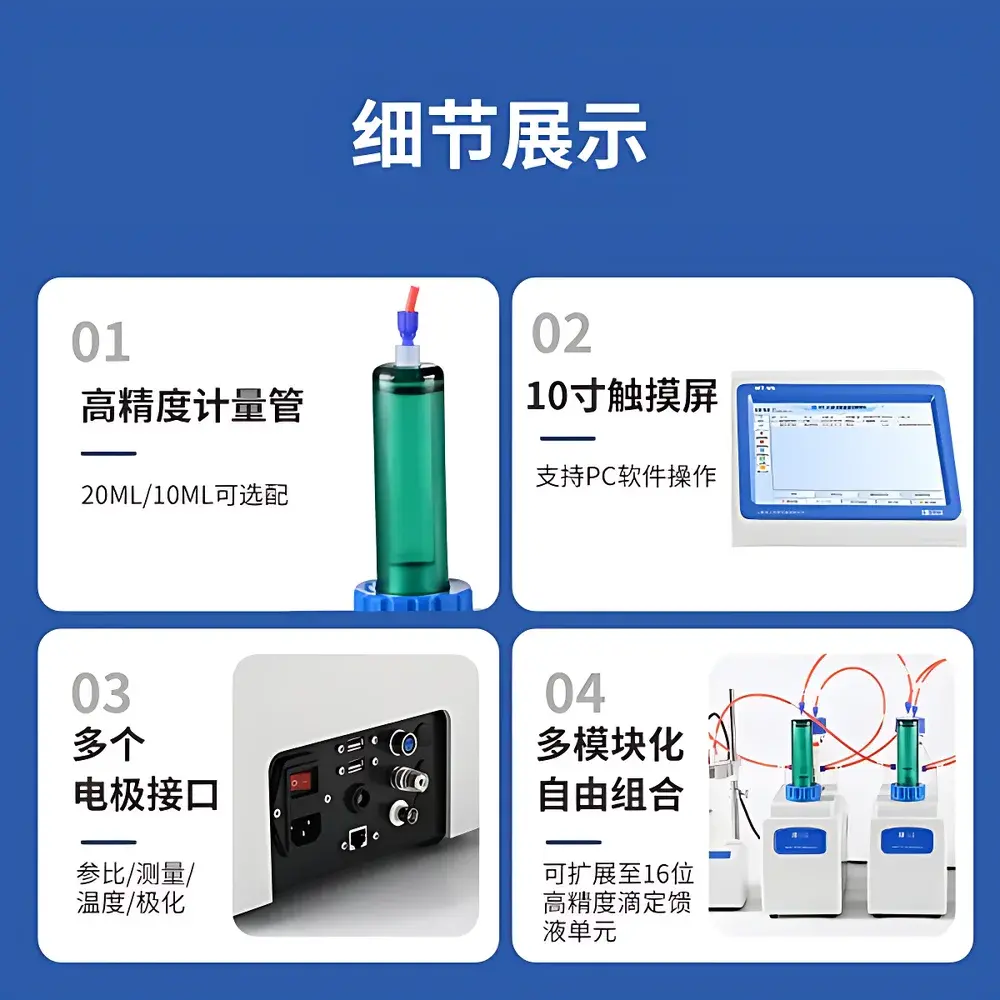
| Burette Precision | 20 mL standard burette (±1 µL), 10 mL optional burette (±0.5 µL) |
| Potential Range | ±2000 mV, Resolution: 0.1 mV |
Overview
The HOGON MT-V6 Automatic Dead-Stop Titration System is a dedicated electrochemical titration platform engineered for high-reproducibility endpoint detection in redox-active analyte systems. Unlike conventional potentiometric titrators that rely on inflection points in potential vs. volume curves, the MT-V6 implements true dead-stop (biamperometric) titration—measuring current response across two identical polarized platinum electrodes under constant applied voltage. At the equivalence point of redox reactions—such as those involving iodine/thiosulfate, cerium(IV)/ferrous ions, or quinone/hydroquinone couples—the net current drops sharply to near-zero due to stoichiometric exhaustion of electroactive species. The instrument detects this current nullification event with sub-microampere sensitivity and triggers automatic burette stoppage within <100 ms, minimizing overshoot and ensuring traceable, operator-independent endpoint determination per ISO 8655-6 and ASTM E2087.
Key Features
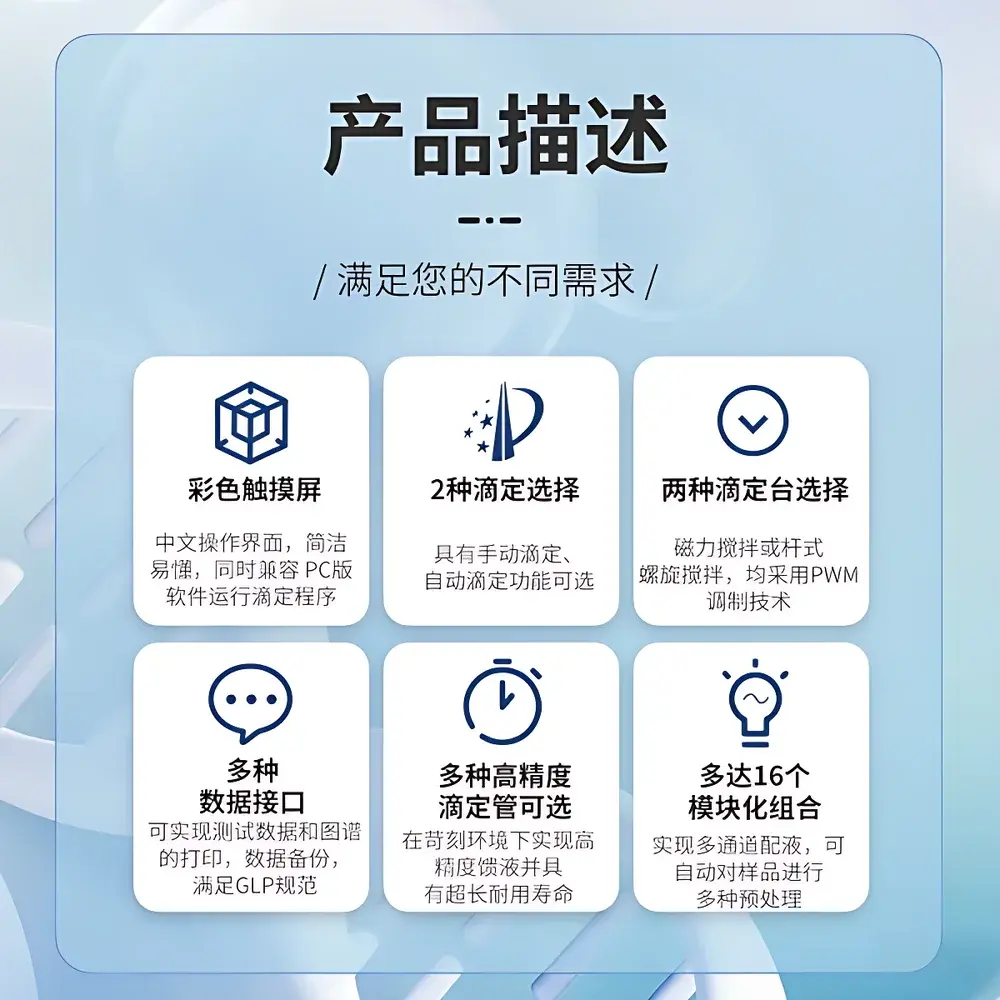
- True biamperometric dead-stop detection using dual Pt microelectrodes with adjustable polarization voltage (±100–500 mV), optimized for low-current stability and minimal electrode fouling.
- Microprocessor-controlled syringe-driven burette system with dual-volume configuration: standard 20 mL glass burette (1 µL dispensing resolution) and optional 10 mL burette (0.5 µL resolution), both compliant with ISO 8655-3 volumetric accuracy requirements.
- Integrated pH/mV meter module calibrated to NIST-traceable standards, delivering 0.001 pH resolution and ±0.1 mV absolute accuracy across ±2000 mV range.
- 7-inch capacitive color touchscreen with intuitive icon-based workflow navigation, real-time current/potential curve overlay, and on-screen titration parameter validation (e.g., minimum current threshold, stabilization time, max titrant addition).
- Modular hardware architecture: detachable titration station, electrode holder with spring-loaded alignment, and swappable reagent reservoirs—enabling rapid method reconfiguration without tools.
- Robust enclosure constructed from chemical-resistant PPS polymer and anodized aluminum; IP54-rated against splashes and particulates; compatible with fume hood integration.
Sample Compatibility & Compliance
The MT-V6 supports aqueous and mixed-solvent systems (e.g., water/methanol, water/acetonitrile) for redox-active solutes including halides, transition metal complexes, organic peroxides, nitroaromatics, and pharmaceutical intermediates. Electrode compatibility includes standard Pt-Pt biamperometric cells, combination pH-redox electrodes (for hybrid mode), and Ag/AgCl reference electrodes. The system meets GLP documentation requirements through built-in audit trail (user login, method change log, titrant lot tracking) and complies with FDA 21 CFR Part 11 for electronic records when paired with HOGON’s validated TitraLink™ software suite. All electrical safety conforms to IEC 61010-1:2010 Ed.3; electromagnetic compatibility follows EN 61326-1:2013.
Software & Data Management
TitraLink™ v4.2 firmware provides method-driven operation with preloaded templates for USP , EP 2.2.20, and Chinese Pharmacopoeia ChP 0701 redox titration protocols. Each titration generates a timestamped data package containing raw current/time series, derivative plots, equivalence point calculation (first-derivative zero-crossing or tangent intersection), and uncertainty estimation per GUM (JCGM 100:2008). Data export formats include CSV (for Excel/LIMS ingestion), PDF analytical reports with digital signature fields, and XML for direct LIMS integration via OPC UA or HTTP REST API. Internal 8 GB eMMC storage retains ≥50,000 titration records with cyclic overwrite protection.
Applications
- Pharmaceutical QC: Quantification of ascorbic acid, epinephrine, and chlorpromazine hydrochloride per USP monographs using iodometric dead-stop titration.
- Environmental analysis: Determination of dissolved oxygen (Winkler method), permanganate index (CODMn), and total oxidant capacity in wastewater per ISO 5813 and EPA 4500-OC.
- Food & beverage testing: Sulfite (SO2) content in wines and dried fruits via iodine titration; nitrite in cured meats per AOAC 973.33.
- Electrochemical materials R&D: In-situ monitoring of Li-ion cathode redox transitions during half-cell titration experiments.
- Academic teaching: Hands-on instruction in electroanalytical principles—including diffusion-controlled current theory (Cottrell equation), limiting current behavior, and electrode kinetics—using real-time current transient visualization.
FAQ
What distinguishes dead-stop titration from conventional potentiometric titration?
Dead-stop titration measures current at fixed potential between two identical electrodes, detecting the equivalence point as current collapse to baseline. Potentiometric titration monitors potential shift of a single indicator electrode versus reference—suited for acid-base or precipitation endpoints, but less robust for redox systems with sluggish kinetics or overlapping potentials.
Can the MT-V6 perform non-redox titrations?
Yes—when equipped with pH or ion-selective electrodes, it operates as a general-purpose potentiometric titrator for acid-base, complexometric (EDTA), or argentometric titrations. However, its dead-stop optimization (e.g., electrode geometry, current gain calibration) is exclusive to redox applications.
Is method validation support available for regulated environments?
HOGON provides IQ/OQ documentation packages, including performance verification protocols for burette accuracy (gravimetric test per ISO 8655-6), electrode response time (<500 ms), and current detection limit (≤10 nA), aligned with ICH Q2(R2) guidelines.
How is electrode maintenance handled during unattended runs?
The system includes automated electrode cleaning cycles using pulsed ultrasonic agitation (40 kHz, 30 s) and optional ethanol rinse between samples—programmable per method to prevent cross-contamination and passivation.
What network security protocols are implemented for remote data access?
TitraLink™ supports TLS 1.2 encryption for web-based monitoring, role-based access control (RBAC) with LDAP/Active Directory integration, and configurable firewall port restrictions (default HTTPS 443 only).
Related Products





