
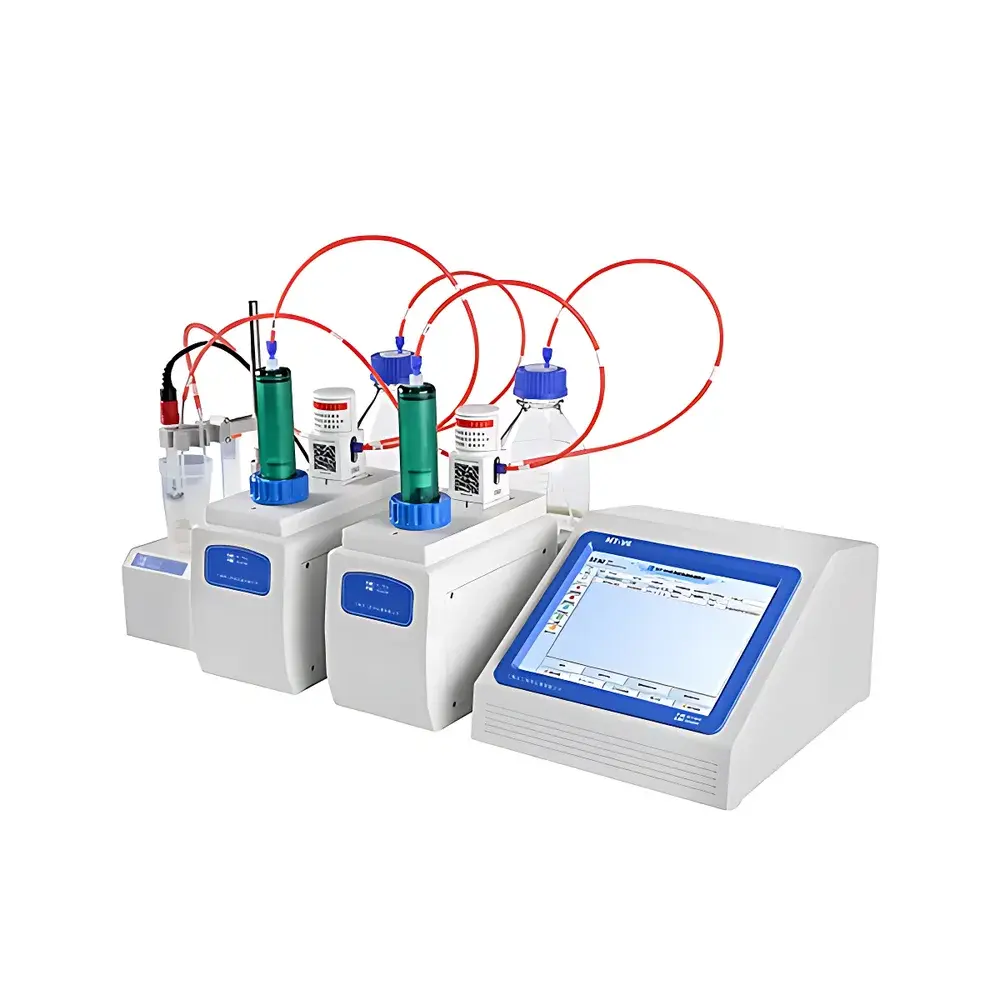
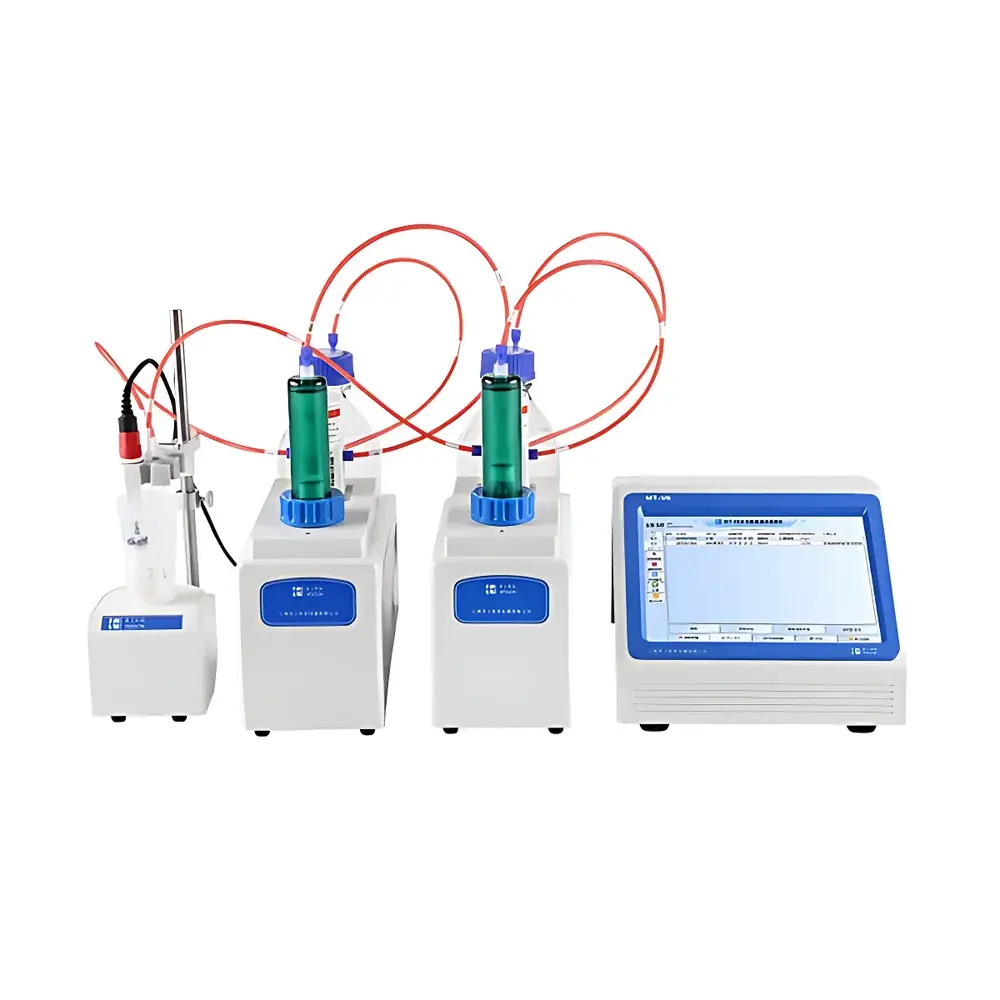
HOGON MT-V6 Dual-Channel Automatic Potentiometric Titrator
| Brand | HOGON |
|---|---|
| Origin | Shanghai, China |
| Manufacturer | HOGON Scientific Instruments Co., Ltd. |
| Model | MT-V6 |
| Instrument Type | General-purpose Potentiometric Titrator |
| pH Range | 0.000–14.000 (Resolution: 0.001 pH) |
| Potential Range | ±2000.0 mV (Resolution: 0.1 mV) |
| Potential Accuracy | ±0.1 mV |
| Burette Precision | 1 µL (20 mL burette, standard), 0.5 µL (10 mL burette, optional) |
| Data Storage Capacity | 1000 sample records with timestamp, temperature, ID, and audit trail |
Overview
The HOGON MT-V6 Dual-Channel Automatic Potentiometric Titrator is an engineered platform for high-reproducibility quantitative chemical analysis based on potentiometric endpoint detection. It operates on the fundamental principle of measuring potential difference between a reference electrode and an indicator electrode as titrant is incrementally added to the analyte solution; the inflection point in the E–V curve (potential vs. volume) is used to determine the stoichiometric endpoint with high fidelity. Designed for laboratories requiring concurrent multi-sample processing without cross-contamination or manual intervention, the MT-V6 integrates dual independent titration channels—each equipped with dedicated burettes, electrodes, stirrers, and fluidic paths—enabling true parallel operation. Its modular architecture supports seamless expansion beyond basic potentiometry, including optional modules for amperometric (dead-stop) titration, photometric titration, and colorimetric endpoint detection. This flexibility ensures compliance with diverse pharmacopeial and industrial standards—including USP , EP 2.2.20, ASTM D97, ISO 8288, and GB/T 1792—while maintaining full traceability under GLP/GMP and FDA 21 CFR Part 11 requirements.
Key Features
- Dual-channel architecture with fully independent fluidic and sensing systems—eliminates carryover risk and enables simultaneous analysis of dissimilar samples (e.g., aqueous acid-base + non-aqueous redox).
- High-resolution potentiometric measurement: ±2000.0 mV range with 0.1 mV resolution and ±0.1 mV accuracy; pH measurement from 0.000 to 14.000 with 0.001 pH resolution.
- Precision burette delivery: Standard 20 mL glass syringe burette with 1 µL dispensing resolution; optional 10 mL burette offering 0.5 µL resolution for micro-titration applications.
- Intelligent endpoint recognition algorithms—including first derivative (dE/dV), second derivative (d²E/dV²), fixed ΔE/ΔV, and Gran plot methods—optimized for complex matrices and weak endpoints.
- Integrated automated routines: auto-calibration (pH/mV), auto-rinsing (pre-/post-titration), auto-waste evacuation, and auto-dilution/preparation via up to 16 configurable peripheral modules.
- Industrial-grade touchscreen interface (≥7″) with intuitive workflow navigation, method template library, and real-time titration curve visualization.
Sample Compatibility & Compliance
The MT-V6 accommodates a broad spectrum of sample types—including aqueous, non-aqueous, viscous, turbid, and suspended-phase solutions—without modification to core hardware. Its electrode compatibility extends to pH glass, Ag/AgCl, Pt, redox, ion-selective (e.g., F⁻, Cl⁻, CN⁻), and combination electrodes. The system meets critical regulatory expectations: built-in four-level user authentication (Admin, Supervisor, Analyst, Guest), time-stamped audit trail with immutable event logging (login, method edit, result override, calibration), and electronic signature support compliant with FDA 21 CFR Part 11 Annex 11. All data files are stored in encrypted binary format with SHA-256 checksum integrity verification. Optional RS-485 and Ethernet interfaces enable direct integration into DCS or LIMS environments using Modbus TCP or HL7 protocols—fully supporting laboratory digitalization initiatives.
Software & Data Management
The MT-V6 runs embedded firmware with local method storage and execution, while also supporting full remote control and method development via Windows-based PC software (HOGON TitraSuite™). Data management includes structured storage of 1000+ complete test records—each containing sample ID, operator, date/time, ambient temperature, titrant batch ID, raw E–V data points, calculated results (titer, concentration, % purity), and annotated endpoint justification. Export options include CSV, PDF (with embedded curve plots), and XML for LIMS ingestion. All data transfers adhere to TLS 1.2 encryption when routed over network interfaces. Audit trails are exportable as tamper-evident PDF reports with digital signatures—required for internal QA reviews and external regulatory inspections.
Applications
- Pharmaceutical QC: Quantification of active pharmaceutical ingredients (APIs) via acid-base (e.g., amine salts), redox (e.g., ascorbic acid), complexometric (e.g., Ca²⁺ in chelating agents), and non-aqueous titrations (e.g., imidazole in acetic anhydride); aluminum adjuvant quantification via pH-stat titration; sulfonamide assays using dead-stop mode.
- Chemical Manufacturing: Acid number (ASTM D974), base number (ASTM D664), chloride content (potentiometric argentometry), and water content (Karl Fischer-compatible pre-treatment workflows).
- Food & Beverage: Total acidity (TA) in juices and wines, peroxide value in oils, iodine value, and preservative (e.g., sorbic acid) quantification via photometric endpoint coupling.
- Battery Materials: LiPF₆ hydrolysis product (HF) titration, residual moisture in LiCoO₂ precursors (via coulometric KF integration), and chloride impurity analysis in lithium carbonate (ISO 18304).
- Environmental Testing: COD determination (closed-reflux dichromate), cyanide speciation (silver nitrate titration), and alkalinity profiling in wastewater streams.
FAQ
Does the MT-V6 support GLP-compliant data integrity?
Yes—full 21 CFR Part 11 and EU Annex 11 compliance is achieved through role-based access control, electronic signatures, immutable audit trails, and encrypted data storage.
Can I upgrade a single-channel unit to dual-channel post-purchase?
No—the dual-channel configuration is hardware-defined at manufacture; channel count cannot be retrofitted due to independent power, fluidic, and signal conditioning circuits.
What electrode types are natively supported?
All standard DIN/ISO-compliant BNC or S7 connectors: pH glass, Ag/AgCl double-junction, Pt redox, ion-selective, and combined electrodes—with automatic recognition via resistor coding.
Is remote monitoring possible without proprietary software?
Yes—via standard HTTP API over Ethernet, enabling third-party SCADA or LabVantage integration using RESTful JSON requests and responses.
How often does the system require calibration verification?
Per ISO/IEC 17025:2017, daily verification with certified buffer standards (pH 4.01, 7.00, 10.01) and redox standards (e.g., quinhydrone) is recommended; full calibration every 72 hours or after 20 titrations, whichever occurs first.
Related Products





