
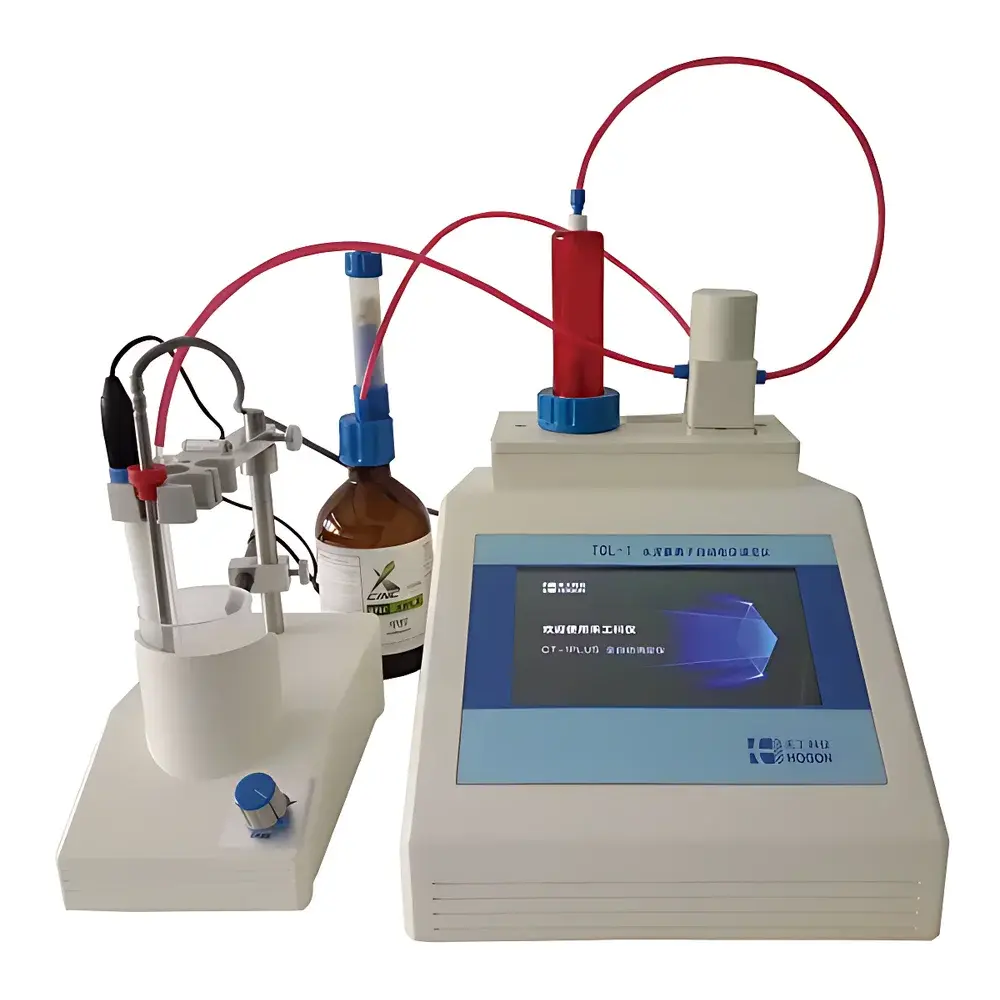
HOGON TCl-1 Cement-Specific Automatic Potentiometric Titrator
| Brand | HOGON |
|---|---|
| Origin | Shanghai, China |
| Manufacturer Type | Direct Manufacturer |
| Product Category | Domestic |
| Model | TCl-1 |
| Instrument Type | General-Purpose Potentiometric Titrator |
| Application Scope | Cement-Specific |
| Potential Range | ±2000 mV |
| pH Range | 0–14 pH |
| Potential Resolution | 0.01 mV |
| pH Resolution | 0.01 |
| Temperature Range | 0–100 °C |
| Temperature Resolution | 0.1 °C |
| Titration Volume | 20 mL |
| Minimum Dispensing Increment | 0.001 mL per step |
| Titration Repeatability | RSD ≤ 1% |
| Titration Accuracy | ±1 µL |
| Potential Measurement Accuracy | ±0.3 mV ±1 digit over 3 h |
| Electrode System | Chloride Ion-Selective Electrode + Double-Junction Saturated Calomel Reference Electrode (Outer Junction: KNO₃ |
| Inner Junction | KCl) |
| Data Export | PDF via USB or WLAN |
| GLP Compliance | Electrode calibration logs, titrant standardization records, user operation audit trail, non-overwritable data history |
| Environmental Operating Conditions | 5–35 °C, ≤80% RH |
| Power Supply | 100–220 V AC, 50–60 Hz |
| Dimensions (W×D×H) | 250 × 360 × 330 mm |
| Weight | 10 kg |
Overview
The HOGON TCl-1 Cement-Specific Automatic Potentiometric Titrator is an engineered solution for precise, standardized determination of chloride ion (Cl⁻) concentration in cementitious materials according to GB/T 176–2017, the current Chinese national standard for cement chemical analysis. It implements the potentiometric titration principle—measuring the potential shift across a chloride-selective membrane electrode relative to a stable double-junction reference electrode during incremental addition of silver nitrate (AgNO₃) titrant. The inflection point in the resulting E–V curve corresponds to the stoichiometric endpoint of the Ag⁺ + Cl⁻ → AgCl(s) reaction. Designed exclusively for cement testing laboratories, the TCl-1 eliminates manual endpoint estimation and operator-induced variability, ensuring reproducible results compliant with regulatory and quality assurance requirements in cement production, ready-mix concrete batching, third-party certification labs, and construction materials R&D.
Key Features
- Full compliance with GB/T 176–2017 Method 10.3: “Potentiometric Titration for Chloride Ion in Cement”, including sample digestion with nitric acid (1+1), interference suppression via hydrogen peroxide oxidation, and spiking with certified Cl⁻ standard solution to enhance sensitivity and accuracy.
- Dual-mode operation: supports both chloride quantification and AgNO₃ standardization titrations under identical hardware and software conditions—enabling traceable, in-house standard verification without external calibration services.
- Integrated dual-electrode system: factory-matched chloride ion-selective electrode (Ag/AgCl-based membrane) and double-junction saturated calomel electrode (outer junction: 3 mol/L KNO₃; inner junction: saturated KCl), minimizing liquid junction potential drift and ensuring stable baseline response in high-ionic-strength cement digests.
- Real-time titration curve visualization with dynamic first- and second-derivative peak detection; built-in formula editor allows user-defined calculation of Cl⁻ mass fraction (wt%) based on sample weight, spike volume/concentration, blank correction, and titrant molarity.
- Role-based access control: administrators can define custom user accounts, password policies, and permission tiers (e.g., analyst, supervisor, QA manager) to restrict method editing, result deletion, or system configuration changes.
- Audit-trail-enabled GLP architecture: every electrode calibration, titrant standardization, sample run, and data export event is timestamped, user-attributed, and immutably logged—fully supporting FDA 21 CFR Part 11 and ISO/IEC 17025 documentation requirements.
Sample Compatibility & Compliance
The TCl-1 is validated for use with all common hydraulic cements covered by GB/T 176–2017, including Portland cement (P·I, P·II), ordinary Portland cement (P·O), slag Portland cement (P·S·A/B), pozzolanic Portland cement (P·P), fly ash Portland cement (P·F), and composite Portland cement (P·C). Sample preparation follows strict procedural controls: 5.0000 g ± 0.1 mg homogenized cement is digested in 25 mL HNO₃ (1+1), spiked with 2.00 mL of 0.02 mol/L Cl⁻ standard, treated with 2 mL 30% H₂O₂, boiled for 1–2 min, cooled to ambient temperature (20–25 °C), and titrated at constant magnetic stirring speed (≥300 rpm). The instrument’s ±2000 mV measurement range and 0.01 mV resolution ensure robust detection of subtle potential shifts even in turbid, particulate-laden digestates. All operational parameters—including electrode conditioning protocols, titrant stability validation intervals, and blank correction thresholds—are preconfigured to align with GB/T 176–2017 Annex B guidelines and ISO 8258 Shewhart control chart practices for analytical process monitoring.
Software & Data Management
The embedded firmware provides a deterministic, menu-driven interface optimized for routine cement QC workflows. Method templates are preloaded for GB/T 176–2017 Cl⁻ analysis and AgNO₃ standardization, each containing fixed parameters for stirring rate, titrant addition increment (0.01 mL initial, auto-adjusting near endpoint), equivalence point algorithm (second-derivative maximum), and automatic blank subtraction. All raw potential (mV), volume (mL), pH, and temperature readings are stored in a relational database with unique run IDs. Data export options include encrypted PDF reports (with digital signature placeholder), CSV for LIMS integration, and direct thermal printing via RS-232 or USB. Audit logs record all user-initiated actions—including login/logout, method modification, result approval/rejection, and USB device insertion—with SHA-256 hash integrity verification. Data retention is indefinite unless manually purged under administrator privilege; no automatic overwrite occurs under any system condition.
Applications
The TCl-1 serves as a primary compliance tool across the cement value chain: incoming raw material screening (limestone, clay, slag, fly ash) for Cl⁻ contamination; final product release testing to meet ≤0.06 wt% Cl⁻ limit per GB 175–2020; quality surveillance in concrete precast plants where chloride ingress directly impacts reinforcement service life; and forensic analysis of chloride-induced corrosion failures in infrastructure projects. Its design also supports research applications such as leaching kinetics studies (per ASTM C1556), chloride binding capacity assessment in blended cements, and inter-laboratory method validation exercises coordinated under CNAS (China National Accreditation Service) proficiency testing schemes. When paired with certified reference materials (e.g., NIST SRM 2689a Cement), the system achieves measurement uncertainty <0.002 wt% Cl⁻ (k=2) under controlled environmental conditions.
FAQ
Does the TCl-1 comply with international standards beyond GB/T 176–2017?
Yes—the electrode configuration, titration algorithm, and data integrity architecture align with ISO 7870-2 (control charts), ISO 5725 (accuracy/trueness), and ASTM C114 Annex A5 (chloride by potentiometric titration), enabling cross-border test report acceptance.
Can the instrument be integrated into a laboratory information management system (LIMS)?
Yes—via configurable ASCII protocol over RS-232 or TCP/IP (WLAN), supporting automated transfer of sample ID, result, uncertainty, and metadata using ASTM E1384-compliant message framing.
What maintenance is required for long-term electrode stability?
The chloride electrode requires daily reconditioning in 0.001 mol/L NaCl; the double-junction reference electrode must be refilled with fresh KNO₃ (3 mol/L) and KCl (sat.) solutions weekly and checked for junction clogging before each batch.
Is method validation support available from HOGON?
Yes—HOGON provides IQ/OQ documentation templates, linearity verification protocols (0.001–0.1 wt% Cl⁻), repeatability studies per ISO 5725-2, and on-site performance qualification (PQ) assistance upon request.
How is data integrity preserved during power interruption?
The system employs non-volatile flash memory with atomic write operations; all active titrations resume from last recorded point upon reboot, and no intermediate data points are lost—even during unexpected shutdowns.





