
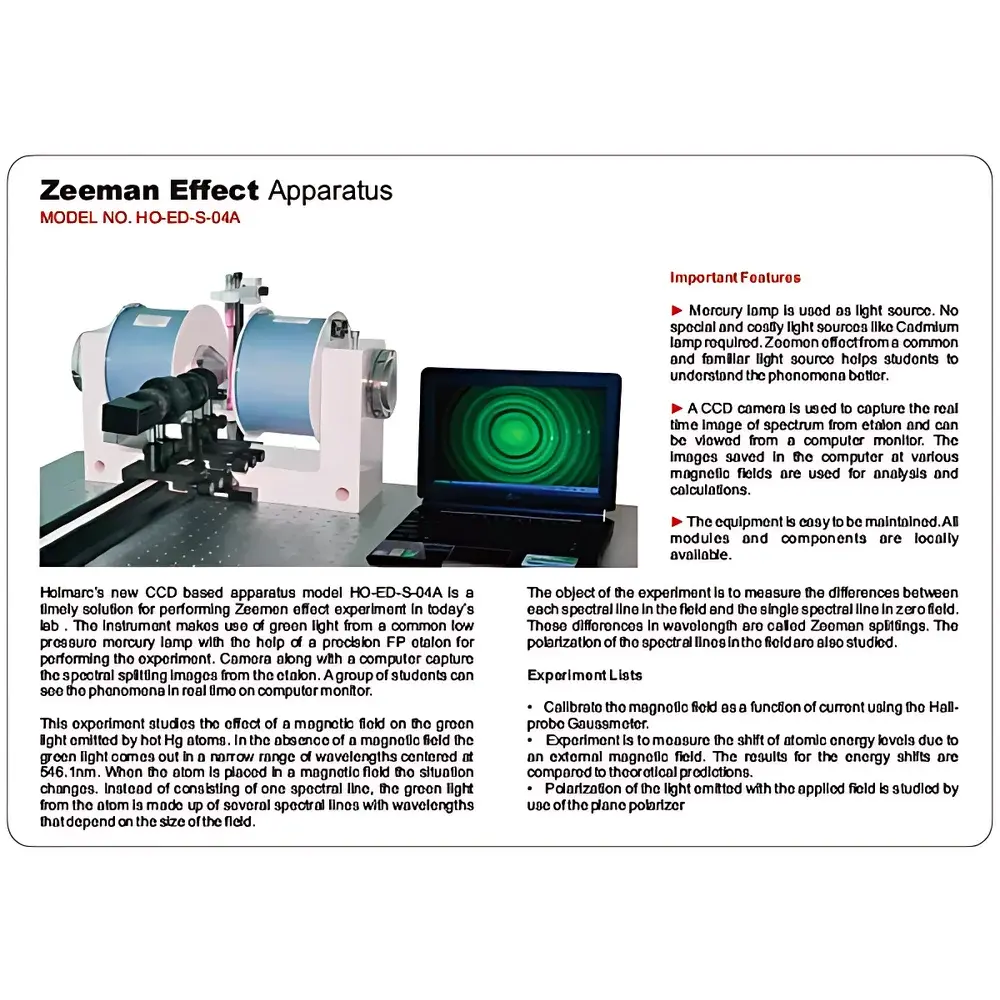
HOLMARC HO-ED-S-04A Zeeman Effect Apparatus
| Origin | USA |
|---|---|
| Manufacturer Type | Distributor |
| Origin Category | Imported |
| Model | HO-ED-S-04A |
| Pricing | Upon Request |
Overview
The HOLMARC HO-ED-S-04A Zeeman Effect Apparatus is a precision educational and research-grade instrument engineered for the quantitative observation and analysis of the normal Zeeman effect in atomic spectra. It operates on the fundamental principle that spectral lines emitted by atoms—specifically mercury vapor under low-pressure discharge—undergo measurable splitting into discrete, polarization-resolved components when subjected to a controlled, uniform magnetic field. This apparatus leverages the well-characterized 546.1 nm green emission line of the mercury atom (transition 3P1 → 1S0) as its primary spectroscopic probe. In the absence of an external magnetic field, this transition appears as a single, narrow spectral line. When exposed to a calibrated magnetic field (typically 0–1.2 T), the degeneracy of the magnetic sublevels is lifted, resulting in symmetric triplet splitting—two π-components (linearly polarized parallel to **B**) flanking a central σ-component (linearly polarized perpendicular to **B**). The magnitude of the splitting (Δλ) is directly proportional to the applied field strength and governed by the classical Lorentz relation: Δλ = (eλ₀²/4πmc²)·B, where e/m is the charge-to-mass ratio of the electron. Designed for university physics laboratories and advanced undergraduate quantum mechanics courses, the HO-ED-S-04A provides a hands-on platform to verify quantum selection rules, validate magnetic moment quantization, and experimentally determine the Bohr magneton.
Key Features
- Integrated low-pressure mercury vapor lamp with stable 546.1 nm spectral output—eliminates need for costly cadmium or iron arc sources
- High-stability electromagnet with adjustable DC current supply (0–10 A), enabling precise magnetic field control from 0 to ~1.2 T (field strength verified via included Hall probe gaussmeter)
- Dedicated Fabry–Pérot etalon-based wavelength calibrator for real-time spectral reference and instrumental drift compensation
- Monochrome CCD camera (1280 × 1024 pixels, 16-bit dynamic range) with C-mount interface and high quantum efficiency in visible range (400–700 nm)
- Optimized optical path including collimating lens, Wollaston prism for polarization separation, and imaging spectrometer with fixed grating (1200 grooves/mm)
- Modular mechanical design with kinematic mounts for repeatable alignment; all optical and electronic components are serviceable using standard laboratory tools and globally available spares
Sample Compatibility & Compliance
The HO-ED-S-04A is specifically configured for gaseous atomic samples under low-pressure discharge conditions, with mercury vapor being the primary validated specimen. Its optical configuration supports direct observation of π- and σ-polarized components without auxiliary polarization optics, though optional linear polarizers (mounted in rotation stages) are provided for detailed polarization state analysis. The system complies with IEC 61000-6-3 (EMC emissions) and IEC 61010-1 (safety requirements for electrical equipment for measurement, control, and laboratory use). All magnetic field calibration procedures adhere to ASTM E1447-19 (Standard Practice for Calibration of Magnetic Field Sensors) and support traceable documentation required under GLP-compliant teaching lab audits.
Software & Data Management
Acquisition and analysis are performed using Holmarc’s cross-platform LabView-based software (Windows/macOS/Linux compatible), which provides real-time spectral image capture, centroid tracking of split components, pixel-to-wavelength mapping via etalon calibration peaks, and automated calculation of Δλ and effective g-factor. Raw TIFF and HDF5 data formats are supported for export. Software includes built-in validation routines for spectral resolution (≤0.02 nm FWHM at 546.1 nm) and intensity linearity (R² > 0.999 over 4-decade dynamic range). Audit trails, user authentication, and metadata tagging (field strength, exposure time, polarizer angle) satisfy basic 21 CFR Part 11 readiness for academic recordkeeping.
Applications
- Quantitative verification of the normal Zeeman effect and comparison with theoretical predictions based on orbital angular momentum coupling
- Determination of the electron’s charge-to-mass ratio (e/m) via measured Δλ–B slope
- Experimental derivation of the Bohr magneton (μB) and evaluation of magnetic moment quantization
- Analysis of polarization selection rules (Δml = 0 for π, Δml = ±1 for σ) using rotating linear polarizers
- Introduction to spectroscopic instrumentation, optical alignment, and error propagation in atomic physics experiments
- Foundation for advanced studies in anomalous Zeeman effect, Paschen–Back regime, and atomic beam magnetic resonance techniques
FAQ
What is the typical spectral resolution achievable with the HO-ED-S-04A?
The system achieves ≤0.02 nm full-width-at-half-maximum (FWHM) resolution at 546.1 nm under optimal alignment and exposure conditions.
Can the apparatus be used with elements other than mercury?
While optimized for Hg 546.1 nm, the optical train supports other visible atomic lines (e.g., Cd 643.8 nm, Zn 481.0 nm) with appropriate lamp and filter changes—though calibration and splitting interpretation require adjustment for g-factors and transition types.
Is magnetic field homogeneity characterized across the vapor cell region?
Yes—the electromagnet pole geometry and shimming ensure ≤1.5% field variation over a 10 mm diameter cylindrical volume centered on the discharge tube.
Does the software support automated fitting of multiple Zeeman components?
Yes—Gaussian-Lorentzian hybrid peak fitting with constrained spacing and amplitude ratios is implemented for robust component identification and wavelength extraction.
What safety certifications does the unit carry?
It conforms to IEC 61010-1:2010 for laboratory electrical safety and includes interlocked power cutoff for the electromagnet and lamp housing.



