
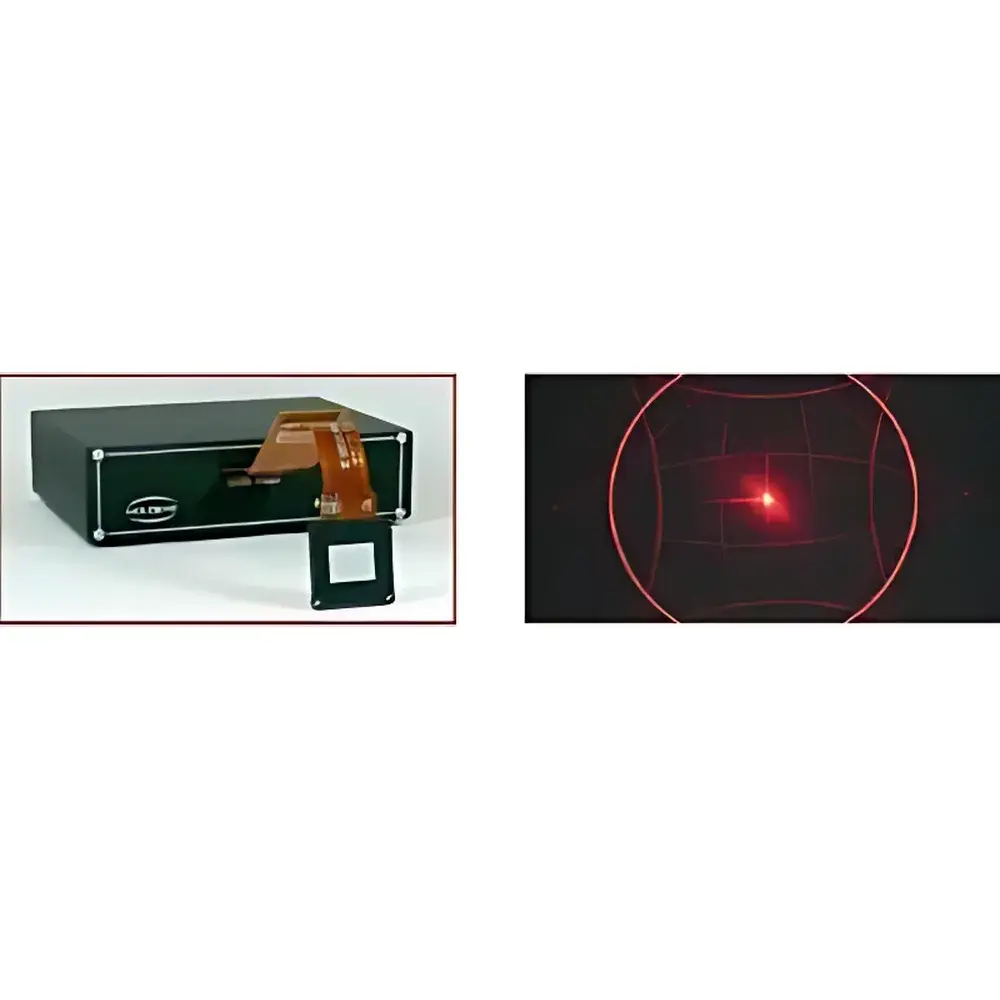
Holoeye LC-R720 Phase- and Amplitude-Modulating Spatial Light Modulator
| Brand | Holoeye |
|---|---|
| Origin | Germany |
| Manufacturer Type | Authorized Distributor |
| Product Origin | Imported |
| Model | LC-R720 |
| Operating Principle | Liquid Crystal on Silicon (LCoS)-Based Optical Phase/Amplitude Modulation |
| Imaging Method | Binary Optical Element |
| Deployment Environment | Benchtop / Laboratory |
| Spectral Range | 420–700 nm |
| Spatial Resolution | 1280 × 768 pixels |
| Pixel Pitch | 20 µm |
| Fill Factor | 92% |
| Addressing Depth | 8-bit |
| Frame Rate | 180 Hz |
| Response Time | <3 ms |
| Phase Modulation Range | >π radians (visible spectrum) |
| Dynamic Range | 1000:1 |
| Field of View (TFOV) | 15.36 × 8.64 mm |
| Instantaneous Field of View (IFOV) | 78 µrad |
| Synchronization | Hardware Trigger Support |
| Video Interface | Digital Visual Interface (DVI) |
Overview
The Holoeye LC-R720 is a high-performance, reflective liquid crystal on silicon (LCoS) spatial light modulator engineered for precise, real-time phase and amplitude modulation of coherent visible-light beams. Unlike conventional transmissive SLMs or static diffractive optics, the LC-R720 leverages a monolithic silicon backplane integrated with nematic liquid crystal layers to enable pixel-level control over optical wavefronts. Its operation is grounded in voltage-dependent birefringence modulation, where each 20 µm pixel alters the phase delay (up to >π rad) or intensity transmission of incident polarized light—making it suitable for adaptive optics, holographic beam shaping, optical trapping, and programmable diffractive element synthesis. Designed for laboratory-grade stability and repeatability, the device operates within the 420–700 nm spectral window—covering violet through red visible wavelengths—and is optimized for integration into interferometric setups, Fourier-plane filtering systems, and laser-based metrology platforms.
Key Features
- Reflective LCoS architecture with 1280 × 768 active pixel array and 92% fill factor, minimizing diffraction artifacts and maximizing optical efficiency
- Simultaneous phase- and amplitude-modulation capability, with primary design emphasis on high-fidelity phase control across the visible spectrum
- 180 Hz native frame rate with hardware-triggered synchronization, enabling closed-loop adaptive optics and real-time hologram updates
- Sub-3 ms pixel response time ensures minimal temporal blurring during dynamic wavefront correction or pattern sequencing
- 8-bit grayscale addressing supports fine-grained modulation depth control, facilitating smooth phase ramps and high-contrast binary patterns
- DVI digital interface ensures low-latency, jitter-free image transfer from host graphics engines or FPGA-based pattern generators
- Compact benchtop form factor with standardized mounting interfaces (e.g., SM1-threaded housing) for seamless integration into optical breadboards and OEM subsystems
Sample Compatibility & Compliance
The LC-R720 is compatible with collimated, linearly polarized illumination sources—including HeNe lasers (632.8 nm), diode-pumped solid-state (DPSS) lasers (532 nm), and tunable visible laser diodes. It requires external polarization management (e.g., half-wave plates and polarizing beam splitters) for optimal phase modulation contrast. The device complies with CE marking requirements for electromagnetic compatibility (EMC Directive 2014/30/EU) and low-voltage safety (LVD Directive 2014/35/EU). While not certified under FDA 21 CFR Part 11 or ISO 13485, its deterministic, repeatable optical response and traceable calibration protocols support GLP-compliant experimental documentation when deployed in research-grade spectroscopic or interferometric workflows per ISO/IEC 17025 guidelines.
Software & Data Management
Holoeye provides the SLM Display Software suite (Windows-based), offering intuitive GUI-driven pattern generation—including kinoforms, vortex beams, lens profiles, and Zernike mode decomposition—with real-time preview and gamma correction. For automated workflows, a documented C++/Python SDK enables direct memory-mapped frame buffer access and hardware trigger coordination. All generated patterns are stored as lossless 8-bit TIFF sequences; metadata (timestamp, exposure settings, trigger latency) can be embedded via EXIF tags or exported as CSV logs. Audit trails—critical for reproducibility in academic and industrial R&D—are supported through optional logging modules that record pattern load events, system temperature, and frame sync pulses—aligning with FAIR data principles (Findable, Accessible, Interoperable, Reusable).
Applications
- Dynamic holography and computer-generated hologram (CGH) projection for optical trapping and micromanipulation of colloidal particles
- Wavefront correction in astronomical adaptive optics testbeds and ophthalmic Shack–Hartmann sensor calibration
- Programmable spectral filtering in Fourier-transform hyperspectral imaging systems using 4f architectures
- Structured illumination microscopy (SIM) with arbitrary pattern sequencing for super-resolution fluorescence imaging
- Laser beam shaping for materials processing—e.g., generating Bessel beams, flat-top profiles, or multi-spot arrays in ultrafast ablation setups
- Quantum optics experiments requiring spatial-mode encoding of single photons or entangled photon pairs
FAQ
What is the maximum usable optical power density for continuous-wave illumination?
The LC-R720 is rated for ≤1 W/cm² at 532 nm with uniform illumination; higher intensities require active thermal management and are subject to accelerated LC degradation.
Can the device operate in pure amplitude-modulation mode without polarization control?
No—amplitude modulation requires precise orthogonal polarization alignment between input beam and analyzer; phase-only operation is more robust but still necessitates polarization conditioning.
Is firmware upgrade supported in-field?
Yes—firmware updates are delivered via Holoeye’s secure portal and applied through USB-connected programming mode; version history and rollback capability are retained.
Does the unit include factory calibration data for phase response vs. gray level?
Yes—each LC-R720 ships with a calibrated phase map (measured via interferometry at 532 nm), provided as ASCII lookup tables and integrated into the SLM Display software.
What mechanical interfaces are available for optical alignment?
Standard SM1 (1.035″-40) internal threading accommodates lens tubes and kinematic mounts; optional cage-system adapters (e.g., 30 mm cage plates) are available separately.





