
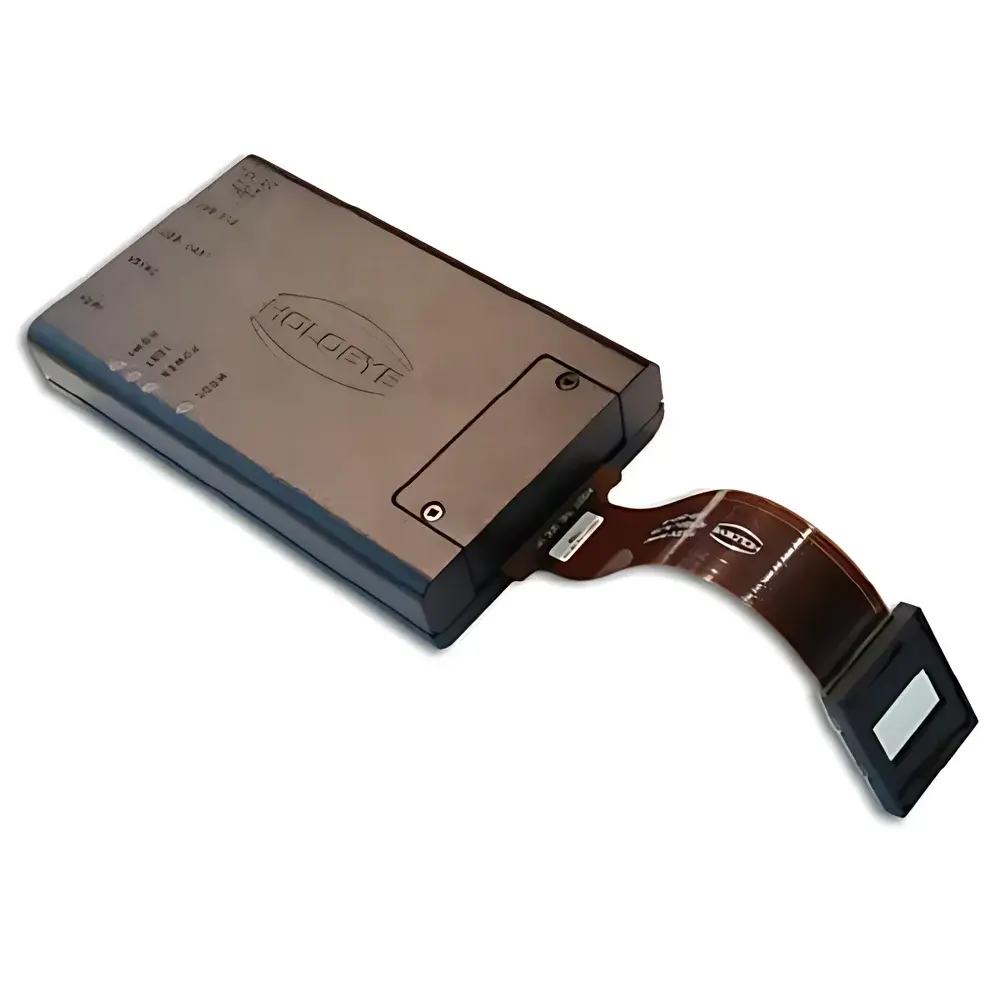
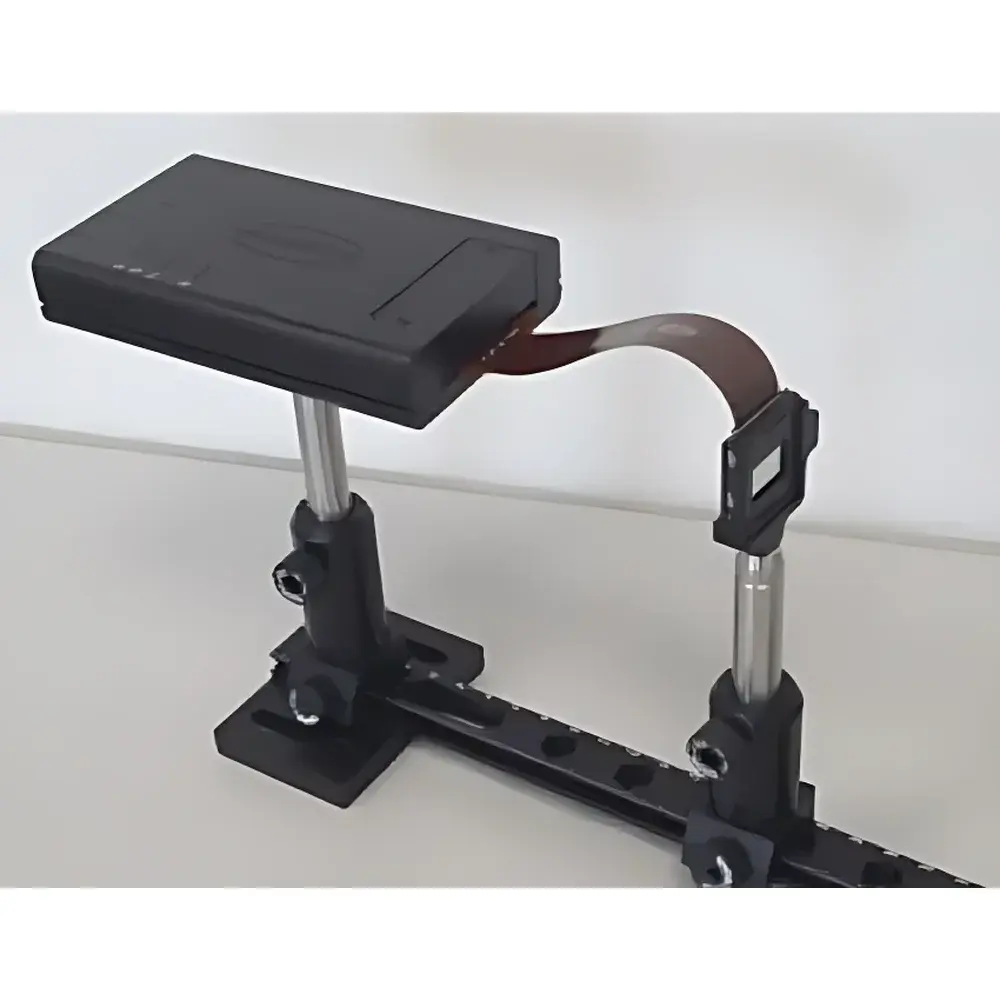
Holoeye PLUTO-2.1 NIR-145 Pure-Phase Spatial Light Modulator
| Brand | Holoeye |
|---|---|
| Origin | Germany |
| Manufacturer Type | Authorized Distributor |
| Product Origin | Imported |
| Model | PLUTO-2.1 NIR-145 |
| Spectral Range | 420–1064 nm |
| Resolution (Spatial & Spectral) | 1920 × 1080 pixels |
| Pixel Pitch | 8 µm |
| Total Field of View (TFOV) | 15.36 × 8.64 mm |
| Instantaneous Field of View (IFOV) | 7.8 µm |
| Frame Rate | 60 Hz |
| Interface | USB-controlled driver + HDMI/DisplayPort video input |
| Operating Mode | Pure-phase modulation |
| Compatibility | Standard GPU-based phase pattern streaming via green-channel 8-bit grayscale addressing |
Overview
The Holoeye PLUTO-2.1 NIR-145 is a high-resolution, pure-phase spatial light modulator (SLM) engineered for precision wavefront shaping in near-infrared (NIR) and visible optical systems. Unlike intensity-modulating devices, the PLUTO-2.1 NIR-145 operates exclusively in phase-only mode—leveraging nematic liquid crystal on silicon (LCoS) technology to impose spatially varying phase delays onto incident coherent light without significant amplitude modulation. Its 1920 × 1080 pixel array, with an 8 µm pixel pitch, delivers diffraction-limited beam control across a broad spectral band spanning 420 nm to 1064 nm. Designed for integration into adaptive optics, holographic optical trapping, structured illumination microscopy, and computational spectroscopy platforms, the device functions as a programmable diffractive optical element (DOE), enabling real-time generation of complex wavefronts—including vortex beams, Bessel beams, and custom point-spread functions—without mechanical reconfiguration.
Key Features
- Pure-phase LCoS architecture with >99% polarization-maintaining efficiency for linearly polarized input at design wavelengths
- Native 1920 × 1080 resolution and 8 µm pixel pitch, supporting sub-microradian angular resolution in Fourier-plane applications
- USB-driven gamma calibration system for precise voltage-to-phase transfer function mapping—enabling wavelength-specific optimization across 420–1064 nm
- Standard HDMI/DisplayPort video interface compatible with consumer and professional GPUs; phase patterns loaded via green-channel 8-bit grayscale encoding
- Hot-pluggable operation with real-time frame buffering—supports stable 60 Hz phase update rate under continuous streaming
- Compact, air-cooled module with integrated driver electronics; no external high-voltage supply or thermal stabilization required
Sample Compatibility & Compliance
The PLUTO-2.1 NIR-145 is designed for use with collimated, spatially coherent light sources including diode lasers, Ti:sapphire oscillators, and fiber-coupled supercontinuum sources. It requires linear polarization alignment and operates optimally with p-polarized illumination at its designated incidence angle (typically 4°–8° off-normal). The device complies with CE marking requirements for electromagnetic compatibility (EMC Directive 2014/30/EU) and low-voltage safety (LVD Directive 2014/35/EU). While not a standalone analytical instrument per se, it serves as a critical subsystem in ISO/IEC 17025-accredited optical metrology setups, particularly in laboratories performing traceable wavefront calibration (e.g., against Shack-Hartmann sensors or interferometric references). Its deterministic phase response supports GLP-aligned experimental protocols where reproducibility of optical path difference (OPD) maps must be documented and auditable.
Software & Data Management
Holoeye provides the SLM Display software suite for Windows-based phase pattern generation, gamma curve calibration, and real-time sequence playback. The software supports direct import of phase maps from MATLAB, Python (NumPy), and common image formats (BMP, TIFF), with batch scripting via COM interface. For integration into automated workflows, the device accepts standard video signals—allowing seamless synchronization with third-party acquisition engines (e.g., LabVIEW, Python OpenCV pipelines, or NI Vision). All gamma calibration profiles are stored locally with timestamped metadata; raw phase data exports preserve full 8-bit depth and spatial coordinates, ensuring traceability in regulated environments. While the PLUTO-2.1 NIR-145 does not implement FDA 21 CFR Part 11 electronic signature controls natively, its output files and configuration logs can be archived within validated LIMS or ELN systems meeting GxP documentation standards.
Applications
- Holographic beam shaping for laser materials processing, including multi-spot drilling and selective annealing
- Adaptive optics correction in astronomical telescopes and ophthalmic imaging systems
- Dynamic pupil engineering in confocal and light-sheet fluorescence microscopes
- Fourier-space filtering in hyperspectral snapshot compressive imaging (SCI) architectures
- Optical encryption and information multiplexing using phase-only Fourier holograms
- Calibration source for phase-sensitive detectors such as digital holographic interferometers and quadriwave lateral shearing interferometers (QWLSI)
FAQ
What is the maximum usable optical power density this SLM can handle?
The PLUTO-2.1 NIR-145 is rated for continuous-wave (CW) operation up to 2 W/cm² at 1064 nm and 0.5 W/cm² at 420 nm. Pulsed operation (e.g., ns pulses) requires derating based on pulse duration and repetition rate; consult the Holoeye Optical Damage Threshold Application Note before deployment.
Can I use this SLM with femtosecond laser pulses?
Yes—provided pulse energy remains below 10 µJ per pulse and average power stays within CW limits. Chromatic dispersion compensation and group delay management must be implemented externally, as the device introduces wavelength-dependent phase nonlinearity.
Is phase calibration data provided with each unit?
Each PLUTO-2.1 NIR-145 ships with a factory-measured phase-response lookup table (LUT) for 633 nm and 1064 nm, along with instructions for user-performed wavelength-specific gamma calibration using the included software.
Does the device support analog voltage input for direct phase control?
No—phase addressing is strictly digital via 8-bit grayscale video signal. Analog control is not supported; all voltage modulation is handled internally by the USB-configurable driver board.
How is spatial uniformity characterized across the active area?
Factory characterization reports RMS phase error <0.05π over 95% of the active aperture at 633 nm, measured via interferometric mapping against a reference flat. Localized pixel defects (if any) are documented in the unit-specific test certificate.
Related Products




