
Holoeye TMS Temperature Control System
| Brand | Holoeye |
|---|---|
| Origin | Germany |
| Model | TMS |
| Component Category | Optical Element |
| Cooling Types | TMS001 (Passive Heat Sink), TMS002 (Active Water-Cooled System) |
| Operating Temperature Range (TMS001) | 30–35 °C |
| Interface | Native Integration with PLUTO-2 and GAEA-2 Controller Software |
| Compliance | Designed for ISO/IEC 17025-aligned optical laboratories |
Overview
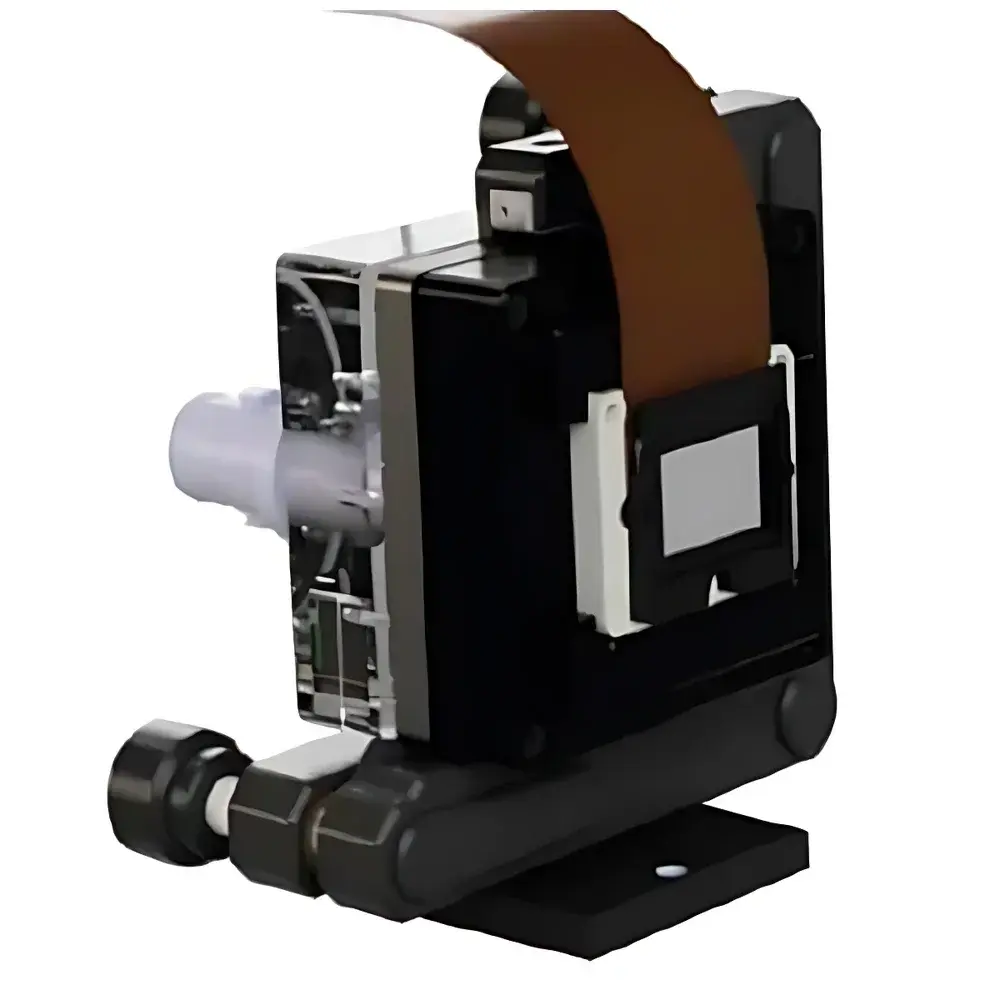
The Holoeye TMS Temperature Control System is an engineered thermal management solution specifically developed to stabilize the operational temperature of spatial light modulators (SLMs), particularly the PLUTO-2 and GAEA-2 series liquid crystal on silicon (LCoS) devices. LCoS-based SLMs exhibit intrinsic thermally sensitive electro-optic response: phase modulation accuracy, retardance uniformity, and pixel-to-pixel consistency degrade significantly with temperature drift. The TMS system addresses this fundamental constraint by maintaining precise thermal equilibrium—critical for applications demanding high-fidelity wavefront control, such as holographic optical trapping, adaptive optics, quantum optics experiments, and coherent beam shaping. Unlike generic lab chillers or ambient air cooling, the TMS architecture is co-designed with Holoeye’s SLM electronics and mechanical interfaces, ensuring minimal thermal gradient across the active LC layer and eliminating condensation risks associated with non-integrated cooling solutions.
Key Features
- Two-tier thermal architecture: TMS001 provides passive, conduction-based stabilization optimized for low-to-moderate optical power (5 W thermal load—essential for continuous-wave lasers operating at multi-watt levels.
- Direct firmware-level integration with PLUTO-2 and GAEA-2 controller software: temperature setpoint, real-time sensor feedback (±0.2 °C resolution), and thermal status indicators are accessible via the same GUI used for pattern loading and phase calibration—eliminating third-party drivers or external DAQ hardware.
- Thermally isolated mounting interface: precision-machined aluminum heat sink with conformal thermal interface material ensures uniform heat extraction from the LC substrate without inducing mechanical stress or birefringence distortion in the optical path.
- Low-noise operation: TMS001 operates silently; TMS002 employs a recirculating pump rated for <38 dB(A) acoustic emission—compatible with vibration-sensitive interferometric setups.
- Modular form factor: both variants mount directly onto the rear chassis of PLUTO-2/GAEA-2 units using standardized M3 threaded holes—no optical realignment required after installation.
Sample Compatibility & Compliance
The TMS system is exclusively validated for use with Holoeye’s PLUTO-2 (1920 × 1080, 8 µm pixel pitch) and GAEA-2 (1920 × 1080, 6.4 µm pixel pitch) LCoS SLMs. It is not compatible with transmissive LCD panels, DMDs, or non-Holoeye SLM platforms. Thermal performance data—including steady-state deviation (≤ ±0.3 °C over 8 hours), response time to setpoint change (τ₉₀ < 90 s), and long-term drift (<0.05 °C/h)—are documented per internal Holoeye Test Protocol HT-2023-01. The system complies with IEC 61000-6-3 (EMC emissions) and IEC 60950-1 (safety) standards. While not certified under FDA 21 CFR Part 11, its logging functionality supports GLP/GMP-aligned audit trails when deployed within validated laboratory information management systems (LIMS).
Software & Data Management
Temperature monitoring and control are embedded within the standard Holoeye SLM Control Software (v4.2+). Users configure setpoints, enable auto-stabilization mode, and export timestamped thermal logs (CSV format) alongside phase pattern metadata. The API supports programmatic access via MATLAB, Python (via PySerial), and LabVIEW through documented serial command protocols. All temperature readings derive from calibrated NTC thermistors embedded beneath the LC layer—traceable to PTB (Physikalisch-Technische Bundesanstalt) reference standards. No cloud connectivity or remote telemetry is implemented; data remains local unless explicitly exported by the user.
Applications
- High-precision digital holography requiring sub-wavelength phase stability over extended acquisition windows (e.g., quantitative phase imaging, holographic microscopy).
- Adaptive optics systems where dynamic aberration correction depends on repeatable LC response—especially in astronomical observatories using laser guide stars.
- Optical tweezer arrays and atom trapping experiments relying on diffraction-limited spot fidelity and temporal phase coherence.
- Calibration-grade optical testing: MTF measurement, wavefront error mapping, and polarization-dependent loss characterization of custom diffractive optics.
- Industrial laser processing R&D involving structured light projection for microfabrication or selective surface modification.
FAQ
Is the TMS system compatible with third-party SLM controllers?
No. The TMS communicates exclusively via Holoeye’s proprietary serial protocol and requires the native PLUTO-2/GAEA-2 controller board for actuation and feedback interpretation.
Can TMS001 maintain temperature below ambient?
No. TMS001 is a passive heat sink—it stabilizes at a fixed offset below the device’s self-heating equilibrium point but cannot achieve sub-ambient temperatures.
What is the maximum recommended optical power density for TMS002?
For continuous-wave lasers at 532 nm, the validated upper limit is 2.5 W/cm² incident on the active aperture; pulsed operation (e.g., 10 ns, 10 Hz) has been tested up to 5 J/cm² without thermal runaway.
Does TMS require external water supply or chiller unit?
TMS002 includes an integrated reservoir and pump—only deionized water or 30% ethylene glycol/water mixture is needed; no external chiller is required for standard lab environments (18–25 °C ambient).
How often must the thermal interface material be replaced?
Under normal usage (≤8 h/day), the phase-change thermal pad is rated for 5 years or 10,000 thermal cycles—replacement is only necessary if visual inspection reveals delamination or oxidation.