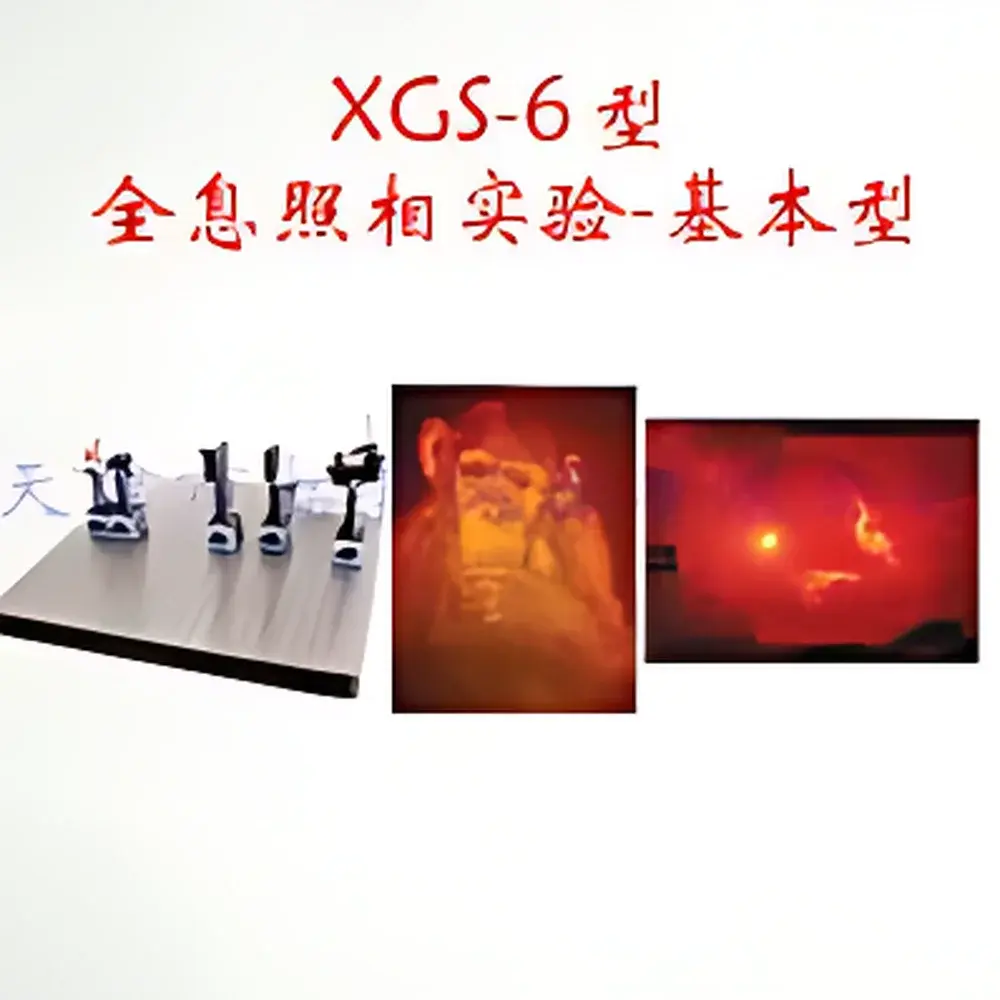
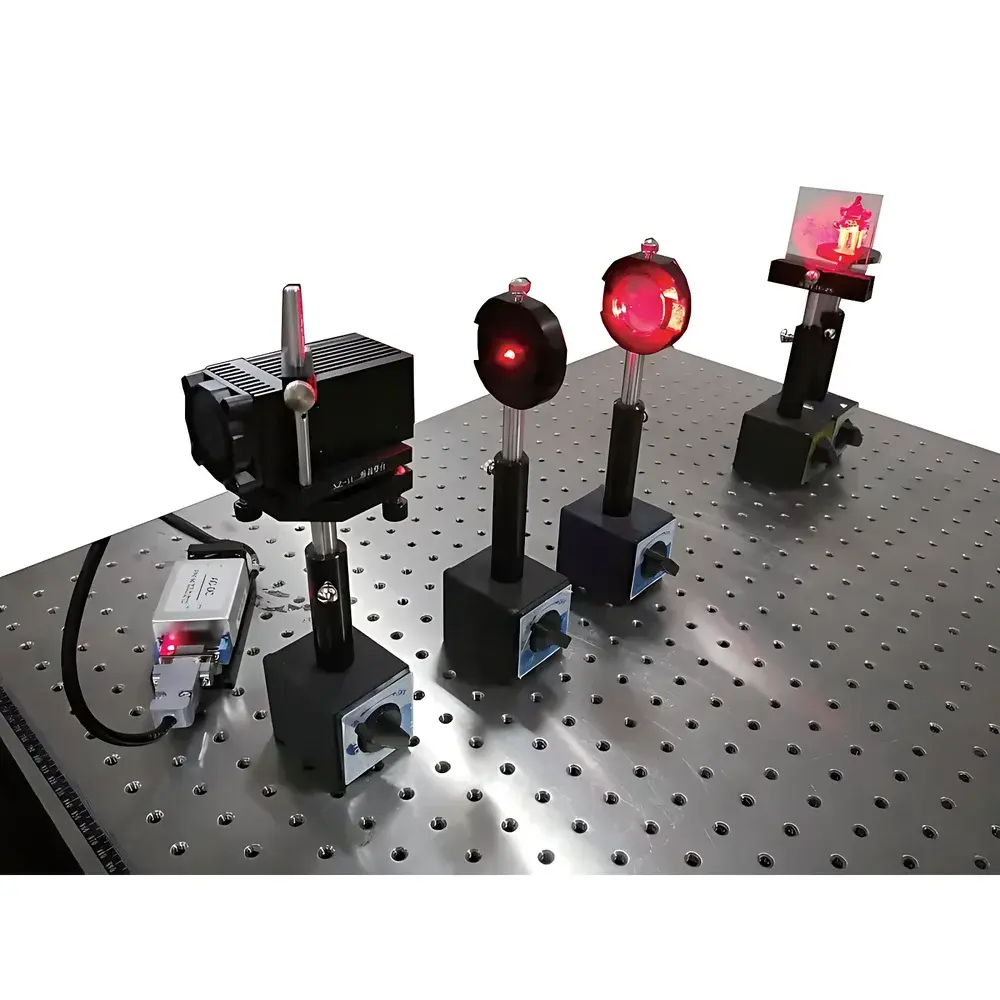
Holography Experiment Kit – Basic Model (TP XGS-6)
| Brand | TP |
|---|---|
| Origin | Tianjin, China |
| Manufacturer Type | Direct Manufacturer |
| Country of Origin | China |
| Model | XGS-6 |
| Pricing | Available Upon Request |
| Light Source | 40 mW Semiconductor Laser |
| Recording Medium | Photopolymer Holographic Dry Plate |
| Exposure Control | Digital Electronic Timer (Manual/Programmable Modes) |
| Development | Isopropyl Alcohol Rinse + Air-Drying |
| Reconstruction Light | White Light (for Reflection Rainbow Holograms) |
| Operating Environment | Ambient Illumination (No Darkroom Required) |
| Portability | Compact, Benchtop Design |
| Illuminance Meter | Integrated Pocket-Sized Photometer (Wide Range, High Accuracy) |
Overview
The TP XGS-6 Holography Experiment Kit is an education- and demonstration-optimized optical instrumentation platform engineered for hands-on instruction in fundamental holographic principles. It operates on the physical basis of interference and diffraction of coherent light, enabling the recording and reconstruction of three-dimensional wavefront information using photopolymer-based dry plates. Unlike traditional silver-halide emulsions requiring darkroom handling and hazardous chemical processing, this system employs a photosensitive polymer medium that exhibits high diffraction efficiency (>75% typical), spatial resolution exceeding 3000 lines/mm, and intrinsic stability under ambient lighting conditions. The integrated 40 mW continuous-wave semiconductor laser (650 nm nominal wavelength) delivers stable output with >10,000-hour operational lifetime and minimal mode hopping—ensuring consistent fringe contrast during exposure. Its design supports both transmission and reflection holography geometries, including the production of white-light-viewable reflection rainbow holograms—a critical pedagogical feature for illustrating wavelength-selective Bragg diffraction in volume-phase gratings.
Key Features
- Ambient-light operation: No darkroom required—enabling rapid setup and iterative experimentation in standard teaching laboratories.
- Dual-mode holography capability: Supports transmission hologram recording (planar reference geometry) and reflection hologram configurations (including Denisyuk-style single-beam rainbow holograms).
- Photopolymer dry plate medium: Non-toxic, shelf-stable recording material developed for high signal-to-noise ratio and robust environmental tolerance; eliminates need for wet-processing baths or silver recovery systems.
- Simplified development protocol: Plate rinsing with isopropyl alcohol (IPA), followed by gentle air-drying using a low-velocity electric blower—no vacuum desiccation or thermal baking required.
- Precision exposure control: Digital electronic timer with dual operating modes—manual trigger and programmable duration (1 s to 999 s, ±0.1 s resolution)—facilitating reproducible exposure dose calibration.
- Integrated photometric verification: Compact handheld illuminance meter (range: 0.1–200,000 lux, accuracy ±4% FS) enables real-time monitoring of reference and object beam intensities—essential for optimizing fringe visibility (V = 2√(IrIo)/(Ir + Io)).
Sample Compatibility & Compliance
The XGS-6 is compatible with standard 10 × 12.5 cm photopolymer plates (e.g., Slavich PFG-03C or equivalent TP-branded variants). It accommodates object sizes up to 8 cm in depth and 10 cm in lateral dimension when mounted on the included vibration-isolated optical bench. All optical components—including beam splitters, mirrors, and spatial filters—are pre-aligned and secured via kinematic mounts compliant with ISO 10110-7 surface quality standards. The system conforms to IEC 60825-1:2014 Class 3R laser safety requirements, with embedded interlock circuitry and aperture labeling per ANSI Z136.1. While not certified for clinical or industrial metrology use, its construction and documentation support adherence to GLP-aligned educational laboratory practices.
Software & Data Management
The XGS-6 operates as a hardware-only platform without proprietary software dependencies. Exposure timing data is retained locally on the digital timer’s non-volatile memory (100-event log capacity) and exportable via RS-232 interface (optional adapter). Illuminance measurements from the integrated photometer are displayed in real time but not stored; users may manually record values in standardized lab notebooks aligned with ASTM E2750-20 guidelines for optical experiment documentation. No cloud connectivity or FDA 21 CFR Part 11 compliance is implemented—consistent with its role as a pedagogical tool rather than a regulated analytical instrument.
Applications
- Undergraduate physics laboratories: Demonstrating wave optics fundamentals—including coherence length measurement, Michelson interferometer alignment, and quantitative analysis of fringe spacing vs. object distance.
- Materials science courses: Investigating refractive index modulation in photopolymers and correlating exposure dose with diffraction efficiency using calibrated neutral density filters.
- Optical engineering curricula: Characterizing angular selectivity and spectral bandwidth of reflection holograms under broadband illumination (e.g., tungsten-halogen or LED sources).
- Museum and outreach programs: Creating durable, white-light-reconstructible holograms for public display—leveraging the system’s robustness, low operational cost, and minimal infrastructure requirements.
- Teacher training workshops: Building foundational competency in optical alignment, laser safety protocols, and experimental uncertainty propagation in interferometric measurements.
FAQ
Is a darkroom required for operation?
No. The photopolymer dry plate is insensitive to visible ambient light, allowing full setup, exposure, and development under normal room illumination.
What safety certifications does the laser source meet?
The 40 mW 650 nm diode laser complies with IEC 60825-1:2014 Class 3R requirements, including maximum permissible exposure (MPE) limits and mandatory labeling per EN 60825-1.
Can this system record holograms of moving objects?
No. Due to the required exposure time (typically 10–60 seconds depending on beam intensity), only static or vibration-isolated objects yield usable fringe contrast.
What is the expected shelf life of unexposed photopolymer plates?
When stored at 15–25°C and <40% RH in sealed aluminum foil packaging, unexposed plates retain full sensitivity for ≥18 months.
Is technical support available for curriculum integration?
Yes. TP provides application notes, alignment checklists, and sample experiment protocols aligned with AP Physics and university-level optics syllabi—available upon institutional request.