
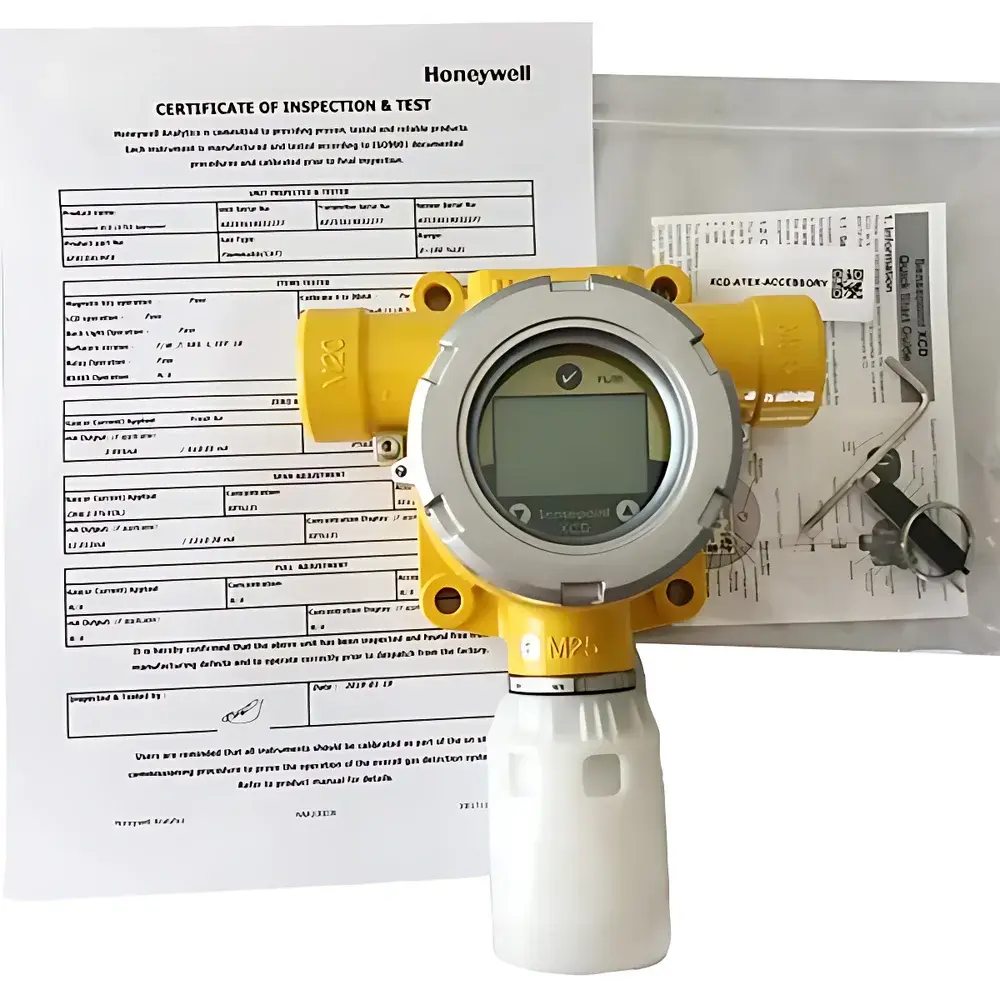
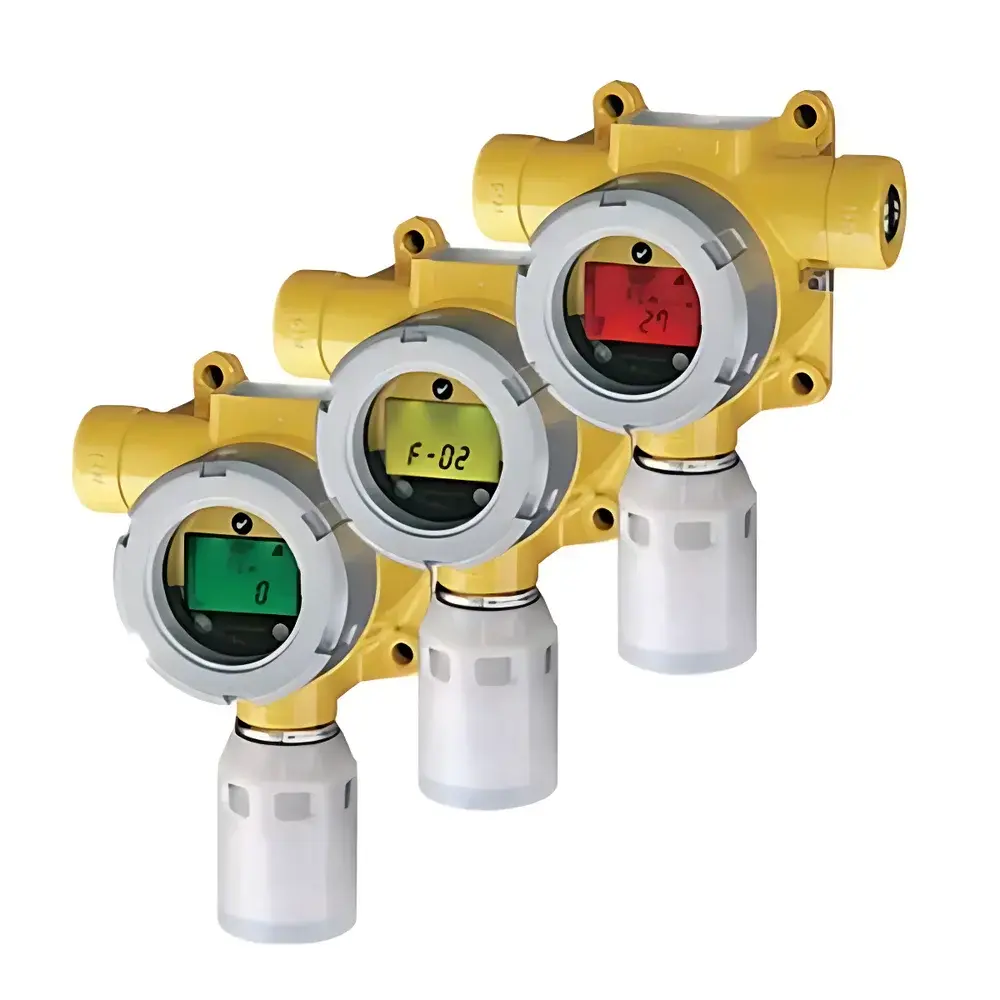
Honeywell BW Sensepoint XCD Fixed Gas Detector
| Brand | Honeywell BW |
|---|---|
| Origin | Canada |
| Model | XCD |
| Sensor Compatibility | Catalytic Bead (LEL), Electrochemical (Toxic/O₂), NDIR (Combustible) |
| Output | 4–20 mA (3-wire), HART optional |
| Certifications | ATEX/IECEx Zone 1/2, UL Class I Div 1/2, CSA C/US |
| Enclosure Rating | IP66/IP67 |
| Operating Temperature | –40 °C to +65 °C |
| Display | Backlit LCD with bar graph, gas type icon, status indicators |
| Calibration | Magnetic wand–enabled, no-open-box configuration & bump test |
| Relay Outputs | 3 programmable SPDT relays |
| Housing Material | UV-stabilized polycarbonate & stainless steel mounting plate |
| Sensor Mounting | Integral bottom port, remote sensor option (RTD/RFD variants) |
| Compliance | EN 60079-29-1, EN 45544-1, IEC 61000-6-2/6-4, FDA 21 CFR Part 11–ready software support (via Honeywell Analytics Suite) |
Overview
The Honeywell BW Sensepoint XCD Fixed Gas Detector is an intrinsically safe, field-proven continuous monitoring solution engineered for reliable detection of combustible gases (LEL), toxic gases (e.g., CO, H₂S, Cl₂, NH₃, SO₂), and oxygen (O₂) in industrial environments. Built upon Honeywell’s legacy in hazardous-area instrumentation, the XCD employs a modular architecture where a single transmitter housing accommodates interchangeable sensor modules—catalytic bead (for hydrocarbons), electrochemical (for toxic species and O₂), and non-dispersive infrared (NDIR) sensors—enabling flexible configuration without hardware replacement. Its measurement principle varies by sensor type: catalytic bead sensors detect combustibles via controlled oxidation-induced resistance change; electrochemical cells generate current proportional to target gas concentration through redox reactions; and NDIR sensors quantify hydrocarbons by measuring absorption at specific infrared wavelengths. Designed for deployment in process areas, pump stations, compressor enclosures, and confined entry zones, the XCD delivers high reproducibility under fluctuating ambient conditions—including humidity extremes, vibration, and transient EMI—thanks to its robust mechanical design and temperature-compensated signal processing.
Key Features
- Universal transmitter platform supporting catalytic bead, electrochemical, and NDIR sensor technologies within one enclosure
- Magnetic wand–based interface enabling zero-entry configuration, calibration, and diagnostics—eliminating need for tool-based access or hazardous-area hot work permits
- Backlit graphical LCD display showing real-time gas concentration (numeric + bar graph), alarm status (TWA, STEL, LEL, O₂ deficiency/enrichment), sensor health, and diagnostic codes
- Three user-programmable SPDT relays for direct control of external devices including audible/visual alarms, solenoid valves, ventilation fans, or PLC shutdown signals
- Standard 4–20 mA analog output with HART® protocol support for integration into DCS, SCADA, or safety instrumented systems (SIS)
- Remote sensor capability via RTD (Remote Transmitter Device) and RFD (Remote Field Device) configurations—extending sensing distance up to 100 m with minimal signal degradation
- IP66/IP67-rated enclosure with UV-resistant polycarbonate front window and corrosion-resistant stainless steel mounting base
- Compliance with global hazardous location standards: ATEX/IECEx Zone 1 & 2 (gas groups IIA, IIB, IIC), UL Class I Division 1 & 2 (Groups A–D), and CSA C/US certification
Sample Compatibility & Compliance
The Sensepoint XCD supports over 30 certified gas-specific sensor configurations, covering common industrial hazards such as methane, propane, hydrogen, carbon monoxide, hydrogen sulfide, chlorine, ammonia, sulfur dioxide, nitrogen dioxide, phosphine, and oxygen deficiency/enrichment. All sensors are individually type-approved per EN 60079-29-1 (gas detectors) and EN 45544-1 (toxic gas detectors), ensuring traceable performance against defined exposure limits. The system meets electromagnetic compatibility requirements per IEC 61000-6-2 (immunity) and IEC 61000-6-4 (emissions), and supports audit-ready operation under GLP/GMP frameworks when paired with Honeywell Analytics Suite—providing electronic calibration logs, user activity tracking, and 21 CFR Part 11–compliant data integrity features including digital signatures and immutable event history.
Software & Data Management
Honeywell Analytics Suite provides centralized configuration, firmware updates, alarm management, and historical trend analysis for fleets of Sensepoint XCD units. The software enables batch calibration scheduling, cross-sensor correlation studies, and automated report generation aligned with ISO 9001 and OSHA 1910.120 compliance documentation requirements. Field-level diagnostics—including sensor drift detection, zero/span verification status, and cable fault identification—are accessible both locally via magnetic interface and remotely via Modbus TCP or HART-IP gateways. All configuration changes and calibration events are time-stamped and logged with operator ID, satisfying regulatory demands for full traceability in safety-critical applications.
Applications
- Petrochemical refineries: Continuous monitoring of flare stack areas, compressor sheds, and loading racks for hydrocarbon leaks
- Chemical manufacturing plants: Detection of chlorine, ammonia, or hydrogen cyanide in synthesis and storage zones
- Water/wastewater treatment facilities: Monitoring of H₂S in wet wells, sludge digesters, and headworks
- Mining and tunneling operations: Oxygen deficiency and CO monitoring in enclosed excavation environments
- Pharmaceutical clean utilities: Verification of inert gas blanketing integrity (N₂, Ar) and solvent vapor presence (e.g., IPA, acetone)
- Power generation: Combustible gas detection in turbine enclosures and battery rooms
FAQ
What hazardous area certifications does the Sensepoint XCD hold?
The XCD carries ATEX/IECEx Zone 1 & 2 (II 2G Ex db IIC T4 Gb), UL Class I Division 1 & 2 (Groups A–D), and CSA C/US approval for use in North America and Europe.
Can the XCD detect multiple gases simultaneously?
No—each XCD transmitter operates with one sensor module at a time. However, multi-gas coverage is achieved by installing multiple XCD units or selecting dual-sensor variants (e.g., CO/H₂S combo) where certified.
Is field calibration possible without opening the enclosure?
Yes—full zero/span calibration, bump testing, and parameter adjustment are performed using a handheld magnetic wand through the front lens, eliminating the need for screwdriver access in classified areas.
What is the maximum recommended cable length for remote sensor configurations?
For RTD/RFD variants, the maximum shielded twisted-pair cable length between transmitter and sensor is 100 meters, maintaining signal fidelity per IEC 60079-29-1 loop resistance specifications.
Does the XCD support digital communication protocols beyond 4–20 mA?
HART 7 is natively supported; Modbus RTU and Ethernet/IP integration require optional gateway modules compatible with Honeywell’s Experion PKS or third-party DCS platforms.




