
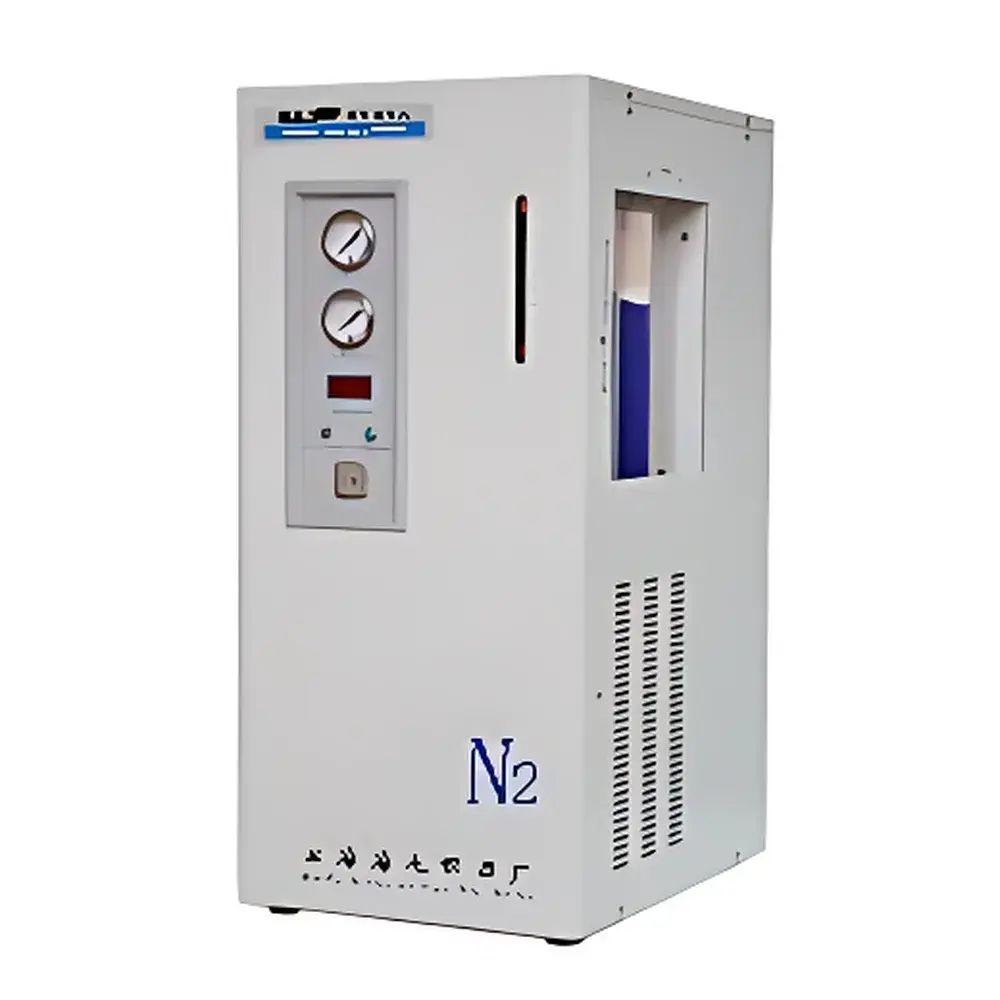
Honeywell HLN-300P High-Purity Membrane-Based Nitrogen Generator
| Origin | Shanghai, China |
|---|---|
| Manufacturer Type | Authorized Distributor |
| Origin Category | Domestic (PRC) |
| Model | HLN-300P |
| Pricing | Available Upon Request |
| Purity | >99.999% N₂ |
| Flow Rate | 0–300 mL/min |
| Output Pressure | 0–0.5 MPa (factory-set at 0.4 MPa) |
| Power Supply | 220 V ±10%, 50 Hz ±5% |
| Max. Power Consumption | 250 W |
| Operating Ambient | 10–40 °C, ≤85% RH, non-corrosive, low-dust environment |
| Warranty | 1-year system warranty |
Overview
The Honeywell HLN-300P is a compact, high-reliability nitrogen generator engineered for continuous on-demand supply of ultra-high-purity nitrogen gas (≥99.999%) in analytical laboratory environments. Unlike pressure swing adsorption (PSA) systems, the HLN-300P employs an advanced electrochemical membrane separation process—specifically, a dual-cathode stainless steel electrolytic cell architecture—to simultaneously generate nitrogen and remove oxygen from compressed air feedstock. This principle leverages selective ionic transport across a proton-exchange membrane under controlled DC current, enabling precise stoichiometric separation without consumable cartridges or moving parts in the core separation stage. Designed for integration with GC, LC-MS, FTIR, and inert atmosphere gloveboxes, the unit delivers stable, oil-free, dry nitrogen meeting ASTM D6803 and ISO 8573-1 Class 1 air quality requirements for instrument-grade gases.
Key Features
- Patented dual-cathode stainless steel electrolytic cell with enlarged active surface area—enhances thermal dissipation, reduces operational cell temperature (<45 °C), and improves long-term stability and gas yield consistency.
- Integrated anti-backflow protection mechanism—mechanically isolates the electrolyte chamber from downstream gas lines, eliminating risk of liquid carryover into sensitive instrumentation.
- Intelligent pressure regulation system with automatic shut-off upon power interruption—maintains safe upstream pressure integrity and prevents uncontrolled gas release during unexpected outages.
- High-efficiency switching-mode power supply (SMPS)—optimized for low ripple DC output, improving electrolytic conversion efficiency by ≥18% versus conventional linear supplies while reducing heat load and component stress.
- Space-efficient footprint (W × D × H: 220 × 320 × 410 mm) and lightweight design (≤12.5 kg)—facilitates benchtop deployment in constrained lab spaces without dedicated floor mounting.
Sample Compatibility & Compliance
The HLN-300P is compatible with ambient air intake (filtered to ISO 8573-1 Class 4 particulate, Class 3 water, Class 2 oil) and requires no external drying or purification stages when operated within specified environmental limits (10–40 °C, ≤85% RH). Its output meets stringent purity thresholds required for trace-level analysis: residual oxygen <1 ppmv, moisture <1 ppmv (dew point ≤ –70 °C), and total hydrocarbons <0.1 ppmv. The system conforms to IEC 61010-1 safety standards for laboratory electrical equipment and supports GLP-compliant operation through stable, repeatable gas delivery profiles—critical for method validation under USP , ISO/IEC 17025, and FDA 21 CFR Part 11–aligned workflows where gas source consistency directly impacts chromatographic retention time reproducibility and detector baseline stability.
Software & Data Management
The HLN-300P operates as a standalone hardware platform with embedded digital control logic—no proprietary software or driver installation is required. All operational parameters (output pressure, flow rate, cell voltage, and runtime hours) are displayed via a backlit LCD interface with real-time status indicators. While it lacks Ethernet or USB connectivity, its analog pressure and flow monitoring outputs (0–5 V DC) enable integration into centralized facility monitoring systems (e.g., LabVantage, Siemens Desigo, or custom SCADA) for audit-trail-capable logging. The internal firmware implements cyclic self-diagnostic routines—including electrolyte conductivity verification and overpressure lockout—and stores last-10-event fault logs accessible via service mode for preventive maintenance planning.
Applications
- Carrier and purge gas for gas chromatography (GC) and GC-MS systems requiring consistent N₂ flow and minimal oxygen interference.
- Blanketing and inerting in sample preparation workstations, solvent evaporation systems, and Schlenk line manifolds.
- Mobile and field-deployable labs where cylinder logistics are impractical—enabling uninterrupted operation for up to 24/7 duty cycles with routine monthly electrolyte top-up.
- Calibration gas dilution systems requiring certified background gas with documented purity traceability.
- Electron microscopy sample chambers and X-ray fluorescence (XRF) analyzers demanding particle-free, moisture-free nitrogen atmospheres.
FAQ
What maintenance intervals are recommended for the HLN-300P?
Electrolyte level should be inspected biweekly and replenished with deionized water (≥18.2 MΩ·cm resistivity) as needed; full electrolyte replacement is advised every 12 months. Air inlet filter must be replaced quarterly in standard lab environments.
Can the HLN-300P be used with mass spectrometry instruments?
Yes—its <1 ppmv O₂ and <1 ppmv H₂O output satisfies the baseline stability requirements for most quadrupole and triple-quadrupole MS systems when paired with optional in-line sub-micron filtration (0.01 µm) and desiccant polishing.
Is remote monitoring supported?
The unit provides analog 0–5 V outputs for pressure and flow; integration with third-party data acquisition systems is possible, but native network protocols (Modbus TCP, BACnet) are not implemented.
Does the warranty cover performance degradation over time?
The 3-year electrolytic cell warranty includes coverage for measurable decline in nitrogen purity below 99.999% under documented operating conditions and scheduled maintenance compliance.
How does ambient humidity affect output specifications?
Operation above 85% RH may reduce electrolyte longevity and increase risk of condensate ingress; use of a pre-filtered, refrigerated dryer is strongly recommended in high-humidity climates.



