
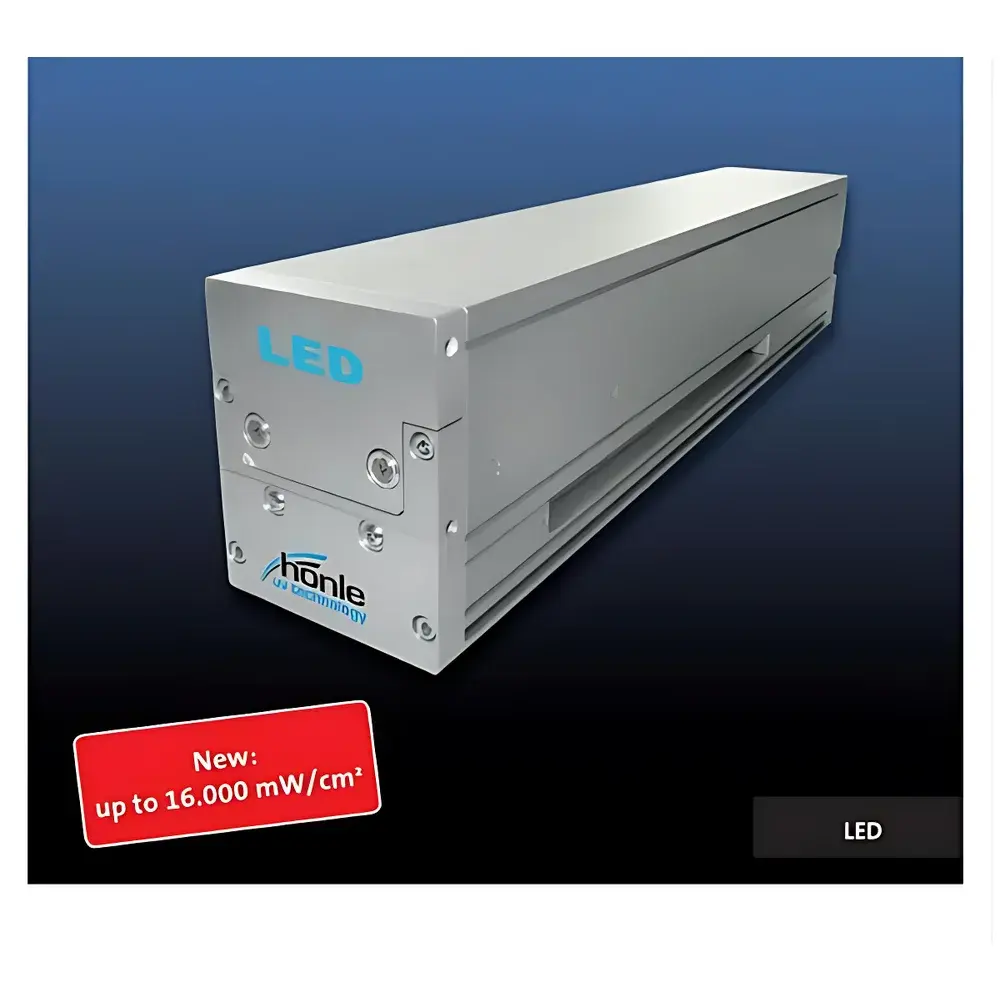
Hönle LED Powerline Flexo UV-LED Curing System for Flexographic Printing
| Brand | Hönle |
|---|---|
| Origin | Germany |
| Model | LED Powerline Flexo |
| Wavelength Options | 365 / 385 / 395 / 405 nm ±10 nm |
| Rated LED Lifetime | >20,000 hours |
| Cooling | Integrated forced-air cooling |
| Control Interfaces | 0–10 V analog dimming, RS485 bus, optional Ethernet, digital PLC I/O (E-Stop, On/Off, Fault) |
| Segment Monitoring | Short-circuit, open-circuit, overtemperature, operational hour logging |
| Segment Control | Independent intensity adjustment per LED zone |
| Compliance | Designed for industrial integration in ISO 9001-certified print production environments |
Overview
The Hönle LED Powerline Flexo is an industrial-grade UV-LED curing system engineered specifically for flexographic printing lines requiring precise, reliable, and energy-efficient intermediate (tacking) and final curing of UV inks, varnishes, adhesives, and encapsulants. Unlike conventional mercury arc or microwave-driven UV sources, this system employs solid-state LED emitters operating at discrete peak wavelengths—365 nm, 385 nm, 395 nm, or 405 nm (±10 nm)—each selected to match the photoinitiator absorption profile of modern UV formulations. Its design follows the principles of photopolymerization kinetics: irradiance uniformity, spectral fidelity, and temporal responsiveness are prioritized to ensure reproducible crosslinking without thermal degradation. The system integrates seamlessly into high-speed web-fed flexo presses (up to 500 m/min), delivering stable radiometric output across the full print width with minimal thermal load on substrates—enabling safe curing of heat-sensitive films, foils, and coated papers.
Key Features
- Modular LED array architecture with independently addressable segments—enabling zone-specific irradiance control aligned to print format width and ink coverage distribution.
- Integrated high-efficiency LED drivers housed within the lamp head, eliminating external power supply cabinets and reducing EMI susceptibility.
- Real-time electronic monitoring of each segment for open-circuit, short-circuit, and overtemperature faults—loggable via internal memory with timestamped operational hour tracking.
- Multi-layer thermal management: optimized aluminum extrusion housing, low-noise axial fans, and intelligent airflow routing ensure continuous operation at ambient temperatures up to 40 °C without auxiliary chillers or water cooling.
- Dual-mode control interface: analog 0–10 V dimming for manual or analog PLC integration; digital RS485 Modbus RTU for centralized supervisory control; optional Ethernet/IP or PROFINET modules available for Industry 4.0-ready automation environments.
- No warm-up or cooldown delay—full irradiance achieved within 90% versus arc-based systems.
Sample Compatibility & Compliance
The LED Powerline Flexo supports a broad range of UV-curable chemistries—including acrylate, epoxy, and hybrid formulations—commonly used in food packaging, pharmaceutical labeling, and decorative laminates. Its narrow-band spectral output minimizes unwanted UV-A/B exposure while maximizing photon delivery to reactive functional groups. The system complies with IEC 62471 (Photobiological Safety of Lamps) for Risk Group 1 (exempt) classification when operated with standard shielding. It is designed to meet mechanical and electrical requirements of EN 60204-1 (Safety of Machinery – Electrical Equipment) and supports integration into GMP-compliant print workflows where traceability and process validation are required. While not a medical device, its stable output and audit-ready segment diagnostics align with GLP documentation expectations for QC-critical curing steps.
Software & Data Management
No proprietary software is required for basic operation; however, Hönle’s optional Powerline Control Suite (Windows-based) enables remote configuration, irradiance mapping visualization, fault history export (CSV), and calibration certificate generation. All segment-level diagnostic data—including cumulative operating hours, thermal profiles, and fault event logs—are stored onboard and accessible via RS485 or Ethernet. For regulated environments, the system supports 21 CFR Part 11-compliant audit trails when paired with validated SCADA or MES platforms—capturing user actions, parameter changes, and system status transitions with immutable timestamps and operator authentication.
Applications
- Intermediate tacking of UV inks between print stations to prevent set-off and enable multi-color registration stability.
- Final cure of aqueous- or solvent-free UV coatings on flexible packaging webs (e.g., PET, OPP, metallized films).
- Curing of pressure-sensitive adhesives in label converting—particularly critical for low-temperature laminates and RFID inlays.
- Encapsulation of printed electronics and conductive traces where thermal budget constraints prohibit mercury-lamp exposure.
- In-line curing of UV-reactive sealants and barrier coatings in pharmaceutical blister packaging lines.
FAQ
What is the typical irradiance output at 100 mm working distance?
Irradiance varies by model configuration and wavelength; representative values range from 1.2–3.5 W/cm² (365 nm) to 4.0–8.0 W/cm² (395/405 nm) under nominal drive conditions—measured per IEC TR 62681 using calibrated spectroradiometers.
Can the system be retrofitted onto existing flexo presses?
Yes—modular mounting brackets, standardized flange interfaces, and compact depth (<180 mm) facilitate mechanical integration into most OEM press frames without structural modification.
Is spectral output validated per batch?
Each production unit undergoes factory spectral verification; full spectral reports and NIST-traceable irradiance calibration certificates are supplied with shipment.
How is safety interlocking implemented?
Hardware-level emergency stop circuitry interrupts LED power within <20 ms; integrated photocell inputs allow external light curtain or door switch linkage compliant with ISO 13857.
What maintenance is required over the 20,000-hour lifetime?
No consumables or periodic lamp replacement; recommended annual inspection includes fan filter cleaning, connector torque verification, and firmware update validation.




