
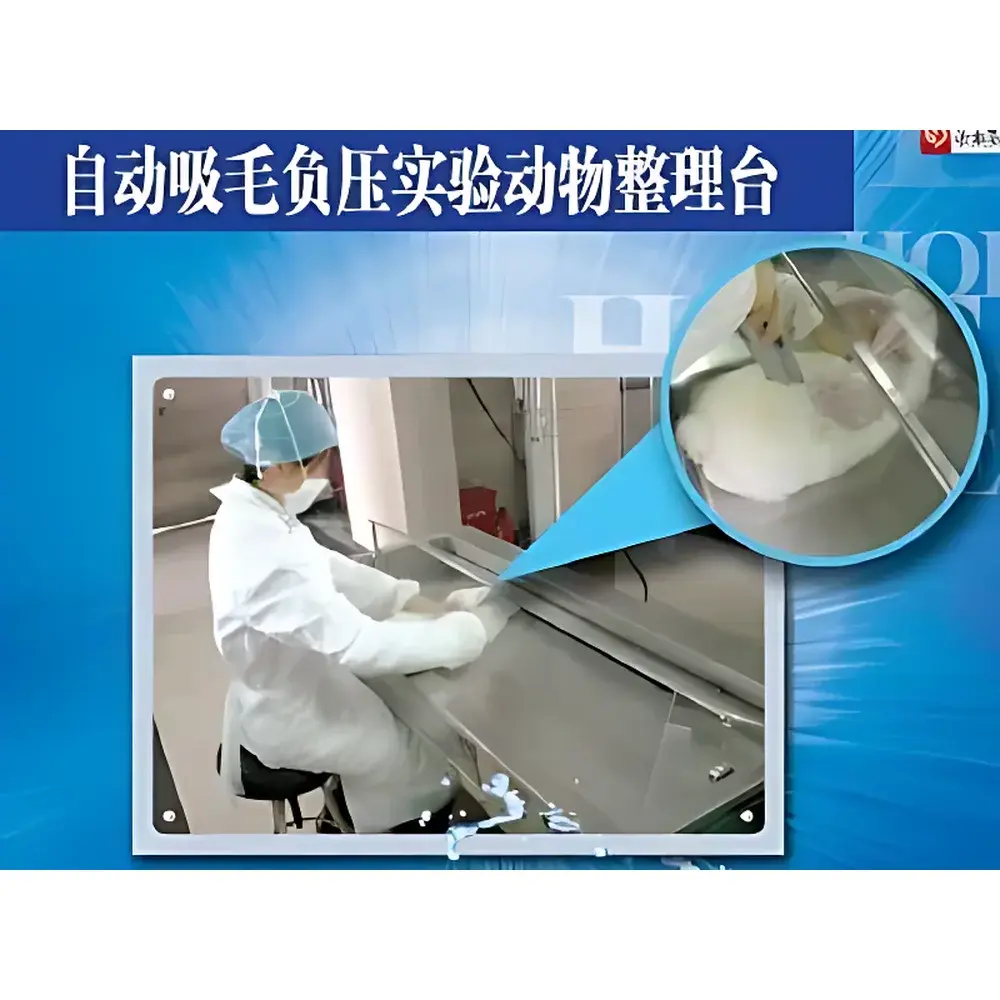
Hope-Med 8180C Automated Hair-Removal Negative-Pressure Animal Preparation Station
| Brand | Hope-Med |
|---|---|
| Model | 8180C |
| Origin | Tianjin, China |
| Power Supply | 198–242 VAC, 50–60 Hz |
| Rated Power | 400 W |
| Operating Temperature | 15–30 °C |
| Relative Humidity | Non-condensing |
| Differential Pressure Range | 50–400 Pa |
| Dimensions (L×W×H) | 1485 × 620 × 750 mm |
| Weight | ~50 kg |
Overview
The Hope-Med 8180C Automated Hair-Removal Negative-Pressure Animal Preparation Station is an engineered solution for controlled, hygienic pre-procedural animal preparation in regulatory-compliant life science laboratories. Designed specifically for dermal irritation testing, toxicology studies, and surgical site preparation, the system operates on a validated negative-pressure aspiration principle—generating a stable airflow gradient across the work surface to capture loose hair, skin debris, fecal particulates, and low-volume biological fluids (e.g., capillary blood) at the source. This prevents airborne dispersion and surface contamination, significantly reducing operator exposure to allergenic bioaerosols, zoonotic pathogens, and malodorous volatiles. The station integrates a real-time differential pressure monitoring system (50–400 Pa range) to ensure consistent suction performance and airflow integrity—critical for maintaining ISO 14644-1 Class 8 (100,000) cleanroom-equivalent local containment during routine handling.
Key Features
- Automated, continuous negative-pressure aspiration with adjustable airflow stability across the full work surface (1485 mm × 620 mm)
- Digital differential pressure display for real-time verification of operational vacuum integrity
- Interchangeable collection modules: disposable polypropylene waste bags (sterile option available) or autoclavable stainless-steel reusable containers
- Integrated visual alert system triggers on bag fill-level detection—prevents overfilling and maintains suction efficiency
- Low-noise, brushless centrifugal blower assembly rated for continuous duty at 400 W input power
- Ergonomically optimized height (750 mm) and footprint designed to integrate with standard vivarium workflow benches and laminar flow hoods
- Electrical safety compliance with GB 4793.1 (equivalent to IEC 61010-1) for laboratory equipment
Sample Compatibility & Compliance
The 8180C accommodates rodents (mice, rats), rabbits, and small non-human primates during conscious or sedated preparation phases. Its sealed aspiration path and HEPA-filtered exhaust (optional add-on) meet core biosafety requirements for BSL-2 environments per WHO Laboratory Biosafety Manual (4th ed.). While not classified as medical devices under FDA 21 CFR Part 820, the unit supports GLP-compliant study conduct by enabling documented, repeatable preparation conditions—particularly relevant for OECD TG 404 (Acute Dermal Irritation/Corrosion) and ISO 10993-10 (Biological evaluation of medical devices: Irritation and skin sensitization). All structural materials comply with RoHS Directive 2011/65/EU for restricted hazardous substances.
Software & Data Management
The 8180C operates as a standalone hardware platform without embedded firmware or network connectivity. Pressure readings are displayed locally via a calibrated digital LCD panel with ±5 Pa accuracy; no data logging or export functionality is included. For audit-trail compliance in regulated settings, users may pair the unit with external environmental monitoring systems (e.g., Vaisala viewLinc or DeltaTrak) that record timestamped differential pressure values. No software validation (e.g., IQ/OQ/PQ) is required for this class of ancillary preparation equipment—but SOP documentation must specify acceptable pressure thresholds (e.g., ≥200 Pa during active use) and bag replacement frequency based on observed particulate load.
Applications
- Pre-test shaving and depilation prior to dermal patch application in regulatory toxicity studies
- Contamination control during necropsy staging and tissue harvesting workflows
- Reduction of airborne endotoxin and dander in allergy and immunology research facilities
- Supporting 3R principles (Refinement) by minimizing animal stress through rapid, quiet, and non-contact debris removal
- Integration into GCP-aligned clinical pharmacology units conducting first-in-human (FIH) dermatological assessments
FAQ
Is the 8180C certified for use in GLP-regulated laboratories?
Yes—while the unit itself does not require formal GLP certification, its design enables adherence to GLP Principles (OECD Series on Principles of Good Laboratory Practice) through documented operational parameters, maintenance logs, and procedural controls.
Can the collection bag be sterilized and reused?
Disposable bags are intended for single-use; however, the optional stainless-steel collection canister is autoclavable at 121 °C for 20 minutes and compatible with standard veterinary disinfectants (e.g., 0.5% sodium hypochlorite).
Does the system include filtration for exhaust air?
The base model discharges unfiltered air; a HEPA (H13) exhaust filter module is available as a factory-installed option for enhanced containment in high-sensitivity environments.
What maintenance intervals are recommended?
Blower motor inspection every 6 months; differential pressure sensor calibration annually or after 500 operating hours; gasket and seal integrity checks before each study initiation.
Is electrical safety certification provided?
The device carries GB 4793.1 test report documentation confirming compliance with IEC 61010-1 safety requirements for laboratory electrical equipment.
Related Products



