
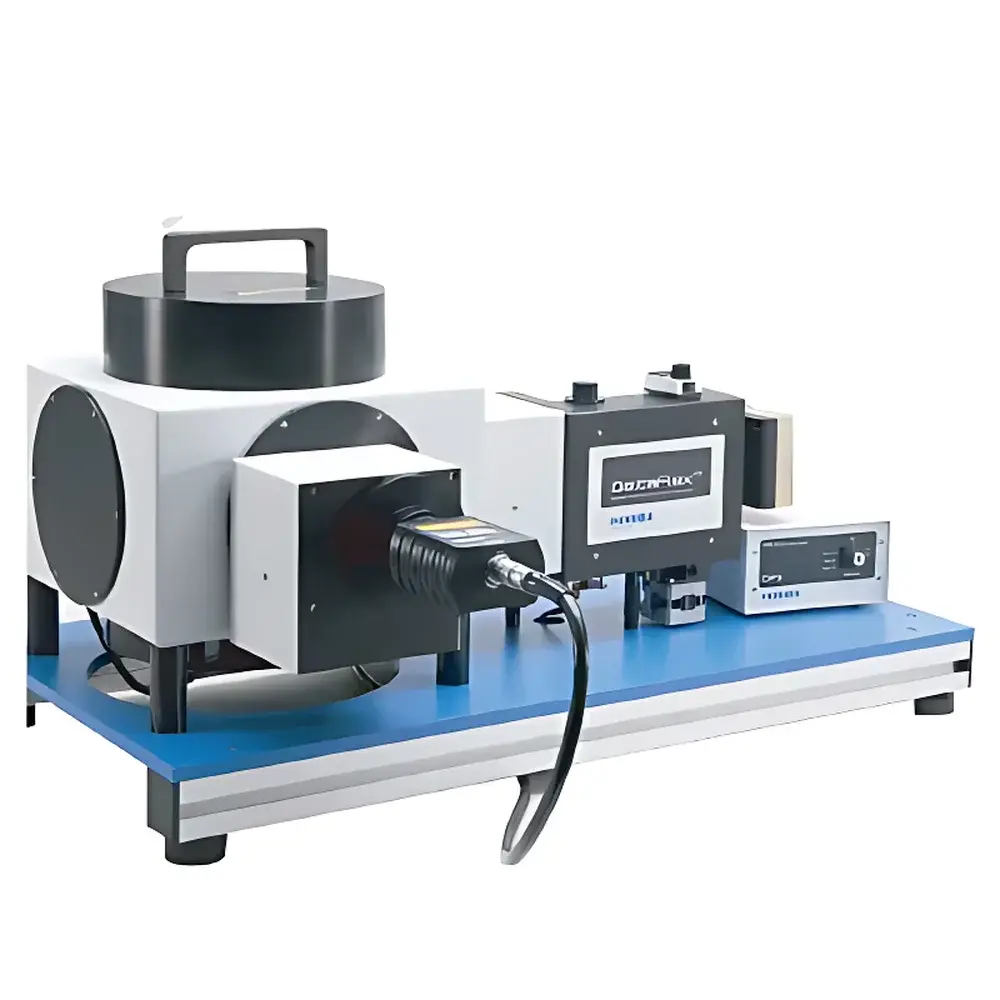
HORIBA DeltaFlex Ultrafast Time-Resolved Fluorescence Spectrometer
| Brand | HORIBA |
|---|---|
| Origin | United Kingdom |
| Manufacturer Type | Original Equipment Manufacturer (OEM) |
| Product Origin | Imported |
| Model | DeltaFlex |
| Dispersion Element | Grating |
| Slit Width (Spectral Bandpass) | Adjustable from 1 to 64 nm |
| Optical Resolution | 1 nm |
| Detection Sensitivity | Single-Photon Counting |
| Wavelength Accuracy | ±1 nm |
Overview
The HORIBA DeltaFlex Ultrafast Time-Resolved Fluorescence Spectrometer is a modular, research-grade TCSPC (Time-Correlated Single Photon Counting) system engineered for high-precision fluorescence and phosphorescence lifetime measurements across an unprecedented dynamic range—from sub-25 ps to 1 second. Built upon HORIBA Scientific’s four-decade legacy in ultrafast photophysics instrumentation—originating from the foundational Jobin Yvon spectroscopy expertise—the DeltaFlex integrates advanced hardware architecture with rigorous metrological design to support quantitative, reproducible time-domain luminescence analysis. Its core measurement principle relies on pulsed excitation (via integrated semiconductor lasers or LEDs) coupled with time-stamping of individual photons at the detector output, enabling direct reconstruction of decay kinetics without analog averaging artifacts. The system is optimized for applications demanding both temporal resolution and long-term stability, including kinetic studies of photoinduced electron transfer, conformational dynamics in biomacromolecules, and defect-state characterization in optoelectronic materials.
Key Features
- Ultra-broad lifetime coverage: 25 ps–1 s, achieved via interchangeable detectors and timing electronics without controller replacement
- DeltaHub timing module with 10 ns dead time, supporting up to 100 MHz repetition rate excitation sources without photon loss
- DeltaDiode pulsed laser diodes (265–785 nm) and SpectraLED phosphorescence-optimized sources (265–1275 nm), all plug-and-play with no alignment or recalibration required
- F-Link intelligent interface enabling automatic recognition of optical modules, detectors, and accessories; full software integration without manual configuration
- Aberration-corrected Czerny–Turner spectrometer with selectable gratings, covering 200–1600 nm with <1 nm resolution and ±1 nm wavelength accuracy
- Standard PPD (Picosecond Photon Detector) module with GaAsP or MCP-PMT options; optional NIR extension to ~1700 nm via cooled InGaAs detectors
- Large-volume sample compartment accommodating temperature-controlled stages (−190 °C to +300 °C), solid-sample holders, polarization optics, and multi-channel flow cells
Sample Compatibility & Compliance
The DeltaFlex accommodates liquid, solid, thin-film, and powder samples with minimal volume requirements (as low as 1 µL for cuvette-based measurements). Its UV-grade optical path ensures high transmission down to 200 nm, while configurable excitation/emission pathways support front-face, right-angle, and fiber-coupled geometries. The system complies with ISO/IEC 17025 requirements for calibration traceability and supports GLP/GMP workflows through audit-trail-enabled software logging. All firmware and control logic adhere to IEC 61000-6-3 (EMC) and IEC 61010-1 (safety) standards. Optional configurations meet FDA 21 CFR Part 11 requirements for electronic records and signatures when paired with validated software deployment protocols.
Software & Data Management
The DeltaFlex operates under HORIBA’s FluoroLog®-3 and DAS6 software platforms, offering fully integrated instrument control, real-time data acquisition, and advanced decay analysis. The included lifetime fitting engine provides over 30 open-access models—including multi-exponential, distributed lifetime, stretched exponential, and FRET-constrained fits—with global analysis capabilities across multiple wavelengths and conditions. All fitting routines are decoupled from hardware operation, allowing offline reprocessing of raw .phd or .sdt files. Data export conforms to ASTM E1421-22 (standard practice for spectral data exchange) and supports HDF5, ASCII, and MATLAB-compatible formats. Version-controlled software updates are delivered via secure HTTPS channels with SHA-256 integrity verification.
Applications
- Forster Resonance Energy Transfer (FRET) efficiency and distance mapping in protein complexes and nucleic acid architectures
- Stern–Volmer quenching analysis for oxygen sensing, solvent polarity probing, and binding constant determination
- Time-resolved anisotropy decay for rotational diffusion and molecular rigidity assessment
- Phosphorescence lifetime thermometry in metal–organic frameworks and triplet-harvesting emitters
- Single-molecule burst analysis and fluorescence correlation spectroscopy (FCS) precursor validation
- Photophysical characterization of perovskite quantum dots, organic photovoltaic blends, and lanthanide-doped nanomaterials
- Real-time monitoring of photocatalytic reactions and singlet oxygen generation kinetics
FAQ
What is the minimum measurable lifetime with DeltaFlex?
The system achieves sub-25 ps resolution using the standard PPD module with time-zero deconvolution and IRF characterization—limited primarily by the instrument response function of the excitation source and detector.
Can DeltaFlex perform simultaneous multi-wavelength lifetime acquisition?
Yes—up to 100 emission wavelengths can be monitored dynamically using the monochromator scanning mode or array detector configurations, with synchronized TCSPC histograms recorded at each channel.
Is the software compliant with 21 CFR Part 11 for regulated environments?
When deployed with validated installation qualification (IQ), operational qualification (OQ), and documented user access controls, the DAS6 software meets ALCOA+ principles and supports Part 11 compliance for electronic records and signatures.
How does DeltaFlex handle photobleaching during long-duration acquisitions?
The system implements adaptive illumination control, automated intensity normalization, and dark-count subtraction algorithms to maintain quantitative fidelity over extended acquisition windows (up to 10,000 minutes).
Are third-party detectors or light sources compatible?
Only HORIBA-certified modules are supported under warranty; however, external TTL-synchronized lasers and detectors may be integrated via the general-purpose trigger I/O port, subject to timing compatibility validation.
Related Products





