
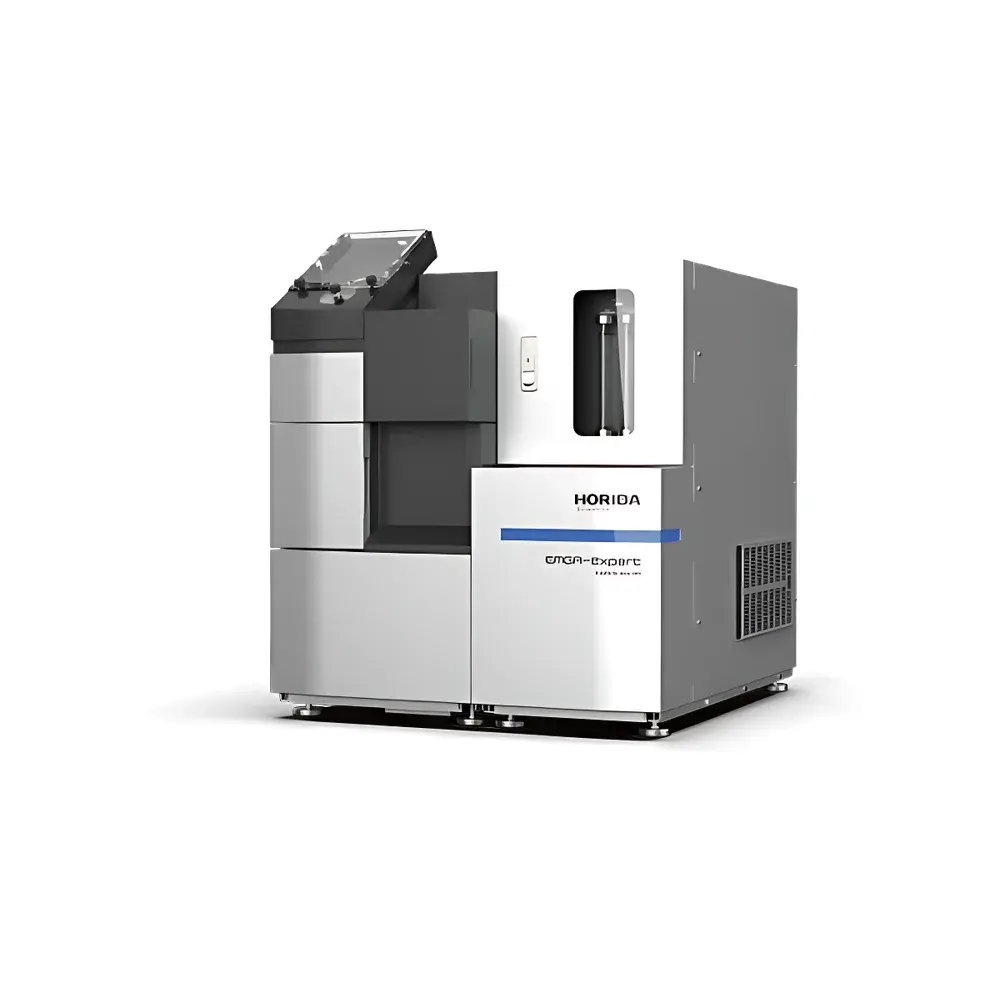
HORIBA EMGA-Pro Oxygen/Nitrogen/Hydrogen Analyzer
| Brand | HORIBA |
|---|---|
| Origin | Imported |
| Manufacturer Type | Manufacturer |
| Model | EMGA-Pro |
| Pricing | Upon Request |
Overview
The HORIBA EMGA-Pro is a high-performance inert gas fusion elemental analyzer engineered for the quantitative determination of oxygen (O), nitrogen (N), and hydrogen (H) in metallic, ceramic, and refractory materials. It operates on the principle of inert gas fusion–infrared (IR) and thermal conductivity detection (TCD). In this method, a solid sample is heated to temperatures exceeding 3000 °C in a graphite crucible placed between upper and lower electrodes within a high-current pulse furnace. Under an inert carrier gas (typically helium or argon), oxygen reacts with graphite to form carbon monoxide (CO); hydrogen is evolved as H₂ and subsequently oxidized to H₂O; and nitrogen is liberated as diatomic N₂. The evolved gases are swept through a dust removal system and routed to dedicated detectors: non-dispersive infrared (NDIR) cells for CO/CO₂ (oxygen) and H₂O (hydrogen), and a thermally stabilized thermal conductivity detector (TCD) for nitrogen. This architecture ensures trace-level sensitivity, long-term stability, and metrological traceability aligned with ISO 14733, ASTM E1019, and JIS G 1211 standards.
Key Features
- Proprietary NDIR detectors designed, manufactured, and calibrated in-house by HORIBA—ensuring optimal signal-to-noise ratio, baseline stability, and resistance to drift over extended operation.
- Integrated TCD module co-developed with HORIBA’s sensor engineering division, delivering high-resolution nitrogen quantification with sub-ppm detection capability.
- Patented low-maintenance electrode design: replacement of the lower electrode requires only removal of the electrode cover and insertion of a new electrode plate—reducing maintenance time to <10% of conventional systems.
- Advanced dust filtration system with replaceable membrane cartridges rated for up to 500 analyses per filter—cutting filter replacement frequency by 90% versus legacy configurations.
- Optimized gas flow architecture reducing carrier gas consumption by ~35%; a standard 47-L He cylinder supports ~2300 analyses (vs. ~1400 previously), lowering operational cost and logistical burden.
- Real-time analytical navigation suite including “Analysis Navigator”, “Maintenance Navigator”, and “Troubleshooting Navigator”—all embedded in the EMGA Control Software v4.x.
Sample Compatibility & Compliance
The EMGA-Pro accommodates a broad range of conductive and semi-conductive solid samples—including steels, superalloys, titanium alloys, silicon carbide, tungsten, and rare-earth metals—with mass ranges from 0.1 g to 1.0 g (adjustable via crucible geometry). Optional halogen traps enable reliable analysis of halogen-containing materials without interference. All hardware and software modules comply with GLP/GMP documentation requirements, supporting full audit trails, electronic signatures (21 CFR Part 11 compliant mode), and instrument qualification protocols (IQ/OQ/PQ). The system meets electromagnetic compatibility (EMC) standards per IEC 61326-1 and safety requirements under IEC 61010-1.
Software & Data Management
EMGA Control Software provides a unified interface for method setup, real-time monitoring, calibration management, and report generation. Calibration curves are stored with metadata (date, operator, reference material lot), and all measurement events—including gas pressure, furnace current, detector voltage, and alarm logs—are timestamped and archived in binary + CSV formats. The software supports automated data export to LIMS via OPC UA or TCP/IP protocols. Audit trail functionality records every user action, parameter change, and calibration event with immutable timestamps and operator IDs—fully satisfying FDA 21 CFR Part 11 and EU Annex 11 requirements for regulated laboratories.
Applications
- Quality control of aerospace-grade titanium and nickel-based superalloys where interstitial O/N/H content directly impacts ductility and fatigue life.
- Process validation in powder metallurgy and additive manufacturing feedstock qualification (e.g., gas-atomized Ti-6Al-4V powders).
- Failure analysis of brittle fracture in high-strength steels linked to hydrogen embrittlement.
- Research-grade quantification of dissolved gases in nuclear fuel cladding materials (Zr-alloys) per ASTM C1596.
- Regulatory testing of medical implant alloys (ASTM F136, ISO 5832-3) requiring certified O/N/H limits.
FAQ
What detection technologies does the EMGA-Pro employ for each element?
Oxygen and hydrogen are measured using proprietary non-dispersive infrared (NDIR) detectors—oxygen via CO/CO₂ absorption at 4.6 µm and hydrogen via H₂O absorption at 2.7 µm. Nitrogen is quantified using a thermally stabilized thermal conductivity detector (TCD).
Is the system compliant with 21 CFR Part 11 for pharmaceutical or medical device applications?
Yes—the EMGA Control Software includes optional 21 CFR Part 11 mode with role-based access control, electronic signatures, and tamper-evident audit trails.
Can the EMGA-Pro analyze non-metallic ceramics such as SiC or AlN?
Yes—provided appropriate fluxing agents (e.g., tin or nickel) are used to ensure complete fusion and gas release; method development support is available through HORIBA Application Laboratories.
What is the typical analysis cycle time for a single sample?
Standard O/N/H analysis takes ≤180 seconds, depending on sample mass and matrix; HORIBA’s patented sequence optimization algorithm minimizes furnace ramp-cool cycles without compromising precision.
Are calibration standards traceable to national metrology institutes?
All certified reference materials (CRMs) recommended for EMGA-Pro calibration—including NIST SRM 660c (LaB₆), BAM S010 (Fe-1000 ppm O), and NMIJ CRM 0312-a (Ti-150 ppm H)—are NIST-traceable or JCSS-certified.
Related Products






