
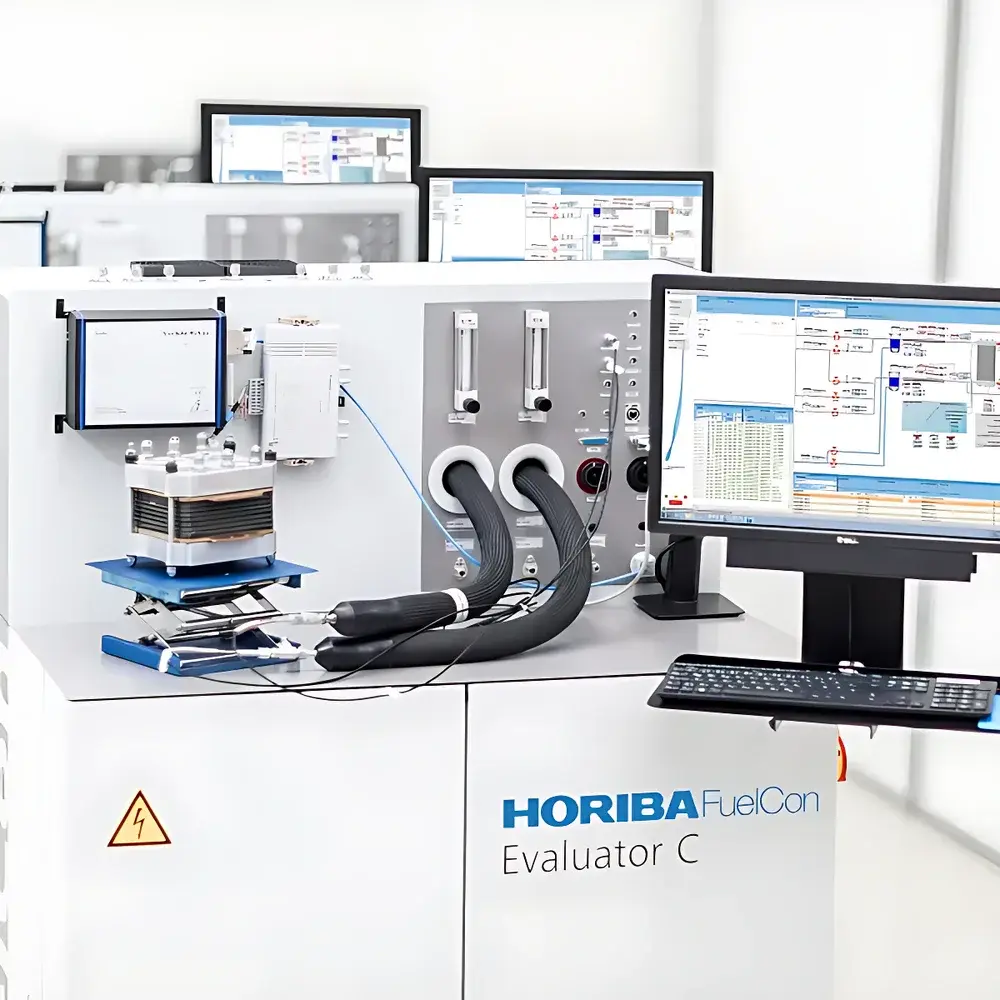
HORIBA Evaluator EC/ES Series Water Electrolysis Test Station
| Brand | HORIBA |
|---|---|
| Origin | Germany |
| Manufacturer Type | Original Equipment Manufacturer (OEM) |
| Product Origin | Imported |
| Model | Evaluator EC/ES Series |
| Pricing | Upon Request |
Overview
The HORIBA Evaluator EC/ES Series Water Electrolysis Test Station is an engineered platform for rigorous, automated performance evaluation of low-temperature water electrolyzers—including proton exchange membrane (PEM), anion exchange membrane (AEM), and alkaline (ALK) electrolysis systems. Based on electrochemical principles governing Faradaic efficiency, ohmic losses, mass transport limitations, and catalyst stability, the system enables quantitative characterization under controlled thermodynamic and electrical boundary conditions. Designed for R&D laboratories, technology validation centers, and industrial scale-up facilities, it supports standardized testing protocols aligned with international hydrogen infrastructure development frameworks—such as ISO 22734, IEC 62282-8-101, and DOE Hydrogen Program targets for stack durability and efficiency. Its modular architecture accommodates single-cell, short-stack, and full-scale stack configurations across a power range from 100 W to 5 MW, facilitating direct correlation between lab-scale findings and megawatt-class deployment requirements.
Key Features
- Wide operational power range (100 W – 5 MW) supporting single-cell, short-stack, and full-stack testing for PEM, AEM, and ALK technologies
- Dual-loop high-purity deionized water and optional KOH electrolyte circulation with precision temperature control (±0.2 °C) and pressure-regulated flow delivery
- Automated pressure management: up to 50 bara standard (100 bara optional), with dynamic anode/cathode differential pressure control and auto-compensation relative to gas-side pressure
- Integrated water–gas separation with active liquid-level regulation to maintain stable backpressure and prevent gas breakthrough or flooding
- Multi-mode electrical stimulation: steady-state polarization, current/voltage ramping, load cycling, intermittent power profiling (e.g., solar/wind-derived duty cycles)
- Onboard electrochemical analysis modules: electrochemical impedance spectroscopy (EIS), high-frequency resistance (HFR), cyclic voltammetry (CV), and chronoamperometry/chronopotentiometry
- Robust mechanical construction using corrosion-resistant alloys and certified sealing systems compliant with PED 2014/68/EU and ATEX Directive 2014/34/EU
Sample Compatibility & Compliance
The Evaluator EC/ES accommodates diverse cell geometries—from 5 cm² lab-scale MEAs to industrial-format stacks exceeding 1 m² active area. It supports both membrane-based and porous transport layer (PTL) configurations, with customizable gasketing, compression force monitoring, and thermal interface adaptation. All fluidic and electrical interfaces conform to DIN/ISO 2852, EN 1515-2, and UL 61010-1 safety standards. Gas-tight integrity is verified per ISO 15848-1 for fugitive emissions. Optional integration with environmental chambers (−40 °C to +80 °C) and electrodynamic shakers enables combined thermal–mechanical stress testing in accordance with IEC 61215-2 MQT 19 and SAE J2380. System-level compliance documentation includes traceable calibration certificates (ISO/IEC 17025-accredited), FAT/SAT reports, and CE marking with Declaration of Conformity.
Software & Data Management
TestWork™—HORIBA’s proprietary control and acquisition software—provides fully automated test sequencing, real-time parameter logging, and configurable alarm logic. It supports audit-trail-enabled operation per FDA 21 CFR Part 11 requirements, including user access levels, electronic signatures, and immutable data archiving. All measurements—including voltage, current, temperature gradients, inlet/outlet flow rates, gas composition (via integrated GC or paramagnetic/O₂ sensors), and conductivity—are time-synchronized at ≤100 ms resolution. Raw datasets export to HDF5 or CSV formats; post-processing tools include polarization curve fitting, EIS Nyquist/Bode analysis, degradation rate calculation (mV/1000 h), and lifetime projection modeling (Weibull distribution). Remote monitoring via secure HTTPS API enables centralized fleet management across multi-site deployments.
Applications
- Performance benchmarking against DOE and EU JRC reference metrics (e.g., cell voltage @ 2 A/cm², system efficiency LHV)
- Durability assessment under accelerated stress tests (ASTs): voltage cycling, start-stop protocols, impurity tolerance (CO, NH₃, SiO₂), and freeze-thaw cycles
- Hydrogen purity validation per ISO 8573-1 Class 1 (≤5 ppb O₂ in H₂) and ISO 14687-2 for fuel cell grade compliance
- Dynamic response characterization during grid-following or islanded operation, including ramp rate analysis (A/s) and transient overpotential quantification
- Electrode catalyst screening via CV and CO-stripping, membrane degradation kinetics via fluoride ion release monitoring, and interfacial contact resistance mapping
- Technology readiness level (TRL) advancement from TRL 4 (component validation in lab environment) to TRL 6 (system prototype demonstration in relevant environment)
FAQ
Can the system operate with both DI water and KOH electrolyte without hardware modification?
Yes—the dual-feed manifold allows seamless switching between deionized water and 25–30 wt% KOH solution via software-controlled valve sequencing and independent temperature/flow regulation.
Is third-party instrumentation integration supported?
Yes—standard EtherCAT and Modbus TCP interfaces enable synchronization with external devices including gas chromatographs, dew point analyzers, vibration shakers, and climate chambers.
What safety certifications apply to the system’s gas-handling subsystem?
The hydrogen and oxygen circuits comply with ISO 22734 Annex B, NFPA 50A, and local jurisdictional explosion protection regulations (ATEX Category 2G, Zone 1); all gas lines feature double-block-and-bleed isolation and catalytic recombiners.
Does TestWork support custom test protocol scripting?
Yes—Python-based script engine allows users to define conditional logic, adaptive termination criteria, and multi-step sequences incorporating real-time feedback from sensor inputs.
Are calibration services included with purchase?
Initial factory calibration is provided with NIST-traceable documentation; annual recalibration kits and on-site service packages are available under HORIBA’s Global Service Agreement program.




