
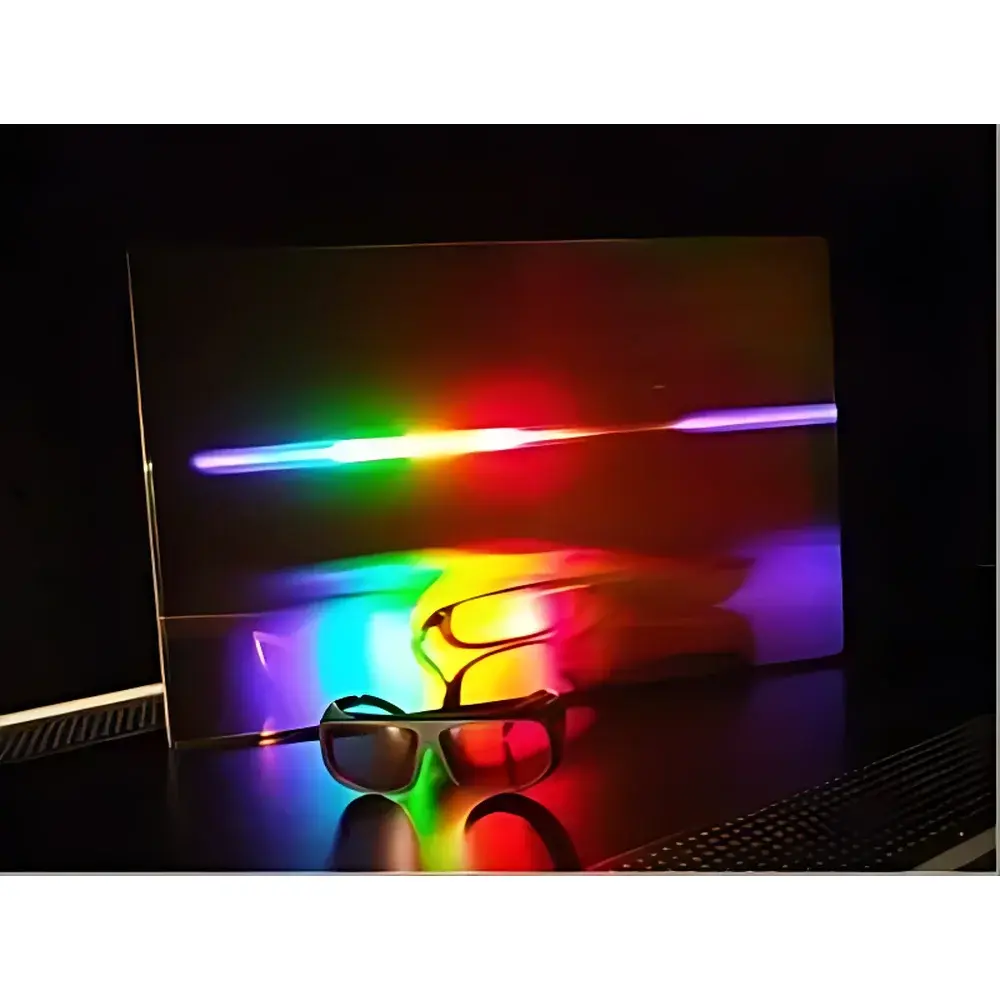
HORIBA Jobin Yvon Gold-Coated Replica & Master Gratings
| Brand | HORIBA |
|---|---|
| Origin | France |
| Manufacturer Type | Original Equipment Manufacturer (OEM) |
| Import Status | Imported |
| Model | Gold-Coated Grating |
| Pricing | Upon Request |
| Type | Replica and Master Grating |
| Maximum Size | 1450 × 700 mm |
| Spectral Range | 600–1600 nm |
| Optimized Wavelengths | 800 nm, 1053 nm, 1550 nm |
| Groove Density | 1200, 1480, 1740 grooves/mm |
| Diffraction Efficiency | 90–95% |
| Substrate Materials | Fused Silica, Heat-Resistant Glass, ULE®, Zerodur®, Metal |
| Coating | High-Purity Gold (Au) |
Overview
HORIBA Jobin Yvon gold-coated replica and master gratings are precision optical components engineered for high-efficiency dispersion in ultrafast and high-power laser systems. Based on decades of expertise in holographic and ruled grating fabrication—dating back to the company’s first commercially deployed gold-coated grating in 1986—these gratings leverage advanced replication processes and proprietary gold deposition techniques to deliver exceptional performance across near-infrared (NIR) and short-wave infrared (SWIR) spectral bands. The underlying principle relies on controlled diffraction governed by the grating equation d(sin α + sin β) = mλ, where groove density, incident angle, and polarization state are precisely calibrated to maximize first-order efficiency at target wavelengths. Designed for use in compressor and stretcher stages of chirped pulse amplification (CPA) systems, optical parametric chirped-pulse amplification (OPCPA), and high-energy Nd:glass or Yb-doped fiber laser architectures, these gratings operate under demanding thermal and irradiance conditions while maintaining long-term wavefront fidelity.
Key Features
- High diffraction efficiency: Achieves 90–95% peak first-order efficiency across optimized configurations—e.g., 94% average at 800 nm for a 300 × 485 mm grating with 1480 grooves/mm, measured under Littrow mounting and p-polarized incidence.
- High laser-induced damage threshold (LIDT): Gold coating combined with low-absorption substrates (e.g., ULE® or fused silica) enables robust operation with femtosecond pulses at multi-TW peak intensities; typical LIDT exceeds 0.5 J/cm² for 30 fs, 800 nm pulses (10 Hz, 1-on-1 test).
- Large-format capability: Supports custom replication up to 1450 × 700 mm—among the largest monolithic gratings available for broadband NIR applications—enabling scalable pulse energy handling without beam segmentation.
- Exceptional groove uniformity: Metrology-verified groove spacing deviation < ±0.05% over full aperture ensures minimal spectral distortion and temporal pulse broadening in compressors.
- Multi-wavelength optimization: Available with design centering at 800 nm (Ti:sapphire), 1053 nm (Nd:glass), or 1550 nm (Er-fiber/OPA), each tailored via blaze angle and coating thickness to balance efficiency, polarization sensitivity, and angular tolerance.
Sample Compatibility & Compliance
These gratings are compatible with standard vacuum-compatible optical mounts (e.g., Kinematic kinematic bases per ISO 10110-7), and integrate seamlessly into commercial and custom-built CPA/OPCPA beamlines from vendors including Light Conversion, Coherent, Amplitude, and Thales. Substrate selection adheres to ISO 10110 optical material specifications; fused silica meets MIL-PRF-17465C Class A, while ULE® and Zerodur® comply with Schott TIE-22 and TIE-23 thermal stability requirements. Gold coatings conform to ASTM B488 Grade A purity standards (>99.99% Au), and surface roughness (Rq) is maintained below 0.3 nm RMS over 10 × 10 µm areas (measured by AFM). All gratings undergo full-aperture interferometric inspection per ISO 10110-5 and are supplied with certified test reports including efficiency maps, wavefront error (PV < λ/10 @ 633 nm), and LIDT validation data.
Software & Data Management
While the grating itself is a passive optical element, HORIBA provides comprehensive metrology datasets—including bidirectional efficiency scans, groove profile SEM cross-sections, and phase map interferograms—for integration into system modeling workflows (e.g., using MATLAB-based pulse propagation codes or commercial tools such as VirtualLab Fusion or ASAP). Customers receive digital calibration files compliant with HDF5 format, supporting traceable spectral response modeling. For OEM integrators, HORIBA supports GLP-aligned documentation packages—including equipment qualification (IQ/OQ), material traceability (mill certificates), and coating process logs—to facilitate FDA 21 CFR Part 11–compliant instrument validation in regulated R&D environments.
Applications
- Chirped pulse compression and stretching in Ti:sapphire, Yb:fiber, and Nd:glass laser systems
- Spectral beam combining and dispersion compensation in high-average-power ultrafast amplifiers
- Monochromator and spectrograph gratings for broadband NIR reflectance and emission spectroscopy (600–1600 nm)
- Front-end pulse shaping in OPCPA pump-probe setups requiring high-throughput broadband dispersion
- Custom grating solutions for EUV and soft X-ray applications when fabricated on low-Z substrates with multilayer enhancements
FAQ
What substrate options are available for high-thermal-load applications?
Fused silica is standard for general-purpose use; ULE® and Zerodur® are recommended for applications requiring sub-ppm/°C thermal expansion stability under repetitive high-repetition-rate irradiation.
Can HORIBA supply gratings with non-standard groove densities or custom blaze angles?
Yes—custom groove densities from 600 to 2400 grooves/mm and blaze angles optimized for specific incidence geometries (e.g., off-Littrow compressor designs) are supported under NRE development agreements.
Is gold coating applied before or after replication?
Gold is deposited onto the master grating surface prior to replication; the replica inherits the exact topography and coating integrity via UV-curable epoxy casting under cleanroom-controlled conditions.
Do you provide efficiency data for s-polarized light?
Yes—full Stokes parameter characterization (including s- and p-polarization efficiency vs. wavelength and angle) is included in standard test reports upon request.
What is the lead time for large-format custom gratings?
Standard lead time for gratings ≤ 600 × 400 mm is 12–16 weeks; sizes approaching 1450 × 700 mm require 20–24 weeks due to extended coating uniformity validation and full-aperture interferometric certification.
Related Products





