
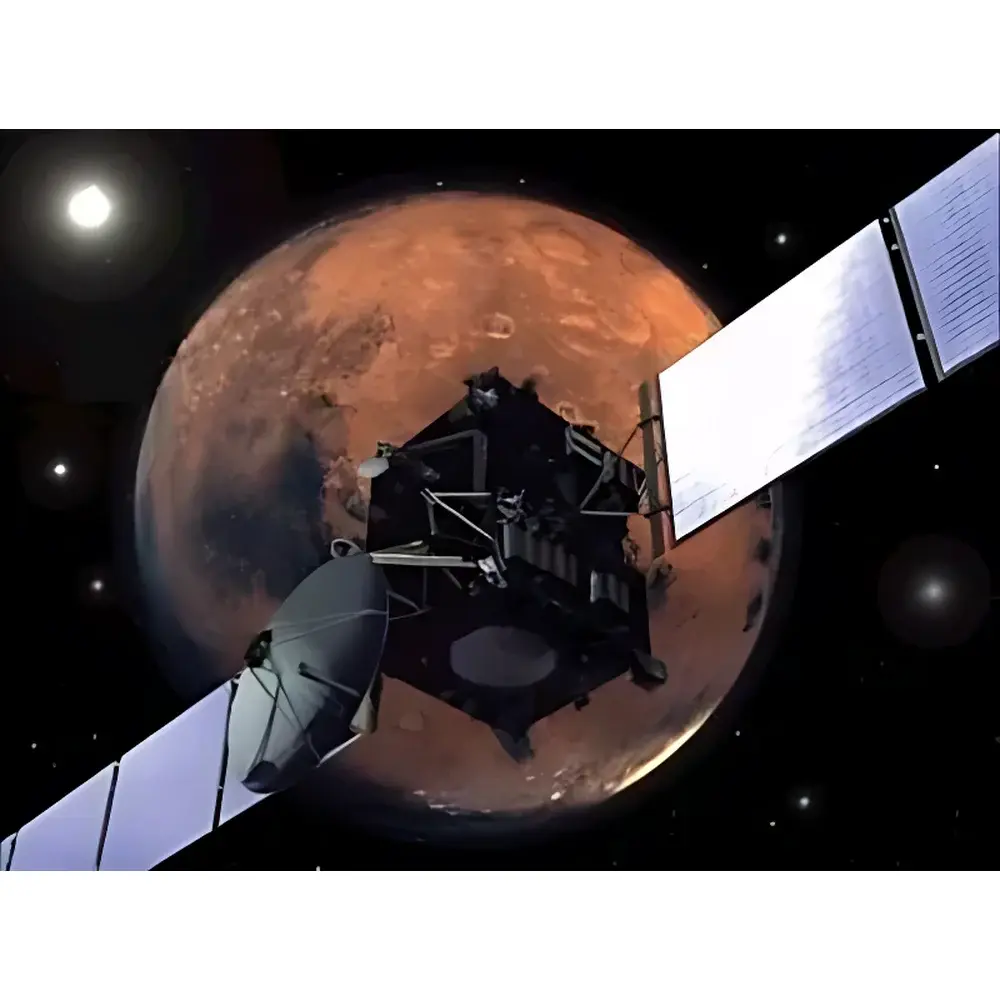
HORIBA Jobin Yvon Space-Grade Diffraction Grating
| Brand | HORIBA |
|---|---|
| Origin | France |
| Manufacturer Type | Original Equipment Manufacturer (OEM) |
| Import Status | Imported |
| Model | Space-Grade Diffraction Grating |
| Pricing | Upon Request |
Overview
HORIBA Jobin Yvon Space-Grade Diffraction Gratings are precision optical components engineered for mission-critical spectroscopic applications in spaceborne and high-altitude platforms. Designed and manufactured in France under stringent aerospace quality protocols, these gratings operate on the principle of wavelength-selective diffraction—leveraging either ruled or holographic fabrication techniques to achieve deterministic spectral dispersion with minimal wavefront distortion. Unlike standard laboratory-grade gratings, space-grade variants undergo accelerated environmental qualification—including thermal cycling (−40 °C to +85 °C), vacuum compatibility testing (<10⁻⁶ mbar), and radiation hardness screening—to ensure long-term performance stability under orbital conditions. They serve as core dispersive elements in hyperspectral imagers, atmospheric trace-gas spectrometers (e.g., OCO-2/OCO-3), and planetary mineralogical sensors deployed on NASA, ESA, and JAXA missions.
Key Features
- High Diffraction Efficiency: Optimized blaze profiles and dielectric coating stacks deliver peak efficiency exceeding 85% across UV–VIS–NIR bands (190–1100 nm), tailored per Littrow or Echelle configuration requirements.
- Ultra-Low Stray Light: Surface roughness controlled to <0.3 nm RMS and groove error minimized to <5 nm PV enable stray light suppression below 1×10⁻⁵ relative intensity—critical for high-dynamic-range Earth observation.
- Optical Stability Under Thermal & Mechanical Stress: Substrate materials include low-expansion ULE® glass and Zerodur®, with bonded mounting interfaces qualified for launch vibration spectra (up to 14 g RMS, 20–2000 Hz).
- Custom Parameter Engineering: Full parametric control over groove density (100–3600 grooves/mm), groove shape (blazed, sinusoidal, sawtooth), substrate curvature (plane, concave, convex), and coating type (Al+MgF₂, Au, protected silver).
- Aerospace Certification Heritage: Validated through flight heritage on NASA’s Orbiting Carbon Observatory (OCO) series; recipient of formal recognition from NASA Jet Propulsion Laboratory for technical contribution to atmospheric CO₂ column retrieval accuracy.
Sample Compatibility & Compliance
These gratings are compatible with both reflective and transmissive spectrograph architectures, including Czerny–Turner, Offner, and Dyson designs. Each unit is supplied with full traceability documentation: individual interferometric surface map (Zygo Verifire™), diffraction efficiency curve (measured at NIST-traceable synchrotron beamlines), and environmental test reports (per ECSS-Q-ST-70-08C and MIL-STD-810H). Manufacturing adheres to ISO 9001:2015 and AS9100D standards; cleanroom assembly occurs in ISO Class 5 environments. Units intended for FDA-regulated instrumentation (e.g., space-derived calibration transfer standards) support GLP-compliant data archiving and audit-ready manufacturing records.
Software & Data Management
While the grating itself is a passive optical component, HORIBA provides companion design support tools—including GratingLab™ optical simulation suite—for predicting system-level throughput, resolution, and polarization sensitivity prior to integration. All delivered units ship with encrypted digital twin files (STEP AP242 format) and calibrated diffraction efficiency datasets in HDF5 format, enabling direct import into Zemax OpticStudio, FRED, or CODE V for end-to-end instrument modeling. Firmware-agnostic metadata includes groove vector orientation, coating layer stack specifications, and certified thermal expansion coefficients—essential for radiometric calibration traceability in Level-1B data processing pipelines.
Applications
- Earth observation spectrometers for greenhouse gas monitoring (CO₂, CH₄, O₂ A-band)
- Planetary surface composition mapping (e.g., Mars rovers, lunar polar volatiles detection)
- Stratospheric ozone profiling via limb-sounding UV spectroscopy
- Calibration reference gratings for ground-based telescope spectrographs (VLT, ELT, TMT)
- High-resolution echelle systems in space-based exoplanet atmospheric characterization missions
FAQ
Are these gratings available in both ruled and holographic configurations?
Yes—both mechanically ruled (using diamond-point ruling engines) and holographically recorded (with He–Cd or Ar⁺ laser interference patterns) variants are offered, with selection guided by required efficiency bandwidth, polarization dependence, and scatter performance targets.
What is the typical lead time for custom-designed space-grade gratings?
Standard configurations ship within 12 weeks; fully customized units—including non-standard substrates, coatings, or metrology requirements—require 20–26 weeks, inclusive of qualification testing and documentation finalization.
Do you provide radiation damage testing data for proton and electron fluence exposure?
Yes—upon request, we supply irradiation test reports per ASTM E1025 (proton) and ASTM E1249 (electron), covering doses up to 1×10¹⁵ p/cm² (10 MeV) and 1×10¹⁶ e/cm² (1 MeV), respectively.
Is there a difference between “space-qualified” and “space-flight” grating certification?
Yes—“space-qualified” indicates compliance with environmental test requirements for a specific mission profile; “space-flight” denotes hardware that has completed full flight acceptance testing and is designated for integration into a flight unit.
Related Products





