
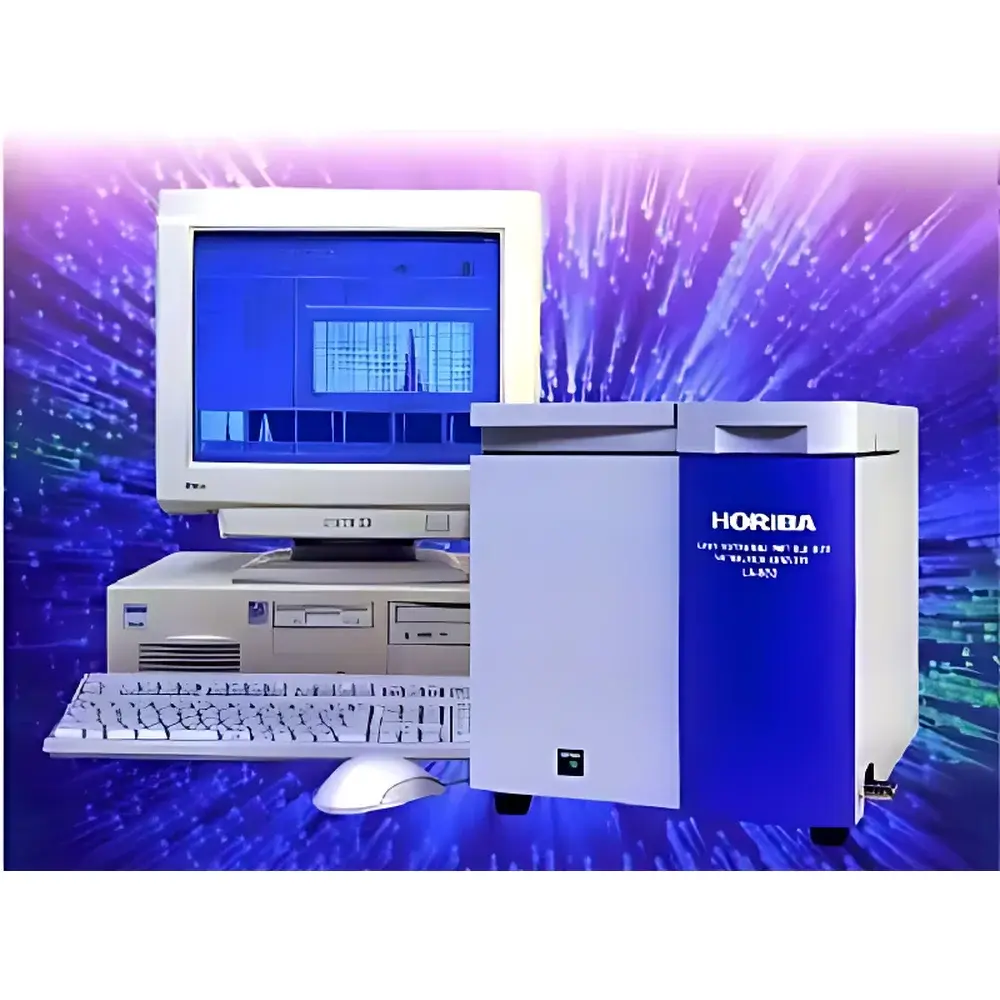
HORIBA LA-300 Laser Diffraction Particle Size Analyzer
| Brand | HORIBA |
|---|---|
| Origin | Japan |
| Model | LA-300 |
| Dispersion Method | Wet Dispersion |
| Measurement Range | 0.1–600 µm |
| Repeatability | <1% |
| Measurement Time | 20 s |
Overview
The HORIBA LA-300 Laser Diffraction Particle Size Analyzer is a high-precision, benchtop instrument engineered for rapid, reliable, and reproducible particle size distribution (PSD) analysis of suspensions and emulsions. It operates on the rigorous Mie scattering theory—derived directly from Maxwell’s electromagnetic equations—to compute particle size distributions from angular light scattering intensity profiles. Unlike empirical or simplified Fraunhofer approximations, Mie theory accounts for particle refractive index, absorption coefficient, and wavelength-dependent optical properties, enabling accurate quantification across broad compositional classes (e.g., polymers, ceramics, pharmaceuticals, metal oxides, and biological colloids). The LA-300 integrates a long-life 650 nm semiconductor laser, a large-diameter optical lens system, and a hybrid detection array comprising six wide-angle lateral/backscatter photodetectors plus a 36-channel annular silicon photodiode matrix—totaling 42 independent detection channels. This architecture ensures high signal-to-noise ratio and robust resolution across its full 0.1–600 µm dynamic range without manual optical realignment.
Key Features
- Optimized optical design with fixed-path Mie-based computation for traceable, principle-driven measurement accuracy
- Compact footprint (25 kg total mass) achieved via integrated optical and fluidic architecture—reducing lab space demand by 30% versus prior-generation systems
- Automated optical alignment: real-time self-calibration of photodiode positioning and laser beam path using multi-dimensional search algorithms
- Dual-mode dispersion: 15 W, 28 kHz ultrasonic probe combined with mechanical stirring and a high-flow centrifugal recirculation pump (5.5 L/min)
- Chemically resistant wetted path: all fluid-contact components fabricated from corrosion- and abrasion-resistant materials (e.g., SUS316 stainless steel, PTFE, and fused silica)
- Embedded safety protocols including method validation checks, user-authenticated operation, and configurable access levels
Sample Compatibility & Compliance
The LA-300 supports aqueous and organic solvent-based dispersions across diverse industrial and research applications—including QC release testing in pharmaceutical manufacturing (aligned with USP & Ph. Eur. particle sizing guidelines), catalyst characterization per ASTM D4464, and pigment quality control per ISO 13320. Its wet dispersion module accommodates slurries with solid concentrations up to 20% w/v and viscosities ≤ 500 mPa·s. All software operations comply with ALCOA+ data integrity principles; audit trails, electronic signatures, and user-role-based permissions support GLP/GMP environments. While the base firmware does not natively enforce 21 CFR Part 11 compliance, optional validated software modules are available for regulated laboratories requiring full electronic record and signature capability.
Software & Data Management
The LA-300 runs on a Windows-compatible platform with a graphical user interface designed for intuitive workflow navigation. Data export is fully interoperable with Microsoft Excel and Word for report generation. Key analytical capabilities include:
- Four simultaneous distribution modes: volume-, surface-area-, number-, and length-based PSDs—selectable via single menu toggle
- Customizable cumulative/differential plots with up to 10 user-defined percentile points (e.g., D10, D50, D90) and corresponding diameters
- Multi-run overlay visualization: up to 10 distributions rendered in distinct colors on a shared axis for comparative trend analysis
- Real-time scatter plot rendering during measurement—enabling immediate assessment of dispersion stability and measurement validity
- Programmable method templates: store complete measurement sequences (dispersion parameters, measurement duration, analysis settings) as executable macros for unattended batch analysis
- 300-sample 3D histogram view with contour projection for longitudinal process monitoring
Applications
The LA-300 delivers quantitative particle sizing in R&D, production QA/QC, and regulatory submission contexts. Typical use cases include:
- Pharmaceutical formulation development: monitoring micronized API particle size shifts during milling or spray drying
- Electrode slurry characterization for lithium-ion battery manufacturing (anode/cathode active material and conductive additive dispersion uniformity)
- Quality assurance of ceramic powders used in additive manufacturing feedstocks
- Emulsion droplet sizing in food science and personal care product development
- Environmental particulate analysis in wastewater treatment effluent monitoring
- Geotechnical soil grain-size distribution profiling (ASTM D422, D1140)
FAQ
What optical model does the LA-300 use for particle size calculation?
It applies the full Mie scattering solution, requiring user input of particle refractive index and imaginary component (absorption coefficient) for highest accuracy.
Is dry powder measurement supported?
No—the LA-300 is configured exclusively for wet dispersion analysis; dry powder measurement requires optional accessories not included in the standard LA-300 configuration.
Can measurement data be exported in machine-readable formats?
Yes—raw scattering intensities, distribution tables, and metadata are exportable as CSV, TXT, and XML files for third-party statistical or AI-driven analysis pipelines.
How often does the system require recalibration?
Under routine use with stable environmental conditions, annual verification using NIST-traceable polystyrene latex standards (e.g., 10 µm and 100 µm) is recommended; automated daily alignment reduces drift-related recalibration frequency.
Does the software support multi-user audit trails?
Yes—each measurement session logs operator ID, timestamp, method name, and parameter set; full audit trail review is accessible only to administrators with elevated privileges.



