
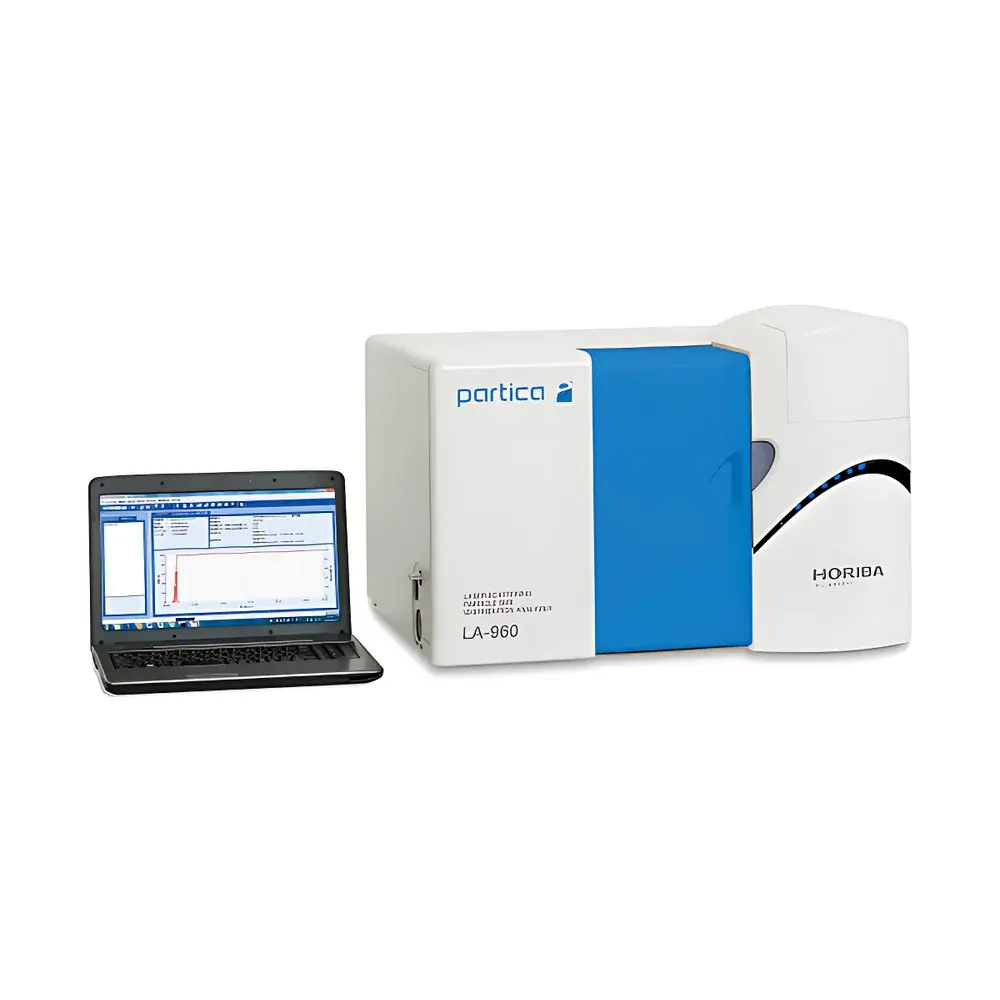
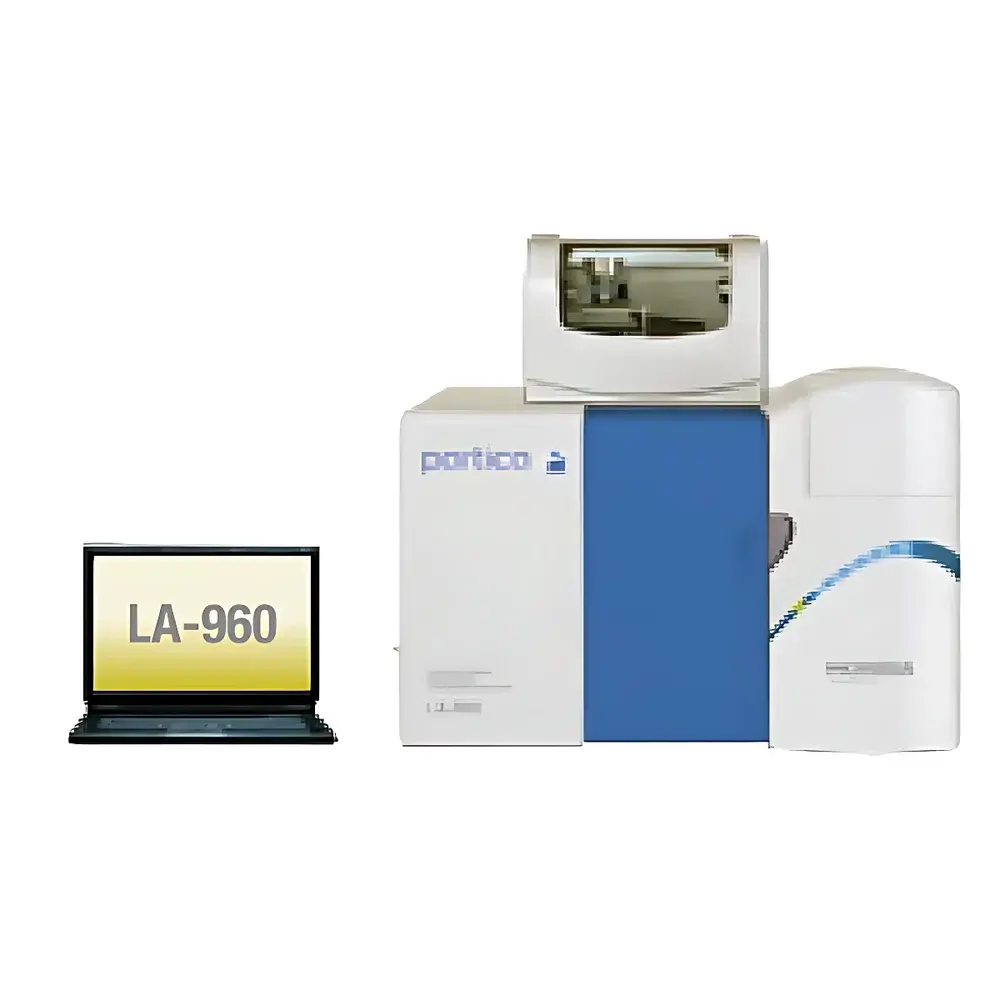
HORIBA LA-960 V2 Laser Particle Size Analyzer
| Brand | HORIBA |
|---|---|
| Origin | Japan |
| Manufacturer Type | Manufacturer |
| Origin Category | Imported |
| Model | LA-960 V2 |
| Dispersion Method | Dry & Wet Dispersion |
| Measurement Range | 10 nm – 5000 µm |
| Repeatability | ±0.1% |
| Measurement Time | 10 seconds |
Overview
The HORIBA LA-960 V2 Laser Particle Size Analyzer is a high-precision, dual-mode (dry/wet) instrument engineered for robust and traceable particle size distribution (PSD) analysis across an exceptionally wide dynamic range—from 10 nanometers to 5000 micrometers. It operates on the principle of Mie scattering theory, supported by rigorous angular light-scattering detection using a multi-element photodiode array and optimized optical geometry. The system employs a high-stability 633 nm He–Ne laser source and features advanced three-dimensional scattering pattern simulation, enabling precise alignment between measured diffraction spectra and theoretical models that fully account for optical component tolerances, refractive index dispersion, and absorption effects. This physics-based computational framework—refined over decades of HORIBA’s metrology expertise—ensures compliance with ISO 13320:2020 for laser diffraction particle sizing and supports traceable calibration protocols aligned with NIST-traceable reference materials.
Key Features
- Ultra-broad measurement range: validated from 10 nm to 5000 µm in a single run, eliminating the need for instrument switching or method revalidation across submicron and coarse fractions.
- Dual dispersion capability: integrated dry powder disperser with controlled air pressure and shear-assisted deagglomeration, plus a fully programmable wet dispersion module with ultrasonic probe, peristaltic pump, and adjustable stirring speed.
- High-speed acquisition: completes full PSD analysis—including background subtraction, intensity normalization, and Mie inversion—in ≤10 seconds per measurement, with full-cycle sample handling (dispersion → measurement → cleaning) completed in under 60 seconds.
- Enhanced repeatability: achieves ±0.1% volume-weighted D50 repeatability (RSD) under GLP-compliant operating conditions, verified using certified reference materials including NIST SRM 1963 (100 nm silica) and HORIBA’s proprietary 20 nm polystyrene standard.
- Optimized optical architecture: features a patented folded-path optical bench with minimized stray light, temperature-stabilized detector array, and real-time laser power monitoring to ensure long-term signal stability.
Sample Compatibility & Compliance
The LA-960 V2 accommodates diverse sample types—including aqueous suspensions, organic solvents, emulsions, dry powders, agglomerated ceramics, pharmaceutical actives, battery cathode materials, and catalysts—without hardware modification. Its fluidic system is chemically resistant to common solvents (e.g., IPA, acetone, toluene) and compatible with USP and ASTM D4468 for emulsion droplet analysis. Instrument design and software workflows support 21 CFR Part 11 compliance via optional audit trail logging, electronic signatures, and user-access controls. All factory calibrations are documented per ISO/IEC 17025 requirements and traceable to NIST or PTB standards. Routine verification follows ISO 13320 Annex B protocols, including linearity checks, resolution validation using bimodal mixtures, and refractive index sensitivity assessment.
Software & Data Management
HORIBA’s proprietary LaVision™ software provides intuitive method setup, real-time scatter plot visualization, and automated report generation in PDF, CSV, or XML formats. It includes embedded Mie calculation engines for complex refractive indices (n ± ik), iterative non-negativity constrained algorithms for improved resolution of multimodal distributions, and batch processing for QC laboratories operating under GMP/GLP environments. Raw scattering data is stored in HDF5 format with metadata tagging (operator ID, timestamp, instrument serial, environmental conditions). Optional network deployment enables centralized data archiving, role-based access control, and integration with LIMS via RESTful API or ODBC drivers. Software validation packages—including IQ/OQ documentation and test scripts—are available for regulated industries.
Applications
The LA-960 V2 serves critical quality control and R&D functions across multiple sectors: pharmaceutical formulation development (e.g., inhalable dry powders, nanoparticle drug carriers); battery materials characterization (anode/cathode slurries, graphite spheroidization); pigment and coating optimization (TiO₂, carbon black dispersion stability); cement and mineral processing (fineness control, clinker grinding efficiency); and environmental monitoring (sediment grain analysis, aerosol characterization). Its ability to resolve sub-20 nm features while simultaneously quantifying >100 µm aggregates makes it uniquely suited for process troubleshooting where both nucleation kinetics and agglomeration behavior must be monitored concurrently.
FAQ
What refractive index values are required for accurate Mie analysis?
Users must input both real (n) and imaginary (k) components of the sample’s complex refractive index at 633 nm; default libraries include >200 materials, and k-values can be estimated from UV-Vis absorbance data.
Can the LA-960 V2 measure particles in viscous media such as polymer melts?
No—it is designed for dilute dispersions (<10 vol%) and dry powders; high-viscosity or molten-state analysis requires complementary techniques such as dynamic imaging or small-angle X-ray scattering.
Is routine recalibration required between measurements?
No—laser and detector stability is continuously monitored; only annual performance verification using traceable standards is recommended per ISO 13320 Clause 8.3.
Does the system support automated unattended operation?
Yes—via optional autosampler modules (up to 60 positions) and scheduled measurement sequences with pass/fail criteria linked to predefined specification limits.
How is data integrity ensured during long-term deployment?
All raw and processed data include cryptographic hash signatures; audit logs record every parameter change, user action, and system event with ISO 8601 timestamps and operator authentication tokens.



