
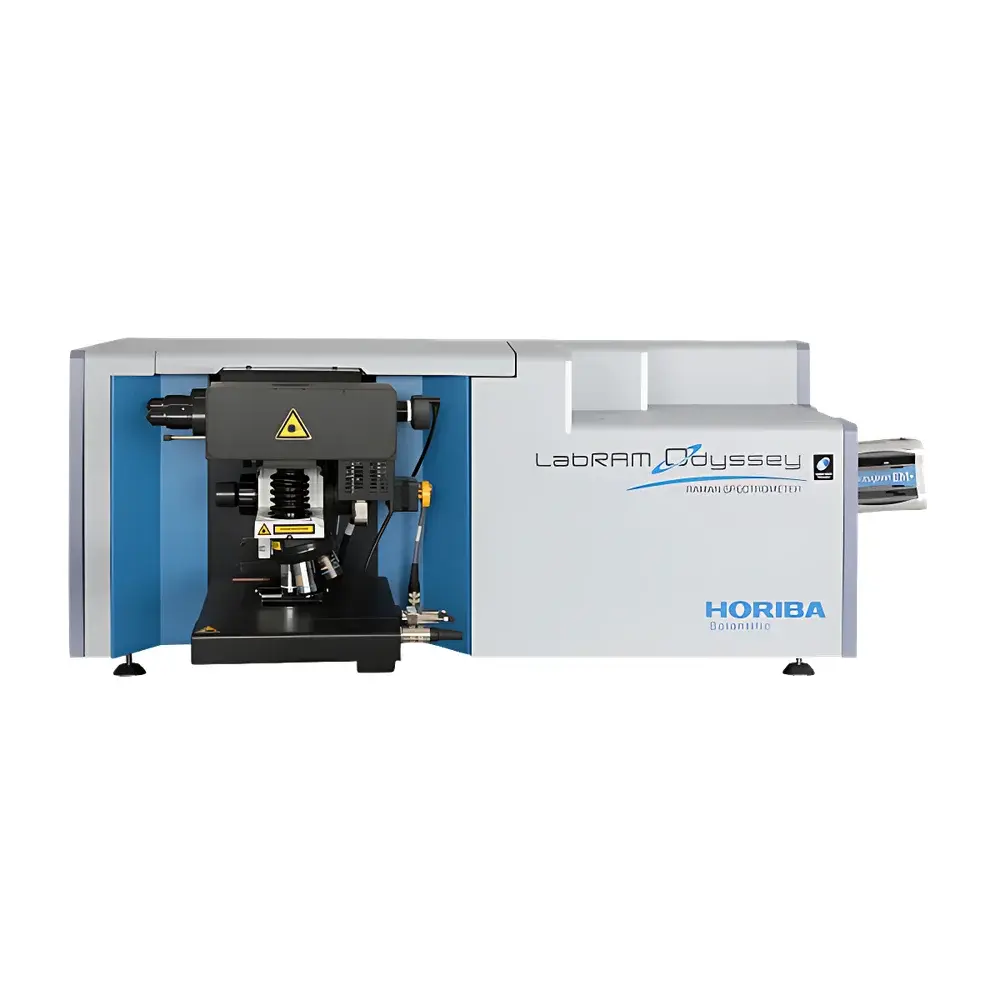
HORIBA LabRAM Odyssey High-Speed High-Resolution Confocal Raman Microscope
| Brand | HORIBA |
|---|---|
| Origin | France |
| Manufacturer Type | Original Equipment Manufacturer (OEM) |
| Instrument Category | Imported |
| Model | LabRAM Odyssey |
| Instrument Type | Confocal Raman Microscope |
| Spectral Range | 200–2100 nm |
| Spectral Resolution | 0.35–0.65 cm⁻¹ |
| Spatial Resolution | down to 250 nm |
| Minimum Wavenumber | as low as 3.5 cm⁻¹ |
| Spectral Reproducibility | ±0.02 cm⁻¹ |
Overview
The HORIBA LabRAM Odyssey is a high-performance confocal Raman microscope engineered for precision spectroscopic analysis and hyperspectral imaging across the deep-ultraviolet to near-infrared spectral domain (200–2100 nm). Built upon HORIBA Scientific’s six-decade legacy in Raman instrumentation and rooted in French optical engineering excellence, the LabRAM Odyssey integrates a fully reflective, achromatic optical architecture — from objective to spectrometer — eliminating chromatic aberration across its entire operational range. Its core measurement principle relies on confocal spatial filtering combined with high-throughput Raman scattering detection, enabling unambiguous molecular fingerprinting with exceptional signal-to-noise ratio (SNR), spectral fidelity, and sub-diffraction spatial localization. The system employs a single-stage 800 mm focal length spectrometer featuring ultra-low stray light design and toroidal mirror-based flat-field correction, delivering industry-leading spectral resolution (down to 0.35 cm⁻¹) without compromising throughput or dynamic range. This architecture ensures reliable quantification of subtle spectral features — including peak shifts, linewidth broadening, mode splitting, and low-frequency lattice vibrations — critical for strain mapping, polymorph identification, crystallinity assessment, and hydrogen-bonding analysis.
Key Features
- Fully reflective, achromatic confocal optical path: eliminates chromatic dispersion across 200–2100 nm; enables consistent spatial and spectral performance regardless of excitation wavelength.
- True mechanical pinhole confocality: dual independently optimized confocal paths — one for visible (400–700 nm), one broadband (200–2100 nm) — with continuously adjustable pinhole (10–1000 µm) and automatic switching.
- 800 mm focal length spectrometer: single-stage design with ultra-low stray light (<10⁻⁵), toroidal mirrors, and lens-free optical layout ensuring high resolution and reproducibility (±0.02 cm⁻¹).
- DuoScan™ kHz resonant mirror scanning: enables rapid, drift-free Raman mapping with fixed objective and sample — ideal for time-resolved and large-area hyperspectral imaging.
- SWIFT™ and SWIFT™ XR modules: synchronized detector-platform acquisition enabling sub-second macro-scale Raman imaging; SWIFT™ XR supports seamless multi-window spectral stitching for simultaneous high-resolution and wide-range coverage.
- Ultra-low wavenumber capability: extended detection down to 3.5 cm⁻¹ using advanced volume Bragg grating (VBG) filters — compatible with single-stage configuration and no cryogenic cooling required.
- Multi-laser support: up to four fully automated excitation wavelengths (UV–NIR), each with dedicated beam path optimization, auto-alignment, and integrated red-light co-alignment source.
Sample Compatibility & Compliance
The LabRAM Odyssey accommodates diverse sample geometries and environmental constraints through its open-microscope architecture, permitting integration of cryogenic stages (e.g., liquid helium cryostats), environmental cells (gas/liquid reaction chambers), custom-built sample holders, and transmission Raman accessories for bulk or turbid materials (e.g., pharmaceutical tablets, composites). Optional SuperHead fiber probes enable remote, in situ, or process-analytical measurements under controlled or hazardous conditions. All hardware and software modules comply with ISO/IEC 17025 requirements for analytical laboratory competence. Data acquisition, storage, and processing workflows support audit-trail generation, electronic signatures, and user-access controls aligned with FDA 21 CFR Part 11 and GLP/GMP documentation standards. Spectral calibration traceability follows NIST-traceable reference standards (e.g., silicon, neon, cyclohexane), with automated daily verification routines embedded in the acquisition software.
Software & Data Management
LabSpec 6 software provides an integrated platform for instrument control, real-time spectral acquisition, multivariate image analysis, and quantitative modeling. It supports batch processing, automated exposure optimization, fluorescence background subtraction, cosmic ray removal, and spectral library matching (including proprietary and user-defined databases). Hyperspectral data cubes are stored in HDF5 format with metadata-enriched headers compliant with FAIR (Findable, Accessible, Interoperable, Reusable) principles. Advanced algorithms include PCA, MCR-ALS, cluster analysis, and machine learning-assisted classification — all accessible via intuitive graphical interface or Python API. Raw data integrity is preserved through write-once archival modes, while version-controlled processing pipelines ensure full reproducibility. Software validation packages and IQ/OQ documentation kits are available for regulated environments.
Applications
- Pharmaceuticals: Polymorph screening, API/excipient distribution mapping, tablet homogeneity assessment, counterfeit detection, and reverse engineering under cGMP-aligned workflows.
- 2D Materials & Nanoscience: Layer-number determination (MoS₂, graphene), strain and doping profiling, heterostructure interface analysis, and correlated Raman/PL/reflectance imaging at cryogenic or high-pressure conditions.
- Semiconductors: Stress/strain mapping in FinFETs and SOI devices, alloy composition quantification (SiGe, InGaAs), thin-film thickness estimation, and defect-related phonon mode analysis.
- Life Sciences: Label-free cellular phenotyping, tissue histopathology, protein conformational analysis, drug–cell interaction studies, and dermal component mapping (collagen/elastin/lipids).
- Advanced Materials: Carbon nanotube chirality assignment, polymer phase separation, battery electrode degradation monitoring, and catalyst surface speciation during operando conditions.
FAQ
What is the lowest measurable Raman shift with the LabRAM Odyssey?
The system achieves reliable detection down to 3.5 cm⁻¹ using its dedicated ultra-low-wavenumber module with volume Bragg grating filters.
Can the LabRAM Odyssey perform both Raman and photoluminescence measurements?
Yes — its broad 200–2100 nm spectral coverage and multi-detector interface support simultaneous or sequential Raman and PL acquisition, including NIR PL up to ~2100 nm.
Is the confocal pinhole mechanically adjustable or virtual?
It uses a true physical pinhole with continuous motorized adjustment (10–1000 µm), providing genuine 3D spatial filtering — distinct from slit-based or software-simulated confocality.
How does the system ensure long-term spectral reproducibility?
Through passive thermal stabilization of the 800 mm spectrometer, NIST-traceable automated calibration routines, and real-time peak position monitoring with ±0.02 cm⁻¹ repeatability over extended sessions.
Does LabSpec 6 support compliance with regulatory data integrity requirements?
Yes — the software includes ALCOA+ compliant features: full audit trails, role-based access control, electronic signatures, raw data immutability, and 21 CFR Part 11 validation support packages.




